Have you ever wondered what Nobel Week looks like through the eyes of a laureate? This article offers insight into the whole experience by outlining the University of Szeged’s Nobel Day program, retracing the path that led László Krasznahorkai to the Nobel Prize in Literature, and highlighting key ceremonial moments shaped by Nobel traditions.
All eyes on Stockholm
What happens on the stage of the Nobel Prize Award Ceremony – and what unfolds behind the scenes? The following account offers a glimpse into the events of Nobel Week 2023 as seen through the eyes of the University of Szeged’s press correspondents reporting from Stockholm: photojournalist István Sahin-Tóth and journalist-editor Ilona Újszászi.
The awarding of the Nobel Prize, arguably the world’s most widely known distinction, follows a strictly regulated process rooted in long-standing tradition. It is this rigor and continuity that underpin the Nobel Prize’s enduring prestige and global appeal, making it one of the most coveted honors worldwide. In accordance with the provisions set out in Alfred Nobel’s will of 1895, responsibility for safeguarding the value and international standing of the prize, established from the assets of his estate, rests with the Nobel Foundation. Since 1901, the Foundation has awarded Nobel Prizes annually in the fields of science, literature, and peace efforts.
Over the years, the University of Szeged’s news portal has repeatedly reported on Hungarian researchers who have joined the ranks of Nobel laureates in the sciences – physics, chemistry, and physiology or medicine – including scientists affiliated with the University. We have also followed the series of events surrounding the award ceremony, held each year on December 10, a date that commemorates the death of the prize’s founder and marks the ceremonial culmination of Nobel Week. Within this broader coverage, we were particularly pleased to report that professors of the University of Szeged were the “Stars” of Stockholm’s Nobel Week in both 1937 and 2023.

Each year, the Nobel Prize is presented to the laureates by the reigning King of Sweden. Katalin Karikó received her Nobel Prize in 2023 from Carl XVI Gustaf, while Albert Szent-Györgyi was awarded the honor in 1937 by Gustaf V. On both occasions, the ceremony took place on December 10 at the Stockholm Concert Hall.
During Nobel Week in Stockholm, held each year from December 6 to 14, Hungarian Nobel laureates have repeatedly attracted exceptional public interest. Throughout the Nobel Week in 1937, Albert Szent-Györgyi was among the most sought-after laureates. The same was true in 2023 for Katalin Karikó. Both were regularly invited to public lectures and events celebrating not only the beauty of scientific discovery but also the important mission of communicating science to the public.
Katalin Karikó, a former biology student of József Attila University (JATE) and now a professor at the University of Szeged, was personally accompanied during Nobel Week in Stockholm by two members of the University of Szeged’s press team: senior communications expert, journalist, and editor Ilona Újszászi, and photojournalist István Sahin-Tóth. Their first-hand reports and visual documentation of the 2023 Nobel Week were published extensively on SZTE’s news portal. Building on these Stockholm experiences, the University later organized its own Nobel Week program in Szeged.
Since then, the Directorate for International Affairs and Public Relations at the University of Szeged, in cooperation with SZTE’s Klebelsberg Library and Archives, has created a permanent exhibition centered on a replica of Katalin Karikó’s Nobel Prize. As part of SZTE’s 2025 Nobel Day, visitors to the ground-floor exhibition space at the József Attila Study and Information Center (TIK) were invited to take part in an ‘Experience Tour’ on December 10. During the program, Ilona Újszászi and István Sahin-Tóth shared their first-hand impressions from their trip to Sweden in 2023, offering a behind-the-scenes view of Nobel Week from the perspective of the laureates and their guests, at a time when global attention was focused on Stockholm.
Headlines and highlights

Nobel laureate László Krasznahorkai
Illustration: Niklas Elmehed, Nobel Prize Outreach
On October 9, 2025, the University of Szeged informed the Hungarian public of László Krasznahorkai’s Nobel Prize in Literature – the day the decision was announced.
SZTE’s press release also highlighted several notable SZTE-related details: Krasznahorkai began his higher education studies in 1973 at József Attila University in Szeged, a legal predecessor of the University of Szeged; his earliest writings were published in IMPULZUS, the student magazine of JATE’s Faculty of Law and Political Sciences; and, importantly, many of the most authoritative scholarly interpretations of his Nobel Prize-winning oeuvre are authored by researchers at the University’s Faculty of Humanities and Social Sciences.

Literary historian László Szörényi (JATE) in conversation with writer László Krasznahorkai at a book-launch event held at the University’s Móra Ferenc Student Residence Hall on March 7, 1996
Archive photo: courtesy of the SZTE Klebelsberg Library and Archives
The University of Szeged is also proud to have preserved remarkable audio recordings documenting László Krasznahorkai’s visits to Szeged and his book launches at the University’s Móra Ferenc Student Residence Hall. These recordings have been digitized and made publicly accessible by SZTE’s Klebelsberg Library and Archives.

Exclusive photograph capturing a moment of personal connection between two former JATE students who began their studies in Szeged in 1973: Katalin Karikó, recipient of the 2023 Nobel Prize in Physiology or Medicine, and László Krasznahorkai, awarded the 2025 Nobel Prize in Literature
Photo: Olivér Sin / Embassy of Sweden
Among the first to congratulate László Krasznahorkai was Katalin Karikó, professor at the University of Szeged. At an event hosted by the Embassy of Sweden in Hungary, she also had the opportunity to meet her former university contemporary from Szeged – now a Nobel Prize-winning writer – in person. SZTE’s news portal published an exclusive photo report capturing a remarkable handshake between the two former students of József Attila University (JATE), marking both their shared academic past and an extraordinary moment of reunion between two Nobel laureates.
The leadership of the University of Szeged also extended their congratulations to László Krasznahorkai. In his honor, SZTE also organized a special Nobel Day program inviting participants to explore the literary oeuvre of its former law student through a 12+10-question quiz designed to spark curiosity.
Stockholm’s Nobel Week Lights
László Krasznahorkai arrived in the Swedish capital in the early hours of December 6, 2025. That same day marked the beginning of Nobel Week, when Stockholm is quite literally bathed in light. The annual light festival honoring the Nobel laureates opened with the unveiling of illuminated artworks created especially for the occasion. Photo walks, masterclasses, and even a night run staged around the glowing works of art complemented the light-themed programs that animated the Nordic capital during the darkest days of the year.
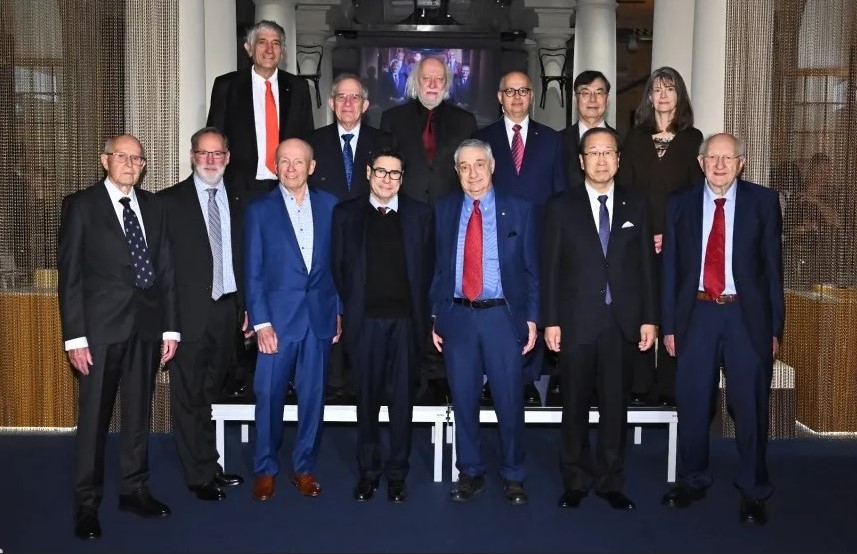
Group photo of the 2025 Nobel Laureates, taken at the opening of Nobel Week in Stockholm
Top row from left: John M. Martinis (Physics), Michel H. Devoret (Physics), László Krasznahorkai (Literature), Omar M. Yaghi (Chemistry), Shimon Sakaguchi (Medicine), Mary E. Brunkow (Medicine)
Bottom row from left: Richard Robson (Chemistry), Fred Ramsdell (Medicine), Peter Howitt (Economics), Philippe Aghion (Economics), Joel Mokyr (Economics), Susumu Kitagawa (Chemistry), John Clarke (Physics)
Photo: Claudio Bresciani / TT News Agency / AFP
During Nobel Week, the official program surrounding the Nobel Prize offers far more than the award ceremony itself. From the rental of formal attire and embassy receptions to museum visits and Nobel Lectures – culminating in the Nobel Prize Award Ceremony on December 10 – a rich sequence of events unfolds, each providing an opportunity to celebrate science and the arts. Alongside exhibitions showcasing the achievements, life’s work, and discoveries of the Nobel laureates, visitors can also learn about the life and legacy of the prize’s founder, Alfred Nobel.
The broader cultural and ceremonial context of the Nobel events is also reflected in the Nobel Museum’s traditions. As previously reported, in December 2023 Katalin Karikó donated her pipette to the Nobel Museum. In doing so, she followed a tradition introduced at the centenary of the Nobel Prize in 2001, when laureates began leaving personal mementos – including signatures on chairs in the museum café – as lasting traces of their presence.

László Krasznahorkai signs the underside of a chair seat at the Nobel Museum.
Photo: Clément Morin, Nobel Prize Outreach
In keeping with the tradition of donating personal objects to the Nobel Museum, László Krasznahorkai donated a netsuke – a Japanese miniature sculpture – depicting an elderly wise man.

László Krasznahorkai donated a netsuke to the Nobel Museum. The Japanese miniature sculpture depicts an elderly wise man.
Photo: Anna Svanberg
On angels, dignity, and rebellion
László Krasznahorkai’s Nobel Lecture opened with Játékok (Games), a piano cycle by the renowned Hungarian composer György Kurtág, composed in the spirit of artistic freedom. After the musical introduction, Krasznahorkai stepped up to the lectern at 5:00 p.m. on November 7, 2025 – less than a month after the Swedish Academy had announced that his literary oeuvre was worthy of the Nobel Prize in Literature.
 Photo: Anna Svanberg
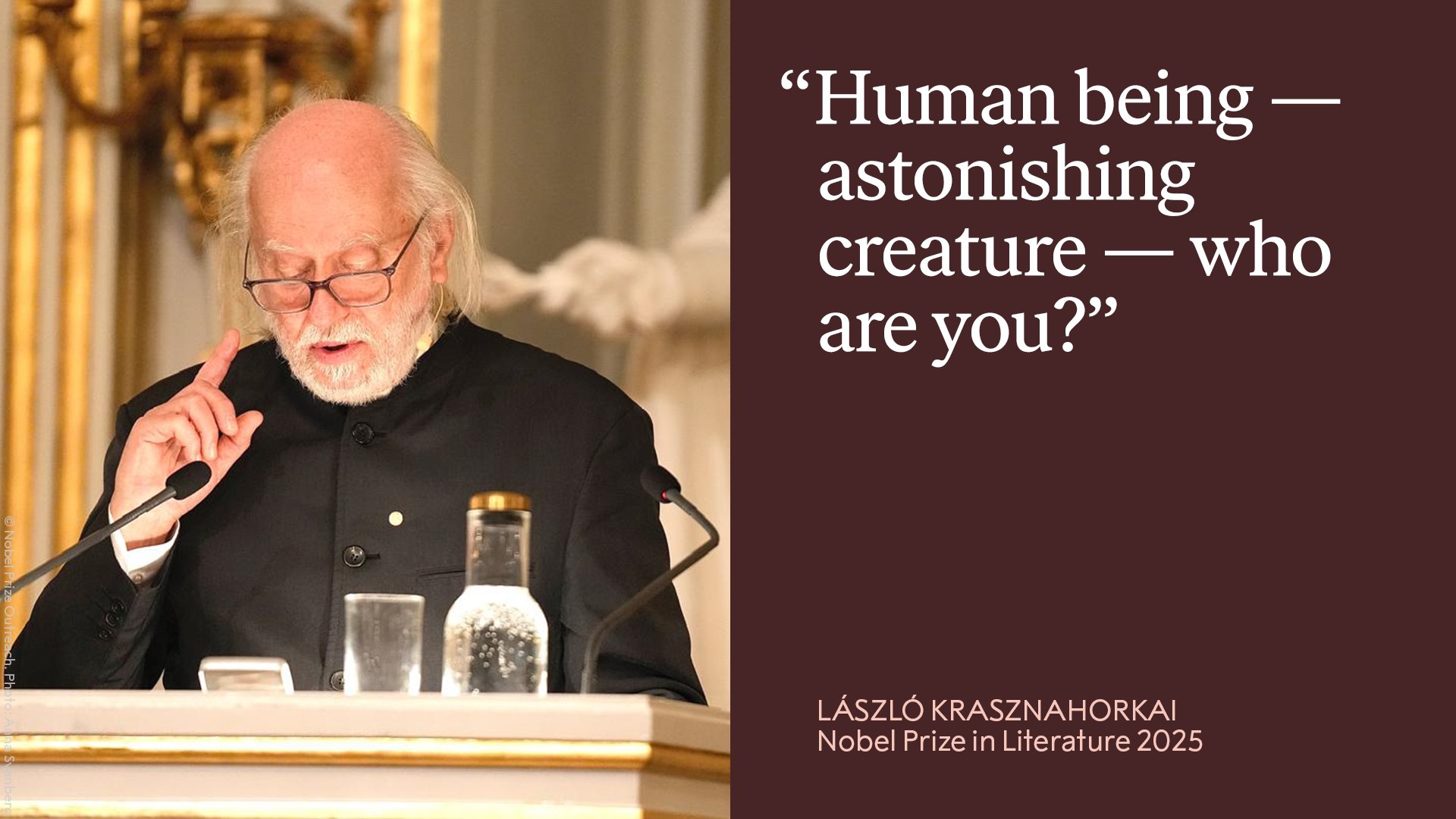
”On receiving the 2025 Nobel Prize in Literature, I originally wished to share my thoughts with you on the subject of hope, but as my stores of hope have definitively come to an end, I will now speak about angels,” László Krasznahorkai began his mandatory Nobel Lecture. Speaking in the Ceremonial Hall of the former Stockholm Stock Exchange building, home to the Swedish Academy, the writer – after reflecting on the angels of our own time – turned to the question of human dignity, asking: “Human being – astonishing creature – who are you?” Reflecting on the irreproducibility of the evolutionary process, he ultimately envisioned not hope, but rebellion.
In an attempt to make certain corrections to his own work Megy a világ (The World Goes On), Krasznahorkai recounted the irreconcilable conflict – the grim contest – between a clochard, an old and ailing vagrant embodying the ‘evil,’ and a police officer representing ‘duty-bound good.’ The example, he suggested, shows that “the Good will never catch flailing Evil, because between Good and Evil there is no hope, none whatsoever.” He went on to recall: “(…) and suddenly, like a flash of lightning, the question flashed through my mind: this clochard and all the other pariahs, when will they finally rebel – and what will this revolt look like. Perhaps it will be bloody, perhaps it will be merciless, perhaps terrible, as when one human being massacres another – then I wave the thought away, because I say that no, the rebellion that I’m thinking of will be different, because that rebellion will be in relation to the whole.”
The full text of the Nobel Lecture is available in English here.
Krasznahorkai concluded his speech by saying: “[…] I feel that I’ve thought about everything, and I have said everything about what I think about rebellion, about human dignity, about the angels, and yes, maybe about everything – even hope.”
As a continuation of the Nobel Lecture, a passage from the novel Seiobo járt odalent (Seiobo There Below) was read aloud:
“(…) A bird fishing in the water: to an indifferent bystander, if he were to notice, perhaps that is all he would see – he would, however, not just have to notice but would have to know in the widening comprehension of the first glance, at least to know and to see just how much this motionless bird, fishing there in between the grassy islets of the shallow water, how much this bird was accursedly superfluous; indeed he would have to be conscious, immediately conscious, of how much this enormous snow-white dignified creature is defenseless – because it was superfluous and defenseless, yes, and as so often, the one satisfactorily accounted for the other, namely, its superfluity made it defenseless and its defenselessness made it superfluous: a defenseless and superfluous sublimity; this, then, is the Ooshirosagi in the shallow waters of the Kamogawa (…)”
The passage was taken from the sixth paragraph of the novel’s opening chapter, titled Kamo Hunter, and its English-language version is recommended reading on the Nobel Prize website. The excerpt was performed in Ottilie Mulzet’s translation by Swedish-American actress Melinda Kinnaman. The reading was followed by a piece by Johann Sebastian Bach, which brought the evening to a close.
Marked by demanding and thought-provoking literary texts, framed by music, and centered on László Krasznahorkai’s Nobel Lecture – with the author also presented with a bouquet of flowers as part of the ceremony – the evening can be revisited at this website. It is also worth noting that, within the framework of the Nobel ceremonies, the organizers regard the Nobel Lecture and the literary and musical program built around it as even more important than the award ceremony itself.
Encounters on the way to the Award Ceremony
A visit to the headquarters of the Nobel Foundation and to the laureates’ room is a key element of the official program for Nobel laureates and an integral part of Nobel Week. During these visits, laureates leaf through a guest book containing entries and signatures left by previous Nobel Prize recipients, reinforcing a sense of continuity and shared tradition.
Beyond these ceremonial moments, Nobel Week also includes a long-standing tradition of outreach. Laureates regularly visit local schools to present their work and engage with younger audiences. As our own experience confirms – and as reflected in the article A Glimpse into Nobel Week, published on the Nobel Prize website in connection with the 2024 programs – laureates often find themselves unexpectedly greeted by enthusiastic crowds of admirers of all ages. These school visits and public encounters are frequently complemented by Nobel-related lectures, during which laureates present their research to students, local audiences, and members of the scientific community.
At the core of Nobel Week’s official events, the Stockholm Concert Hall (Konserthuset) has served as the venue for two of Nobel Week’s central events since 1926: the traditional Nobel Concert on December 8 and the Nobel Prize Award Ceremony on December 10.

Designed by Erik Lindberg, a leading Swedish sculptor at the turn of the twentieth century, the medals awarded for the three science prizes and the Nobel Prize in Literature share a common obverse: a 64-mm-diameter profile portrait of Alfred Nobel. The reverse of the Literature Nobel medal depicts a man listening intently to the song of the Muse as he records her words.
The award ceremony marked the highlight of both Nobel Week in Stockholm and University of Szeged’s Nobel Day on December 10, 2025. In Szeged, participants gathered in the community space of the University’s József Attila Study and Information Center to follow the laudation of László Krasznahorkai and then watch the live broadcast of the Nobel Prize Award Ceremony, which began at 4:00 PM.

In Stockholm, the week culminates in the Nobel Prize Award Ceremony, followed by the traditional banquet. We reported on the 2023 series of events in our in-depth report From the Stockholm Concert Hall to the Golden Hall of City Hall: Katalin Karikó and Her Guests at the Nobel Prize Ceremony, documenting the celebrations attended by Katalin Karikó.
Photo: Szilárd Koszticsák / Hungarian News Agency (MTI)
Traditionally, around 1,300 guests attend the Nobel banquet, where the Nobel Prize laureates are the guests of honor and dine alongside members of the Swedish Royal Family. Each year, the banquet is distinguished by newly designed décor and a specially curated menu created for the occasion.
Following the banquet, the celebrations continue as laureates take to the dance floor or attend an afterparty. In the days that follow, they visit the facilities of the Nobel Foundation, where – after completing the required formalities – they officially receive their Nobel Prize gold medals and replicas, along with their ceremonial diplomas.
Nobel Week in Stockholm concludes with the laureates gathering once more at the Nobel Museum for a closing reception, while those who are able also take part in the Saint Lucia Day Festival of Light on December 13. Once the laureates have departed from Stockholm and Oslo with their medals and commemorative items, the cycle begins anew: the nomination process resumes, and preparations are set in motion for the following year’s Nobel Week.
What to read?

Photo: Nina Subin
László Krasznahorkai received the 2025 Nobel Prize in Literature “for his compelling and visionary oeuvre that, in the midst of apocalyptic terror, reaffirms the power of art.” Yet for readers newly drawn to his work, the question naturally arises: Where should one begin when entering Krasznahorkai’s distinctive literary world?
Since the announcement of the Nobel Prize, interest in Krasznahorkai’s works has surged at the University of Szeged’s library. “The Hungarian-language editions of László Krasznahorkai’s books have been in constant demand,” said Erika Csengődi, Deputy Director General of the SZTE Klebelsberg Library and Archives. “At present, all lendable copies are on loan and waiting lists have formed for several titles.” She added that alongside the Hungarian editions, the University’s collection also includes foreign-language versions, making a number of Krasznahorkai’s works available in English, German, French, Estonian, Serbian, Spanish, and Slovak – although these editions are borrowed less frequently than the Hungarian-language volumes.
László Krasznahorkai, who will turn 72 on January 5, 2026, stands among the most significant contemporary writers, with a life’s work now recognized by the Nobel Prize in Literature. This recognition crowns decades of sustained literary effort and artistic commitment.
A glimpse into Krasznahorkai’s distinctive prose was offered during a 120-minute reading marathon held as part of University of Szeged’s Nobel Day program. In a flash mob-style event, university students and faculty members – joined by staff of the University’s Directorate for International Affairs and Public Relations and the SZTE Klebelsberg Library and Archives – read aloud excerpts from his works, bringing to life texts shaped by a highly original, almost musical rhythm.
With regard to László Krasznahorkai’s oeuvre, there is also a special three-person conversation that offers a wealth of intriguing insights – into the announcement itself, the pronunciation of Krasznahorkai’s surname (no small challenge for Swedish speakers), and the circumstances surrounding the selection of the Nobel Prize in Literature laureate. The discussion features two members of the Swedish Academy, Ellen Mattson and Steve Sem-Sandberg, who respond to questions posed by Carin Klaesson of the Nobel Prize Museum.
“It’s all about quality. Literary quality, of course. The winner needs to be someone who writes excellent literature, someone who you feel when you read that there’s some kind of a power, a development that lasts through books, all of their books,” said Ellen Mattson, novelist and member of the Nobel Committee of the Swedish Academy, in response to the question about the criteria guiding the selection of Nobel laureates. She added that “It takes a lot of work and dedication to be a really, really good writer.”
“You discover new things in the text when you reread it. That is a fundamental quality of a good writer. A text must be worthy of rereading,” said Ellen Mattson in reference to László Krasznahorkai’s literary art. She added that the work which particularly captivated her was Az ellenállás melankóliája (The Melancholy of Resistance).
According to Steve Sem-Sandberg, the atmosphere of Satantango is overwhelming. “The description of everyday things creates tension and foreshadows the drama,” he observed. “It is at once familiar and alien – that is what creates the distinctive atmosphere of Krasznahorkai’s world,” he added.
The intriguing one-hour public roundtable discussion was recorded on October 9, 2025, in the ceremonial hall of the Börshuset on Stortorget in Stockholm’s Old Town and was later screened for audiences attending the University of Szeged’s Nobel Day on December 10, 2025. Extending this focus on dialogue and active engagement, participants of SZTE’s Nobel Day were also invited to take part in a 12+10-question quiz exploring László Krasznahorkai’s work and the Nobel Prize.
Beyond these on-site programs, Krasznahorkai’s work is also accessible in digital form. Since 2004, he has been a member of the Digital Literary Academy, and several of his writings are available online through this platform.
The Baron’s Homecoming
One of the more personal highlights of SZTE-related Nobel events in 2025 was László Krasznahorkai’s presentation of a signed copy of his novel Báró Wenckheim hazatér (Baron Wenckheim’s Homecoming) to Katalin Karikó. As we have previously reported, in addition to this book – described as a vast, almost monumental synthesis of the author’s career to date, his intellectual vision, and his oeuvre – Professor Karikó also received two further volumes written by her former fellow student as a friendly gift on her most recent visit to Szeged: the short story collection Kegyelmi viszonyok (Relations of Grace), offering insight into Krasznahorkai’s literary world, and his most recent novel, A magyar nemzet biztonsága (The Security of the Hungarian Nation).
Beyond these personal gestures, in Szeged, the Nobel Prize also prompted collective expressions of recognition for the author himself. During University of Szeged’s Nobel Day program on December 10, 2025, well-wishers were invited to leave personal messages for László Krasznahorkai in a commemorative album prepared in his honor in the university city.
At the same time, a similar commemorative album was compiled in the writer’s hometown of Gyula, during Gyula’s Nobel Week, held between December 6 and 12, 2025, reflecting the nationwide resonance of Krasznahorkai’s Nobel recognition.

Citizens of Gyula extend their congratulations to the city’s renowned native son, László Krasznahorkai, recipient of the 2025 Nobel Prize in Literature.
“Together with Mayor Ernő Görgényi, we organized Gyula’s Nobel Week in honor of László Krasznahorkai, his Nobel Prize, and the legacy that Alfred Nobel placed in the service of science and culture,” said Adrienn Müller, a lawyer and Hungary’s former ambassador to Stockholm.
Hungary’s former ambassador to Stockholm is herself a native of Gyula and an alumna of the University in Szeged. She shares this background with Katalin Karikó, the first Hungarian woman to receive a Nobel Prize, as well as with László Krasznahorkai, who began his higher education studies in 1973 as a law student at József Attila University. The university in Szeged also counts Gyula’s current mayor among its alumni.
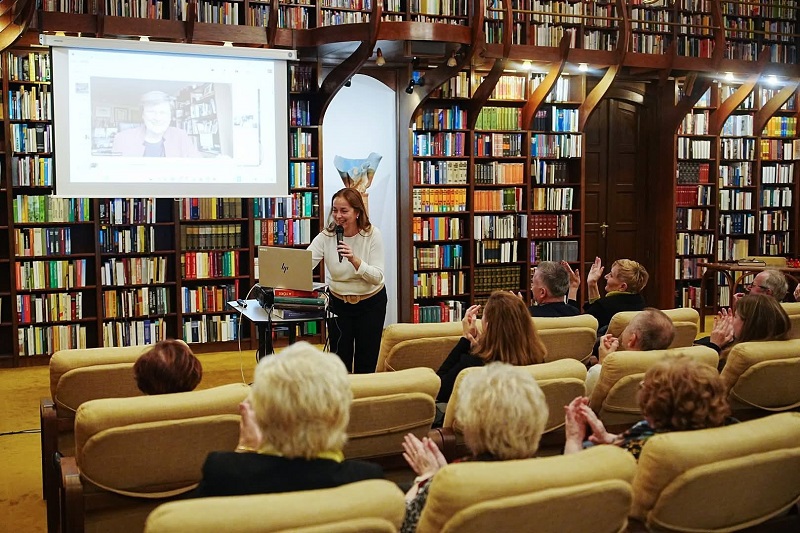
During her diplomatic service, Adrienn Müller attended the Nobel Prize Award Ceremony on eight occasions. One particularly memorable moment for her was welcoming two Hungarian laureates – Katalin Karikó and Ferenc Krausz – at the formal dinner hosted by the Hungarian Embassy in Sweden during Nobel Week in Stockholm in 2023. Two years later, her presentation during Gyula’s Nobel Week was followed online by Katalin Karikó, professor at the University of Szeged.
Photo: Adrienn Müller
It is a long-standing tradition for Sveriges Television (SVT) to produce portrait documentaries on each year’s Nobel laureates. In keeping with this practice, Swedish film crews visited several locations in Hungary while documenting the lives of Katalin Karikó and László Krasznahorkai – filming in Kisújszállás and Szeged, and in Gyula and Szentendre, respectively.
The Krasznahorkai documentary – tracing key moments of the writer’s life through historical context and archival footage – was screened both for participants of the University of Szeged’s Nobel Day program and for audiences in Gyula.

In her presentation, Adrienn Müller – a native of Gyula and a former JATE student who later served as Hungary’s ambassador to Sweden – presented an overview of Hungary’s Nobel Prize laureates.
Photo: Adrienn Müller
On November 6, 2025, Adrienn Müller, Hungary’s former ambassador to Sweden, delivered a public presentation at the Mogyoróssy János City Library in Gyula, offering insight into the Nobel Prize and the traditions and institutional processes behind it.

Invited to the library event opening Gyula’s Nobel Week, Katalin Karikó joined the program online and showed her Nobel medal to the audience. The reverse side of the medal depicts two female figures: the genius of healing, with a book resting on her knee, supports a suffering woman while gathering water from a spring in a bowl to offer her relief.
Photo: Adrienn Müller
Speaking to audiences in Gyula about her personal experiences surrounding the Nobel Prize, Katalin Karikó recalled that, because she received the award jointly with Drew Weissman, tradition required her – as the female member of the research duo – to deliver the address at the banquet following the award ceremony on December 10, 2023. She noted that the speech had to be condensed to just two minutes and admitted, as reported by the local newspaper Gyulai Hírlap, that the occasion made her extremely nervous: having left her own reading glasses behind, she was forced to rely on her husband’s to read the text. She also added that the strict protocol governing both the award ceremony and the dinner that followed demanded such sustained concentration that it became difficult for her to fully enjoy either moment.
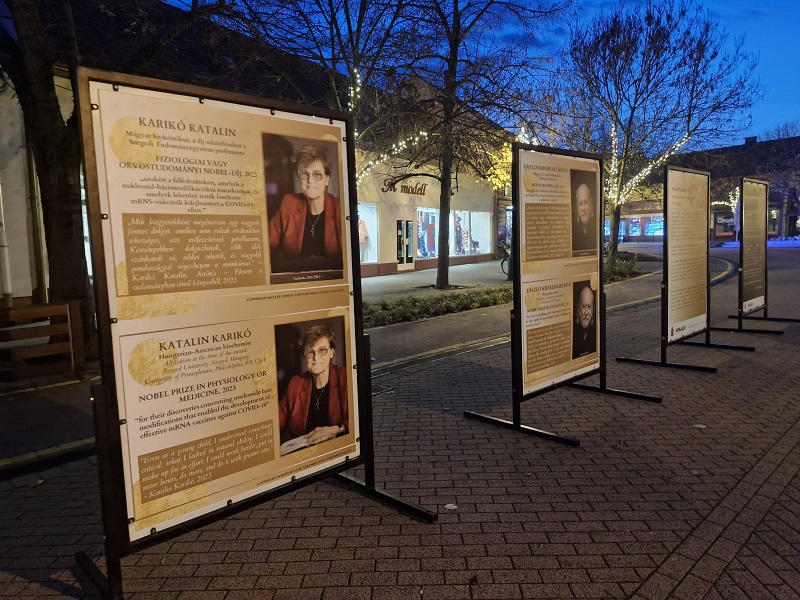
An open-air exhibition titled Hungarian-Born or Hungarian-Connected Nobel Laureates was presented to the public as part of Gyula’s Nobel Week.
Photo: Adrienn Müller
In the days surrounding the Nobel Prize Award Ceremony, Gyula honored László Krasznahorkai with a rich and varied program of events. An online quiz titled In the Footsteps of Hungarian Geniuses added an interactive element to the city’s celebrations, while a workshop led by writer László Kiss focused on the question How Should We Read Krasznahorkai? The program was further complemented by public readings from the author’s latest novel, A magyar nemzet biztonsága (The Security of the Hungarian Nation).

Audiences in both Gyula and Stockholm were able to watch the 2018 poetic documentary about László Krasznahorkai, titled A báró hazatér (The Baron’s Homecoming), on the same day.
Photo: Nina Subin
Original Hungarian article: SZTEinfo – Ilona Újszászi