Through storytelling sessions, live readings, a documentary, a Nobel lecture, and a playful double quiz, participants at SZTE’s Nobel Day were immersed in the spirit of Stockholm’s Nobel Week, culminating in the screening of the Award Ceremony held on December 10, 2025. Gathering in the CommuniTIK community space at the University of Szeged’s József Attila Study and Information Center, attendees followed the live feed from Stockholm Concert Hall, experiencing the ceremony not as distant spectators but as part of a shared, collective moment. Among the many highlights of the day, the intellectual and emotional high point came with Nobel laureate writer László Krasznahorkai’s banquet speech, marking the close of the official Nobel program.
By early afternoon on December 10, 2025, one Nobel Prize – that of Katalin Karikó – had already found its audience at the University of Szeged, on display in the University’s permanent exhibition dedicated to its Nobel laureate professor. Meanwhile, half a continent away, László Krasznahorkai was likely preparing for the 4 p.m. ceremony in Stockholm, where he would receive the Nobel Prize in Literature.
A spirit of rebellion
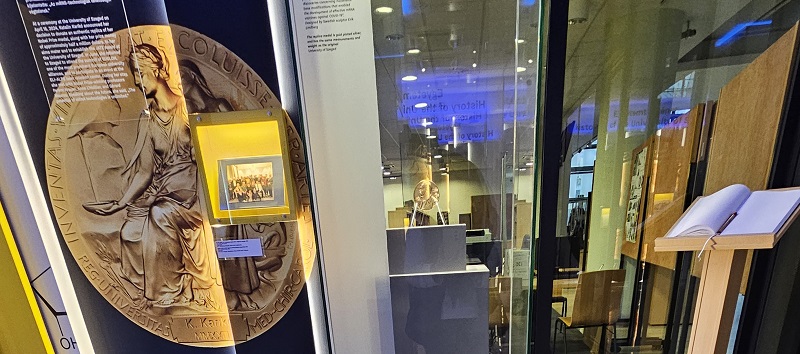
A carefully arranged display of gleaming, awe-inspiring honors guides visitors to Katalin Karikó’s Nobel Prize medal at the University of Szeged’s permanent Karikó exhibition.
Photo: Ilona Újszászi
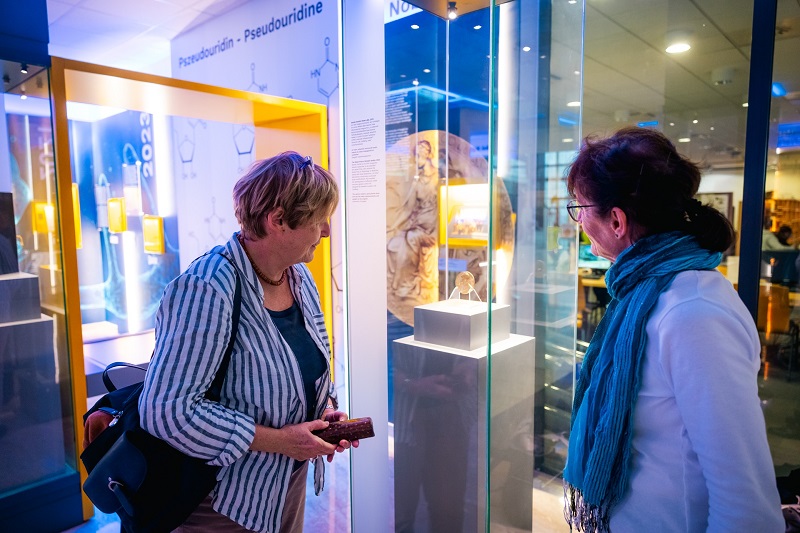
At the exhibition Katalin Karikó’s Journey to the Nobel Prize and Beyond, a concise, easy-to-read overview introduces visitors to the history of the University of Szeged while highlighting the achievements of its two Nobel laureate professors: Albert Szent-Györgyi’s groundbreaking work during his years in Szeged and the life’s work of Katalin Karikó. “This is a well-curated exhibition,” visitor Lívia Somogyi remarked, reflecting on what had most captured her attention as she walked through the ground-floor exhibition space of the University of Szeged’s József Attila Study and Information Center.
Across the display cases, visitors are presented with a paired view of items such as Albert Szent-Györgyi’s academic gown and glass laboratory flasks, alongside Katalin Karikó’s elementary school photographs, university relics, ornate diplomas, and distinguished honors.
“We found ourselves laughing as we lingered by the display cases featuring Katalin Karikó’s personal belongings, peering into the open drawers. We stayed there for quite a while because the objects and documents on display brought back fond memories of experiences from our own university years,” reflected another exhibition visitor, Ildikó Halminé Szénássy.
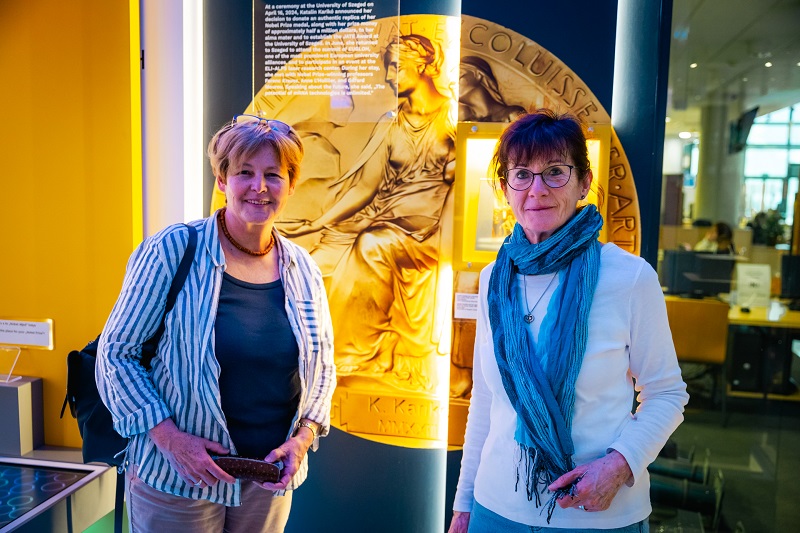
Viewing the Karikó exhibition: Two former Hungarian–German majors at JATE (SZTE’s predecessor), Ildikó Halminé Szénássy and Lívia Somogyi, whose friendship – formed at the University in Szeged – has endured through their careers as secondary-school teachers and into retirement.
Photo: István Sahin-Tóth
Unaware of SZTE’s Nobel Day program, Lívia Somogyi and Ildikó Halminé Szénássy were just strolling along Ady Square when a banner advertising the University’s permanent exhibition caught their attention. Ildikó had travelled to Szeged from Budapest to visit Lívia, as she does once or twice a year – a routine rooted in a long-standing bond. Their friendship dates back to their formative years between 1979 and 1984, when they were both Hungarian–German majors at JATE – József Attila University, a legal predecessor of the University of Szeged.
“I only just learned that Katalin Karikó and László Krasznahorkai both began their university studies as first-year students at JATE in the same academic year,” Lívia Somogyi remarked. “What, if any, is the message of such a coincidence? I do tend to believe coincidences actually point to something more,” she added.
“There’s a measure of pride in me, and a measure of regret as well – pride when I think of JATE, and regret because I never had the chance to meet those two former students, now both Nobel laureates, during my years in Szeged,” said Ildikó Halminé Szénássy. She went on to recall that at the Móra Student Residence Hall, their mentor, Ágnes Erdélyi, an avid organizer of cultural programs, regularly invited prominent figures. “I remember visits by writer Péter Esterházy and songwriter-performer János Bródy, as well as attending an evening with Tamás Cseh at the JATE Club. It was also widely known that in certain apartments in Szeged, members of opposition circles often gathered – places where writers such as György Konrád and István Eörsi would appear. In the years leading up to Hungary’s political transition, being able to experience that spirit of rebellion at JATE meant a great deal to us.”
Nobel stories
Katalin Karikó began her studies in biology at JATE in 1973. Half a century later, in 2023, she arrived in Stockholm as a distinguished guest of Nobel Week, welcomed with a suite at the Grand Hôtel, where she hosted a reception for family members, friends, and colleagues. Near the windows overlooking the Swedish Royal Palace, a group photograph was taken – an image that now accompanies the most valuable exhibit in SZTE’s permanent Karikó Collection: the Nobel Prize itself.
The photograph conveys a simple yet powerful message: although Katalin Karikó has received more than a hundred honors, she experiences each award ceremony as a shared moment. She accepts distinctions on behalf of the broader research community and, even as a Nobel laureate, continues to lecture and appear at public events, championing science and the promise of discovery.
During Nobel Week in Stockholm in 2023, two correspondents represented SZTE’s press team: István Sahin-Tóth captured the events in photographs, while journalist Ilona Újszászi documented the days through vivid on-the-spot reporting. Drawing on these experiences, on December 15, 2025, the two colleagues from SZTE’s Directorate for International Affairs and Public Relations set out to recreate the atmosphere surrounding the Nobel Prize ceremony, bringing the humorous and uplifting moments of the Stockholm days to life for their audience and offering a glimpse into the experiences of Hungary’s Nobel laureates.
“Is the JATE Award really connected to Katalin Karikó’s Nobel Prize? I hadn’t even heard of this distinction,” Ildikó Halminé Szénássy admitted. She was delighted to learn that Katalin Karikó, now a professor at the University of Szeged, established the award using the prize money accompanying her Nobel Prize, naming it the JATE Award to highlight the academic excellence of the university in Szeged as she had known it. She was equally pleased to hear that one of the first three recipients of the JATE Award was Professor Mihály Ilia. “As a teacher of contemporary Hungarian literature and as the opposition-minded editor-in-chief of the literary journal Tiszatáj, he commanded great respect among young faculty members and university students alike,” recalled the former Hungarian–German major, speaking as a JATE alumna.
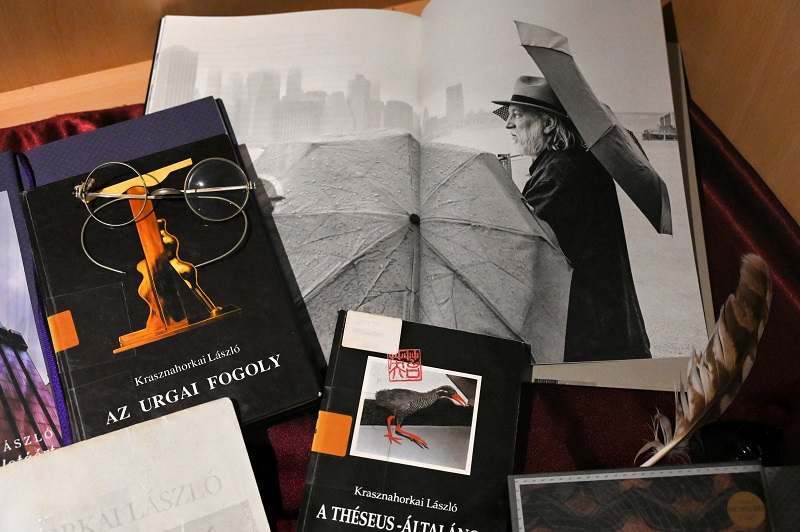
In the 1970s and 1980s, JATE served as a genuine cradle for writers. Today, at the University Library, amid the everyday bustle of the University of Szeged, the Alumni #Bookshelf installation – unveiled on November 14, 2025, ahead of the first JATE Award ceremony – features shelves lined with poetry collections and novels by former students of Professor Mihály Ilia, alongside works by László Krasznahorkai, among others. As the originator of the special book collection, Györgyi Gerháth, representing SZTE’s Directorate for International Affairs and Public Relations and the University’s Alma Mater Office, outlined the collection’s origins and purpose to participants in SZTE’s Nobel Day event.

“Whether you’re hearing and seeing László Krasznahorkai’s Nobel Lecture for the first time or watching it again – this time during SZTE’s Nobel Day event – it’s a powerful experience,” one of the program organizers remarked to another.
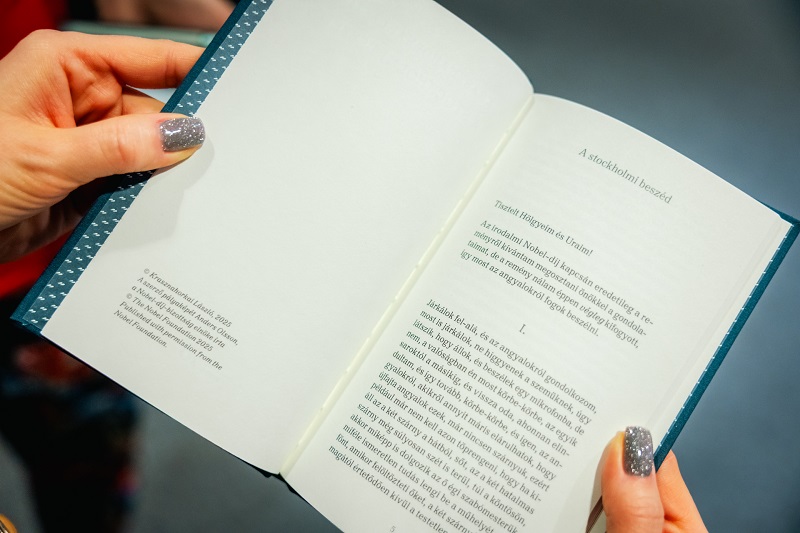
“It is just as rewarding to read those rolling, flowing sentences about angels, both past and present,” she said, holding up A stockholmi beszéd (The Stockholm Speech), Krasznahorkai’s latest book, which she had just purchased at the bookshop.
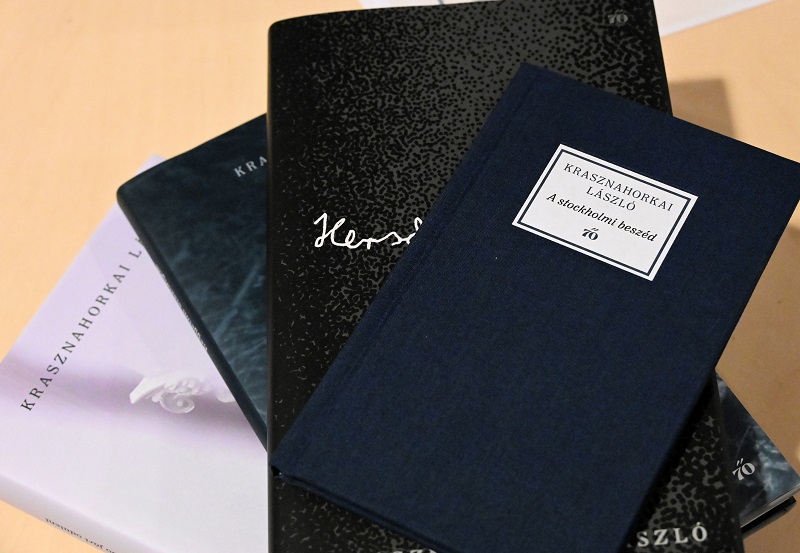
Krasznahorkai’s works read aloud
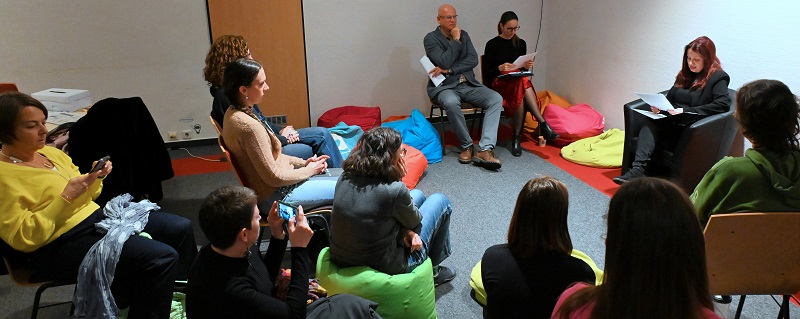
Without IMPULZUS – the student magazine founded in 1973 by law students in Szeged – there would have been neither a forum nor an opportunity for publication. Some of László Krasznahorkai’s earliest writings, produced while he was still a first-year student at the University in Szeged, resurfaced during SZTE’s Nobel Day as spoken texts. These readings set the tone for the event’s literary marathon: twelve consecutive ten-minute sessions, amounting to a total of 120 minutes.
“The short story Tebenned hittem (I Believed in You) shook me to the core. Thank you for the tears,” wrote Anita Beslin, a radio reporter and editor, known for her distinctive speaking voice. She had read aloud Krasznahorkai’s first short story, originally published in the journal Mozgó Világ in 1977, and penned these words on the opening page of the commemorative album being prepared as a gift for the Nobel Prize-winning author.
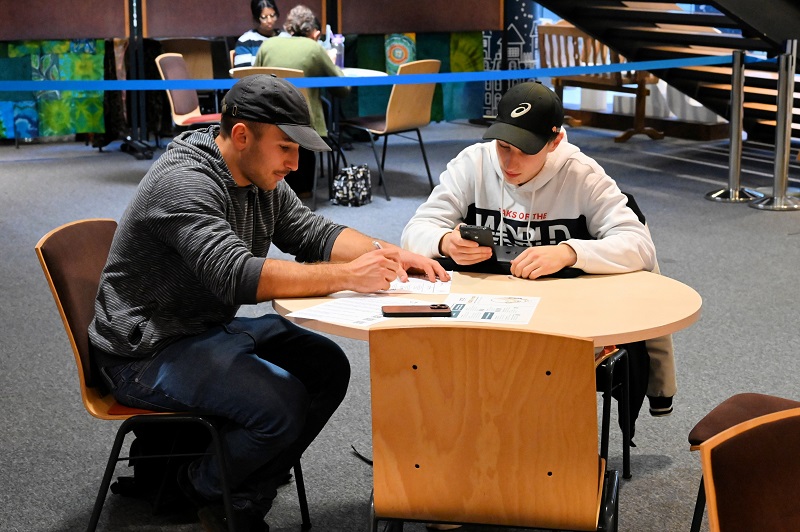
Students gathered around the tables of SZTE TIK’s community space as they tackled the questions in SZTE’s Nobel Day 12+10 quiz.
”I’d already had the chance to read and analyze the short story Herman, a vadőr (Herman, the Gamekeeper) as a Hungarian literature major in Professor Gábor Szabó’s literary history seminar. It was an extraordinary experience, which is why I was delighted to read from it today,” said journalist Helga Balog, speaking from the cozy reading nook set up in one corner of SZTE’s CommuniTIK community space.
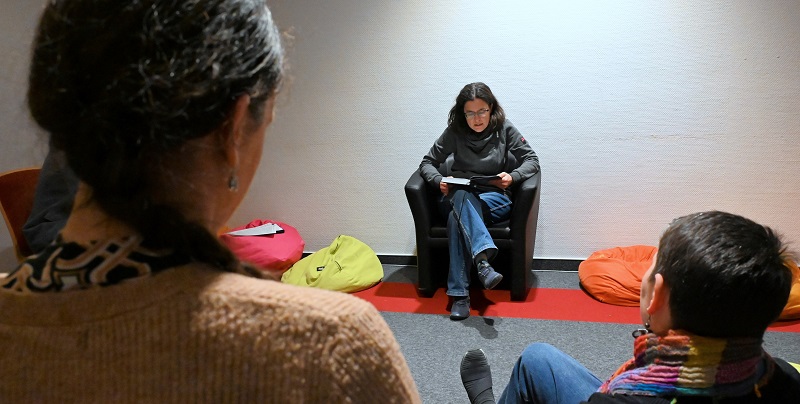
A short story from the volume Kegyelmi viszonyok (Relations of Grace) was read aloud by journalist Sándor Panek (SZTE’s Directorate for International Affairs and Public Relations) and psychology major Dávid Janzsó. By selecting a ‘close-to-nature’ text from the same collection, Pál Diószegi Szabó of the Szeged Writers’ Society wished to express his personal connection to SZTE’s Faculty of Agriculture.
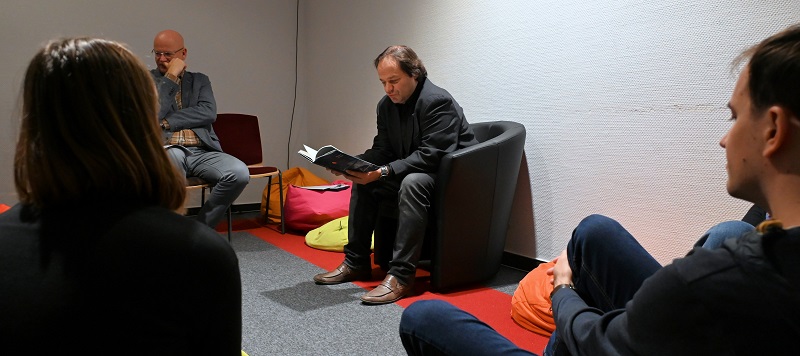
“László Krasznahorkai is one of Hungary’s most beautifully expressive writers. His style is utterly compelling and unmistakably unique,” librarian Daniella Harkai told a reporter from Szeged City Television. A staff member of the SZTE Klebelsberg Library and Archives, she first encountered Krasznahorkai’s texts while she was a college student. “He describes the decaying world he portrays in such a way that beauty can still be found within it,” she said, adding that she also appreciates the humor of the author often described as ‘apocalyptic.’
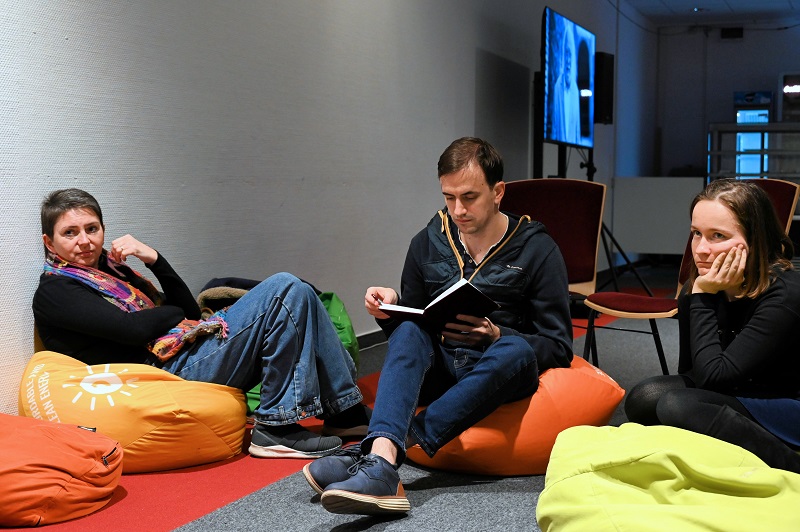
Representing the SZTE Klebelsberg Library and Archives, Juli Babos and Daniella Harkai selected and read excerpts from Herscht 07769. Florian Herscht Bach-regénye (Herscht 07769 – Florian Herscht’s Bach Novel). Given the length of the text, librarian Krisztina Márki also joined the reading session.
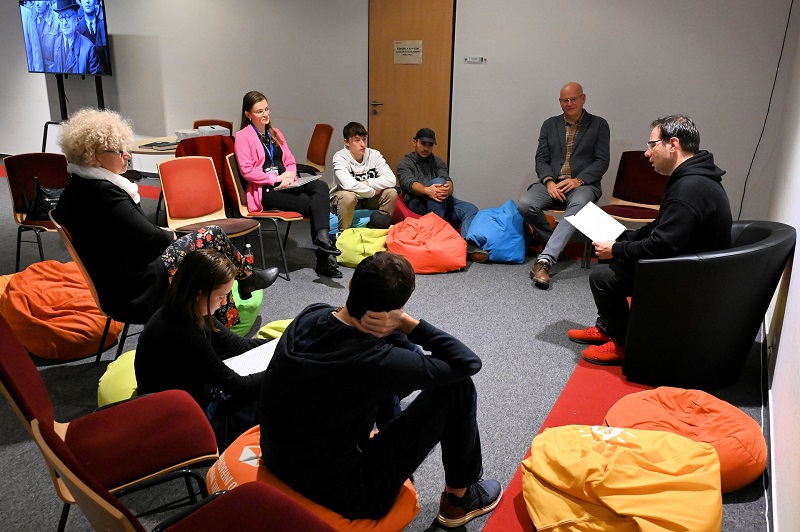
Theater historian and university instructor Tamás Jászay read a striking excerpt from László Krasznahorkai’s short-story collection Seiobo járt odalent (Seiobo There Below).
“I asked for – and was given – the opening pages of Seiobo There Below, the ones with that heron standing in the middle of the river, and within minutes the magic happened: I was back in Kyoto, on the banks of the Kamo, where I had stood every morning a year earlier, and once again I could see the heron clearly,” Tamás Jászay recalled in a social media post, reflecting on his experiences during a scholarship period in Japan. In his academic capacity, Jászay is an assistant professor at the Department of Comparative Literature at SZTE’s Faculty of Humanities and Social Sciences.
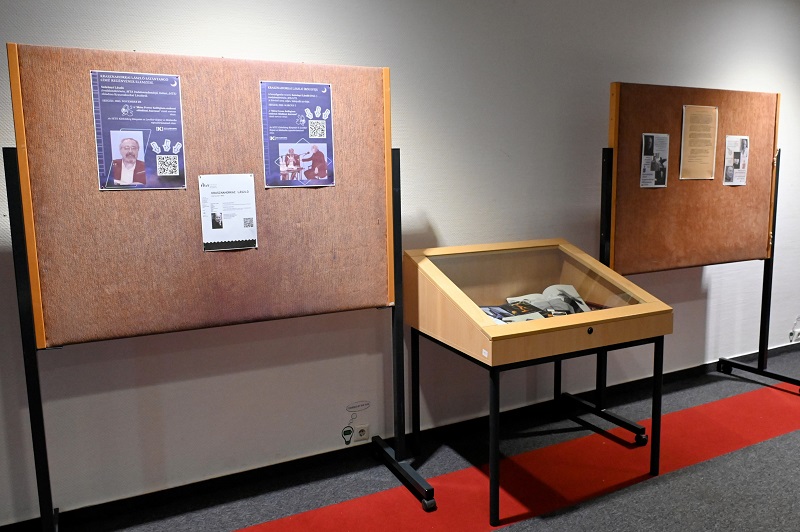
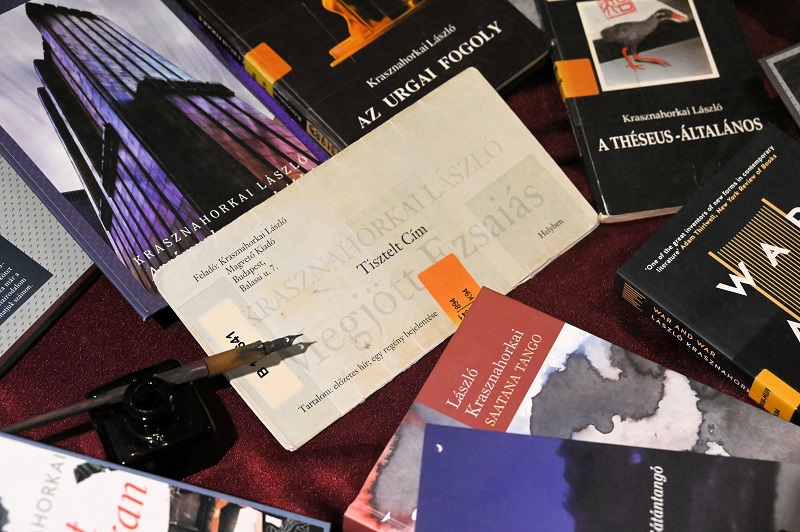
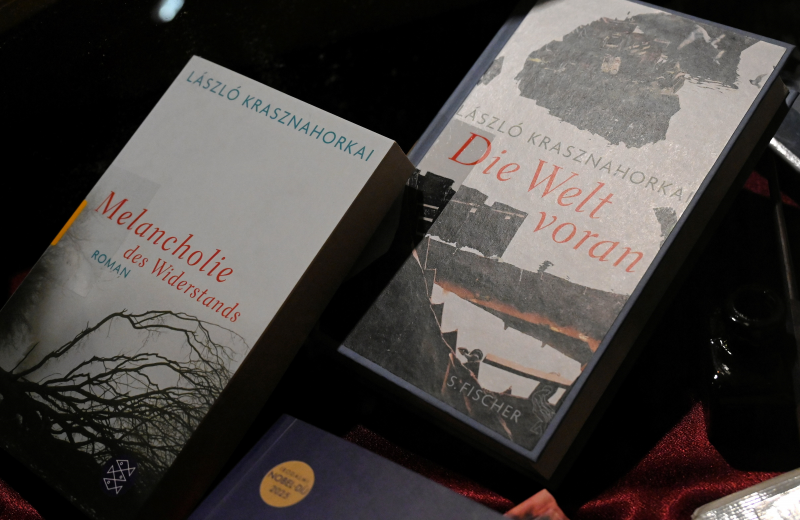
At a mini-exhibition during SZTE’s Nobel Day, the university library presented the spoken and written – printed – treasures that together now form SZTE’s ‘Krasznahorkai Collection’.
The award ceremony
”Krasznahorkai’s signature as a writer is a flowing syntax that encompasses both weightiness and lightness, melancholy and elation, tall tales and poetic intensity,” said Professor Anders Olsson, Chair of the Swedish Academy’s Nobel Committee for Literature, in his laudation of László Krasznahorkai, delivered on the stage of Stockholm Concert Hall at 4 p.m. on December 10, 2025. In his address, the member of the Swedish Academy and chair of the Nobel Committee for Literature introduced the audience gathered in the Concert Hall to several key works by the Hungarian writer, ranging from Satantango and Az ellenállás melankóliája (The Melancholy of Resistance) to the collection A világ folyik (The World Goes On).
Back in Szeged, participants in SZTE’s Nobel Day event followed the live broadcast of the Nobel Prize Award Ceremony from the CommuniTIK community space.
“It is a tremendous source of pride for me to have attended eight Nobel Prize Award Ceremonies. Last year, for example, I was seated next to this year’s laureate presenter, Professor Anders Olsson, at the Nobel banquet, where we spoke at length about the exceptional achievements of writers László Krasznahorkai and Péter Nádas. I am delighted that it was he who delivered Krasznahorkai’s laudation today,” said Adrienn Müller, Hungary’s former ambassador to Stockholm and a former law student at JATE. Interestingly, like the 2025 Nobel laureate in literature, she hails from the town of Gyula.
“It is László Krasznahorkai’s greatness as a writer to have succeeded in combining an artistic gaze, entirely free of illusion, that sees through the fragility of the orders established by man, with an unwavering faith in the power of literature,” observed Professor Olsson, Chairman of the Swedish Academy's Nobel Committee for Literature.
“In 2023, the two Hungarian Nobel laureates – Katalin Karikó and Ferenc Krausz – were invited to every official event in Stockholm, from the Nobel Lectures and the Nobel Concert to various receptions and meetings, including the dinner at the Royal Palace, the Nobel Prize Award Ceremony, and the banquet,” Adrienn Müller recounted in a phone interview. As Hungary’s former ambassador to Sweden, she played a key role in ensuring that the celebratory event in Gyula honoring the newest laureate, László Krasznahorkai, presented both the distinction itself and Hungary’s Nobel recipients to date in a nuanced and well-contextualized manner.
Through a carefully choreographed Nobel ‘cavalcade’ and a range of savvy communication strategies, the Swedes have turned the Nobel Prize into the world’s most recognizable award – despite the fact that it is neither the oldest nor the most lucrative in terms of prize money. One enduring detail, however, has remained unchanged: the floral arrangements always come from San Remo, Italy, where Alfred Nobel died on December 10, 1896.
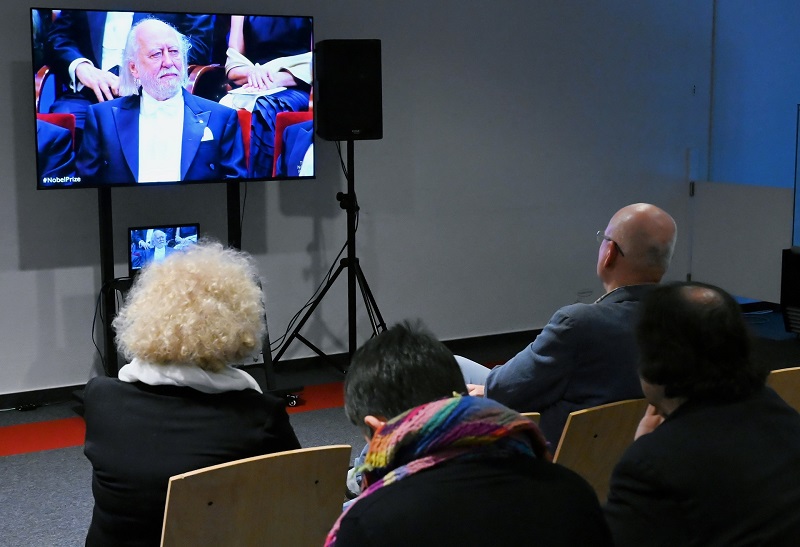
The Nobel Prize Award Ceremony held in Stockholm on December 10, 2025, can be viewed here.
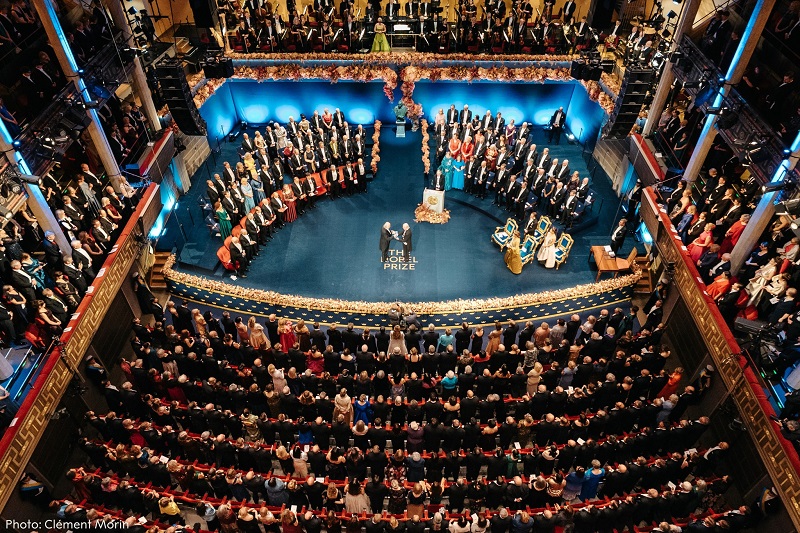
At 4 p.m. on December 10, 2025, twelve men dressed in white tie and one woman in a full-length evening gown took the stage of the Grand Hall of the Stockholm Concert Hall as the newly announced Nobel laureates. In the scientific categories – Physics, Chemistry, Physiology or Medicine – as well as in Economics, each prize was jointly awarded to three recipients.
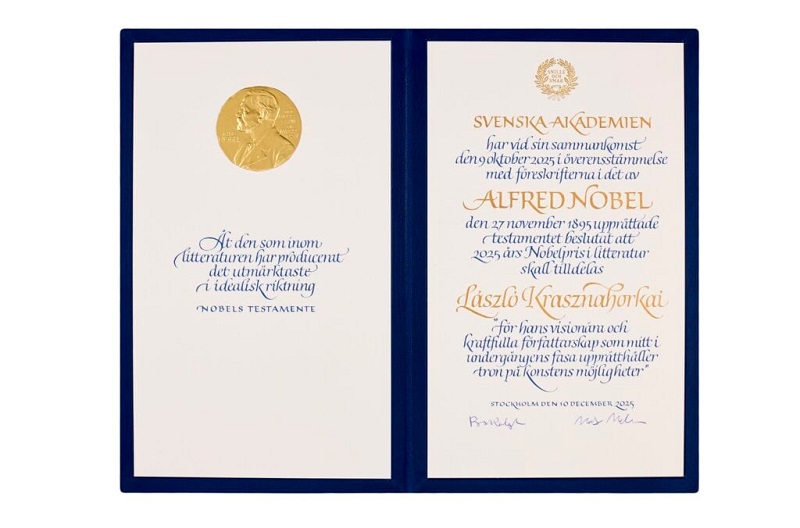
The Nobel diploma of Literature laureate László Krasznahorkai
All three scientific Nobel Prizes, as well as the Nobel Prize in Economics, were each jointly awarded to three recipients.
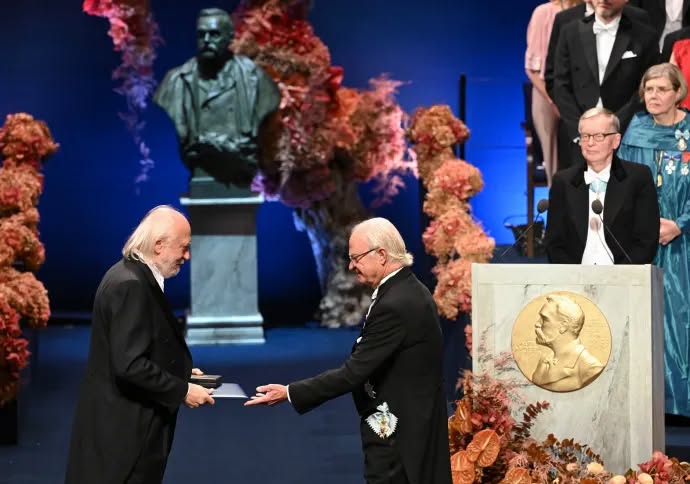
At the 2025 ceremony at the Stockholm Concert Hall, Literature laureate László Krasznahorkai was the only honoree to receive the full monetary award on his own: in addition to the Nobel medal and diploma, he was presented with the entire prize sum of 11 million Swedish kronor.
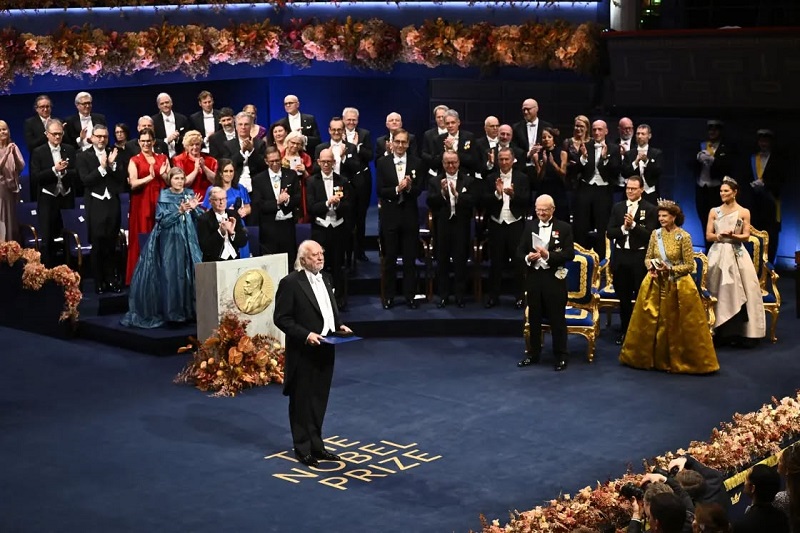
The leadership and entire community of the University of Szeged, together with all participants in SZTE’s Nobel Day, hereby extend their heartfelt congratulations to László Krasznahorkai on the occasion of the ceremony honoring his Nobel Prize in Literature. The SZTE community takes particular pride in the fact that one of Krasznahorkai’s alma maters is JATE, the József Attila University of Szeged, a predecessor institution of SZTE.
Seven sentences
László Krasznahorkai gave no interviews during Nobel Week in Stockholm, allowing his texts to speak in his place. On the evening of December 10, 2025, his voice was nevertheless heard loud and clear at the gala banquet following the Nobel Prize Award Ceremony, held in the Golden Hall of Stockholm City Hall and transformed by a striking light installation.
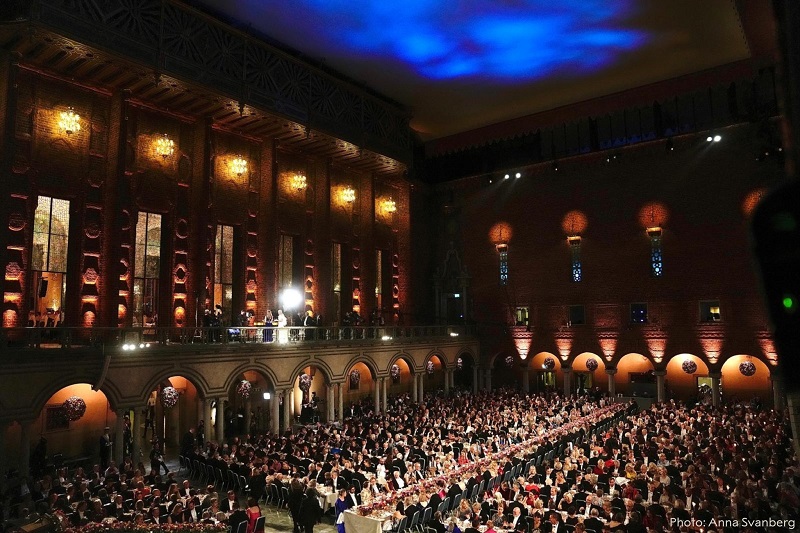
At the banquet honoring the laureates, the Nobel Prize-winning author expressed his gratitude in unmistakably ‘Krasznahorkai-esque’ fashion. The following morning, his speech of thanks could first be seen, heard, and read on the social media page of former Stockholm diplomat Adrienn Müller – later appearing on the Nobel Prize’s official website, too.
In what might be called László Krasznahorkai’s ‘second Stockholm speech,’ the banquet speech, his initial words duly followed the rules of protocol. Yet what came next was anything but conventional, as he distilled the story of his life into seven sentences, paying tribute to the figures who had shaped and influenced him.
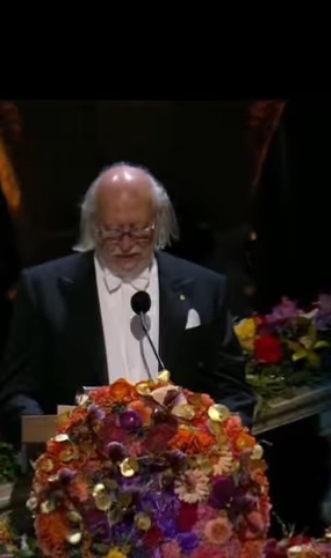
“Your Majesties, Your Royal Highnesses, Excellences, Dear Laureates, Ladies and
Gentlemen, I wish to thank the Swedish Academy, and the Nobel Foundation!
Thank you!
I thank all of my publishers and translators, I thank the building of the Swedish Academy and the dear light falling into that room as the final decision was being made in the awarding of this year’s Nobel Prize in Literature,
And I give my thanks to Uncle Kerekes, sexton of the Gyula Romanian Orthodox church and cobbler, who is no longer among the ranks of the living, as the precise time of his death had come,
I give my thanks to my friend Jóska Pálnik, who told me, on the second stair of the Water Slide Pool in 1960, how babies are made, and under the grievous weight of this revelation I wanted to die,
I give my thanks to Franz Kafka, whose novel Das Schloss I read when I was twelve years old so that I would be accepted in the circle of my brother, six years older than me; and so my fate was sealed,
I give my thanks to the first thirty-one girls with whom I fell fatally in love, but especially to Márti Klinkovics,
To Ernő Szabó and Imre Simonyi, unknown poets of Gyula, whom I have always admired, and who bore my admiration in a manner worthy of a man,
To Péter Hajnóczy, the most staggering among Hungarian short story writers, who succumbed in his struggle with his phantasms, and thus is no longer among the ranks of the living,
I give my thanks to the artists of Classical Greece,
To the Italian Renaissance,
To Attila József, the Hungarian poet who showed the magical power of words,
To Fyodor Mihailovitch Dostoyevskij,
To my older brother, who often carried me home from kindergarten, because of which I became infinitely grateful to him, as he showed me that there could be another way of looking at the world, not just that which is given,
To William Faulkner,
To the city of Kyoto,
To Thomas Pynchon, beloved friend, to whom I owe deep gratitude,
To Johann Sebastian Bach, for the Divine,
To Patti Smith, for she is the eternal warning: never submit to anyone,
To the voices of Agnes Baltsa, Natalie Dessay, Jennifer Larmore, Monserrat Caballe, Teresa Berganza and Emma Kirkby,
To Béla Tarr, who created colours by making them disappear, because in his great films he tried to speak as the sinner who nevertheless, with all his sins, must still be loved,
To Allen Ginsberg, the friend who is no longer among the ranks of the living, because the time of his death had come,
To the literati of Imperial China,
To Max Seebald, the marvellous writer and friend who is no longer among the ranks of the living, as he gazed for too long at one single blade of grass in the meadow,
To the last wolf in Extremadura,
To nature, that was created,
To Prince Siddhartha,
To the Hungarian language,
To God.”
Translated by Ottilie Mulzet
As a closing note to SZTE’s Nobel Day program, three dates stand out in the context of this stream of sentences: László Krasznahorkai – who began his studies as a first-year law student at József Attila University in 1973 – addressed the audience on the evening of December 10, 2025, as a Nobel Prize-winning author, in his ‘second Stockholm speech,’ expressing his gratitude. Among those he thanked was Attila József, the Hungarian poet who enrolled at the University in Szeged in 1924 as a student of Hungarian, French, and philosophy and who showed him “the magical power of words.”
Original Hungarian article by SZTEinfo – Ilona Újszászi
Photo: Réka Nemes (SZTE Klebelsberg Library and Archives), István Sahin-Tóth (SZTE)
Feature photo: Hungarian writer László Krasznahorkai receives the Nobel Prize in Literature from King Carl XVI Gustaf of Sweden on December 10, 2025, in the Grand Hall of the Stockholm Concert Hall.
Photo: Clément Mori
Previous articles on Krasznahorkai:
Studying in Szeged, Shaping the World: Nobel Laureates Katalin Karikó and László Krasznahorkai