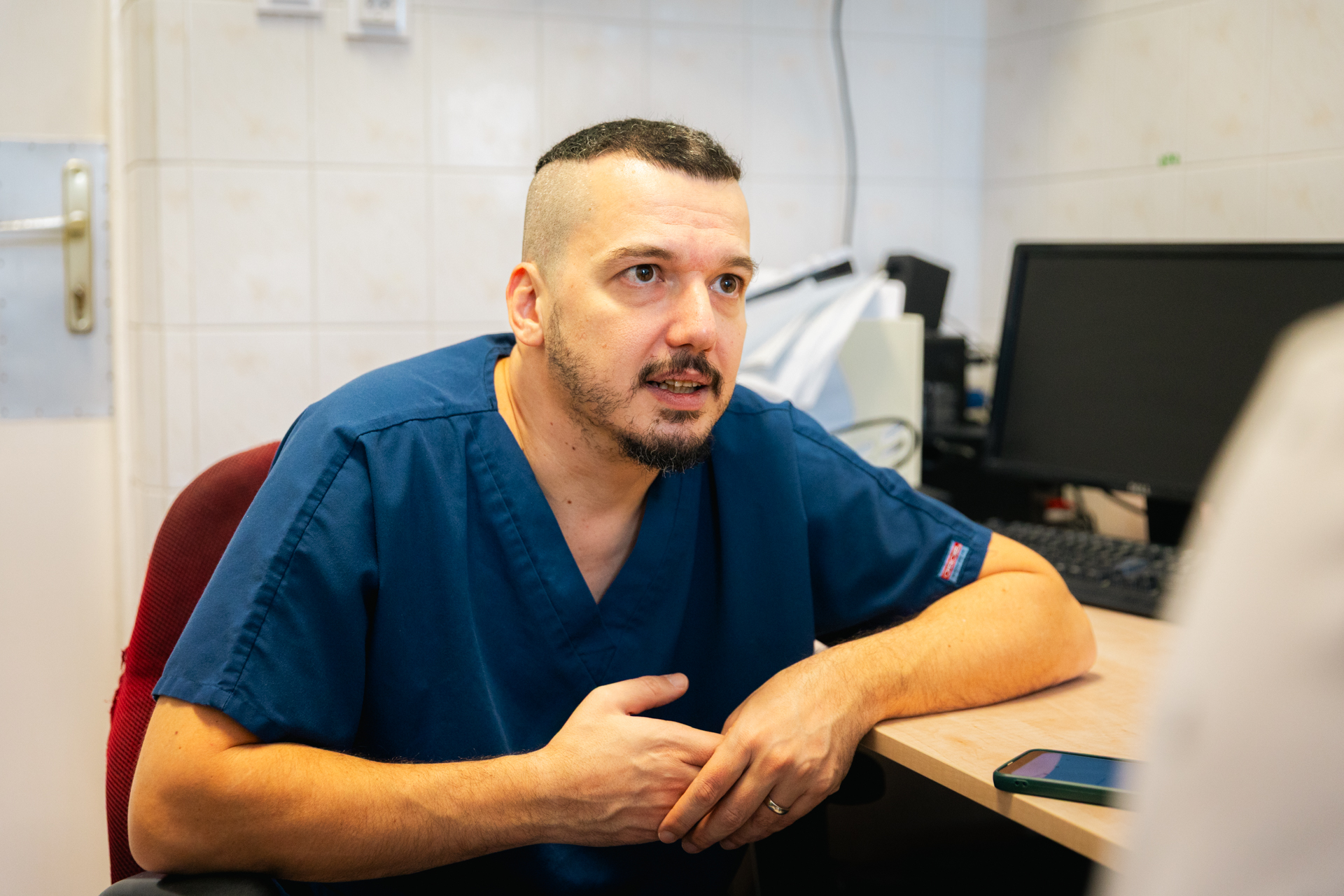
In November 2025, Pál Pásztor, a bronchology specialist and Deputy Head of the Pediatric Intensive Care Unit at the Department of Pediatrics of the Albert Szent-Györgyi Clinical Center of the University of Szeged, received SZTE’s Innovation Award, together with two research colleagues, in recognition of their innovative work in health care development. Their project, titled “DoseLearn – A Clinical Protocol and Machine Learning-Based Predictive Model for the Personalized and Objective Planning of Long-Term Sedoanalgesia and Weaning,” was also awarded Proof of Concept funding by the University. We spoke with Dr. Pásztor about the origins of the project, the clinical challenges behind it, and the directions it may take in the future.
Q: What clinical or research experience sparked the DoseLearn project?
A: Children with severe illnesses treated in the intensive care unit often require sedation and strong analgesia, particularly during mechanical ventilation and other painful procedures. The challenge is that tolerance to sedatives and analgesics can develop in as little as two days, setting off a vicious cycle. As these medications become less effective, doses must be increased, which in turn accelerates drug tolerance. In many cases, this process leads to withdrawal symptoms or delirium, both of which can significantly worsen a child’s condition.
This is, in fact, a global challenge. When I began working in an intensive care unit in England, I encountered the same issues there. In pediatric intensive care, reducing tolerance to sedatives and analgesics is one of the most widely discussed topics, with clinicians around the world searching for effective solutions. After returning from England, it became clear that the very same problem was also causing significant difficulties at the clinic in Szeged. That was the point at which I began actively seeking a solution.
My goal has been to develop a system that helps children be weaned off these medications as quickly and as gently as possible. Against this background, the project has now been underway for eight years. During this time, we have fundamentally rethought our approach to sedation and long-term pain management, developed new clinical protocols, and introduced scoring systems based on international recommendations. These steps alone represented major progress, but we ultimately decided to take the work one step further.
Building on our results, we developed a machine learning-based predictive system. Using currently available clinical data, the model estimates the most efficient and appropriate weaning schedule for each individual patient. Our preliminary findings suggest that this approach can significantly shorten the weaning process.
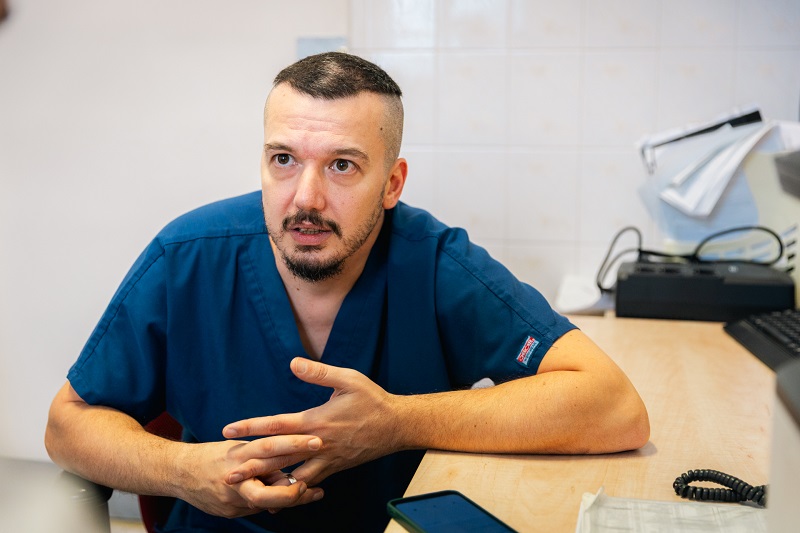
Dr. Pál Pásztor, bronchology specialist and Deputy Head of the Pediatric Intensive Care Unit at the Department of Pediatrics at SZE’s Albert Szent-Györgyi Clinical Center. Photo: Ádám Kovács-Jerney
Q: How does machine learning fit into a clinical decision-making process that remains fundamentally patient-centered?
A: What we are developing is a decision-support system – but the final decision will always rest with the physician. One of the main challenges is that these clinical situations rarely present with clear, specific symptoms. Signs of withdrawal can also be caused by sepsis, infection, or other complications. In everyday practice, clinicians must first recognize the symptoms and then determine whether they are truly related to withdrawal or whether something else is occurring. This is not always straightforward, and a considerable degree of subjectivity is often involved in interpreting these signs. What we aim to do is support clinicians by making better use of the information that is already present – but often hidden – in our data.
For this project, we retrospectively analyzed data from all patients who received sedation in our unit over the past five years. We quickly realized that our initial assumptions about how long the weaning process would take often did not align with what actually happened in practice. Our preliminary results, however, indicate that the new system can provide significantly more accurate estimates than before. As a result, we expect both the duration of the weaning process and the length of stay in the intensive care unit to decrease.
The next step is multi-center validation once the application we are developing is ready. In practical terms, this means working with other intensive care units and testing whether the same results can be achieved using their patient data.
Q: What role do your research colleagues play in the project?
A: Everyone working in the intensive care unit played a vital role in the success of this project, and I would particularly like to acknowledge the nurses. Without their dedication and expertise, a system of this complexity simply could not function. I would also like to express my gratitude to my direct supervisor, Dr. Péter Gál, who created the space and opportunity for innovation and has supported the work with insightful guidance from the outset, and continues to do so today.
I coordinated the research in close collaboration with two colleagues, Dr. Tímea Rácz and Dr. Mátyás Bukva. I started the project together with Tímea Rácz, who at the time was working in the unit as an intern. She made an invaluable contribution to data collection and grew professionally as the project progressed, supporting its implementation not only through organizational efforts but also by contributing ideas that helped drive the work forward. Mátyás Bukva joined the team at a later stage. As a biostatistician, he played a central role in shaping data analysis procedures, and the predictive model itself is largely the result of his expertise.
Q: What key milestones do you hope to achieve during the funding period?
A: Our primary objective is to develop a software application that supports the weaning process and can later be implemented in other units as well. In parallel, we aim to establish a multicenter research platform that would enable the collection of anonymized data from multiple departments. It is important to emphasize that in pediatric intensive care, access to large datasets is particularly limited; even studies based on only a few hundred – or at most a few thousand – cases are considered high-quality contributions to the field.
If the system could be implemented across five or six units, or potentially even more, we could reach case numbers in the thousands within a relatively short period of time. This would substantially enhance the statistical power of our future research and could give our findings significant impact at the international level.
About the researcher
Pál Pásztor earned his medical degree from the University of Szeged in 2007. Between 2011 and 2017, he worked in England, after which he returned to the Department of Pediatrics at the University of Szeged. Since 2017, he has served as Deputy Head of the Pediatric Intensive Care Unit at the Albert Szent-Györgyi Clinical Center.
Original Hungarian article: Imre Vida-Szűcs
Photo: Ádám Kovács-Jerney