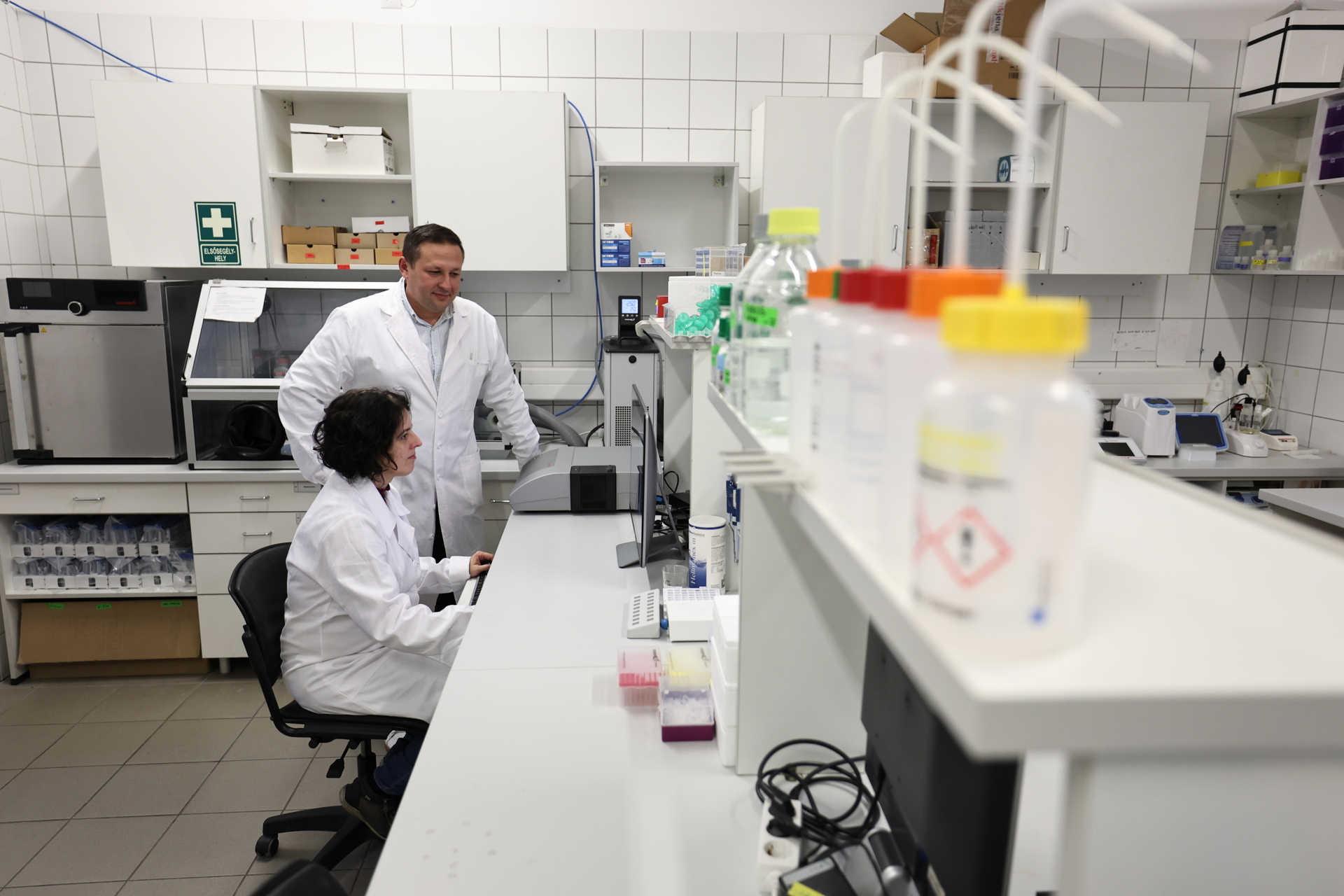
SZTE’s Materials Science and Photonics project set out to reinforce cutting-edge basic research in materials science and photonics, while also advancing the applied and experimental developments built on these foundations. By integrating fundamental research with practical innovation, the initiative aimed to deliver tangible contributions to Hungary’s national defense and security.
The program was structured around four interrelated subprojects:
Subproject A – Environmental Sensing, Sensor Technology, Signal Processing, Remote Sensing, Laser Technology, and Photonics
Subproject A focused on advancing sensing technologies for the rapid and reliable detection of hazardous substances. Researchers refined laser-based and photoacoustic measurement techniques capable of identifying toxic gases and environmental pollutants even at extremely low concentrations, significantly improving sensitivity and response time.
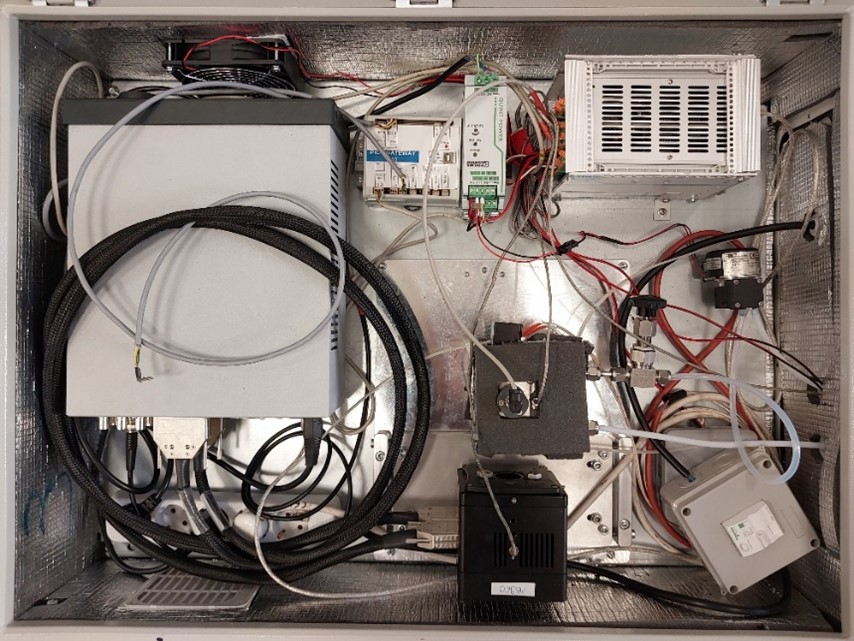
Prototype of an N2O measuring device
Developments enabling measurements to be conducted directly in field environments – for example, via drone-mounted platforms – represent a particularly promising advance. As part of the project, researchers developed prototype sensor systems capable of playing a crucial role in the rapid assessment of industrial accidents, environmental contamination, and disaster scenarios. By supporting faster and more accurate on-site detection, these technologies can significantly enhance the protection of the public and critical infrastructure.
Subproject B – Space and Manufacturing Technologies
Subproject B focused on applications in space technology. Researchers developed advanced materials and innovative processing methods designed to help lay the foundation for future in-space manufacturing and resource utilization.
One of the most notable achievements of Subproject B was the advancement of electrochemical oxygen production – a technology that could play a key role in enabling long-term self-sufficiency in space. The solutions developed within this framework are not limited to space exploration; they also hold promise for use in extreme terrestrial environments. In this way, the results extend well beyond fundamental research, opening tangible pathways for technology transfer into future industrial and defense applications.
Subproject C – Micro-, Materials, and Manufacturing Technologies
Subproject C aimed to develop advanced manufacturing solutions that are flexible, energy-efficient, and rapidly adaptable to diverse applications. Significant progress was achieved in 3D printing through the development of novel printing materials with specialized properties, as well as functionally graded structures that enable different mechanical and physical characteristics to be integrated within a single component.
Quality assurance was elevated to a new level through the advancement of micro-CT–based inspection methods, allowing even the smallest internal defects to be detected with high precision. These innovations pave the way for decentralized manufacturing and rapid-response industrial solutions – capabilities that are strategically significant not only from an economic standpoint but also for national security.
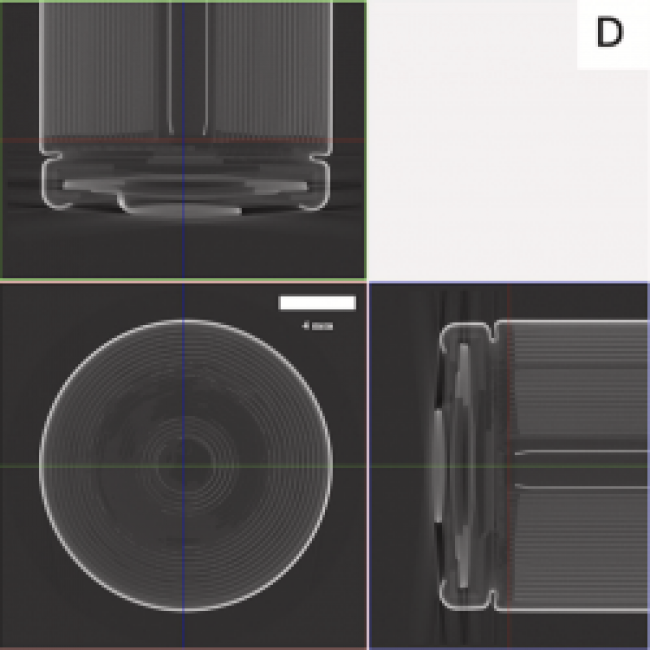
Micro-CT image of an 18650-format lithium-ion battery, revealing the area affected by electrolyte movement
Subproject D – Nanotechnology for Protection Against CBRN Materials
Subproject D addressed protection against chemical, biological, radiological, and nuclear (CBRN) threats. Researchers developed advanced two-dimensional nanomaterials and their composites capable of selectively binding, removing, or neutralizing hazardous substances, offering innovative solutions for next-generation protective technologies.
These novel nanostructures are designed to perform reliably across a wide range of environmental and climatic conditions and could, in the future, be integrated into personal protective equipment, advanced filtration systems, or decontamination technologies. In this way, the outcomes of Subproject D contribute directly to strengthening Hungary’s preparedness and response capacity in addressing contemporary security challenges.
Key Outcomes
The program brought together leading researchers and staff from the Institute of Chemistry and Physics at the University of Szeged under the professional leadership of Prof. Dr. Zoltán Kónya. Its outcomes have received international recognition, reflected in numerous high-impact scientific publications, conference presentations, and the establishment of new European and overseas research collaborations. Beyond delivering significant scientific achievements, the project also played a pivotal role in training and mentoring early-career researchers, thereby strengthening the next generation of experts in materials science and photonics.
Source: SZTEinfo