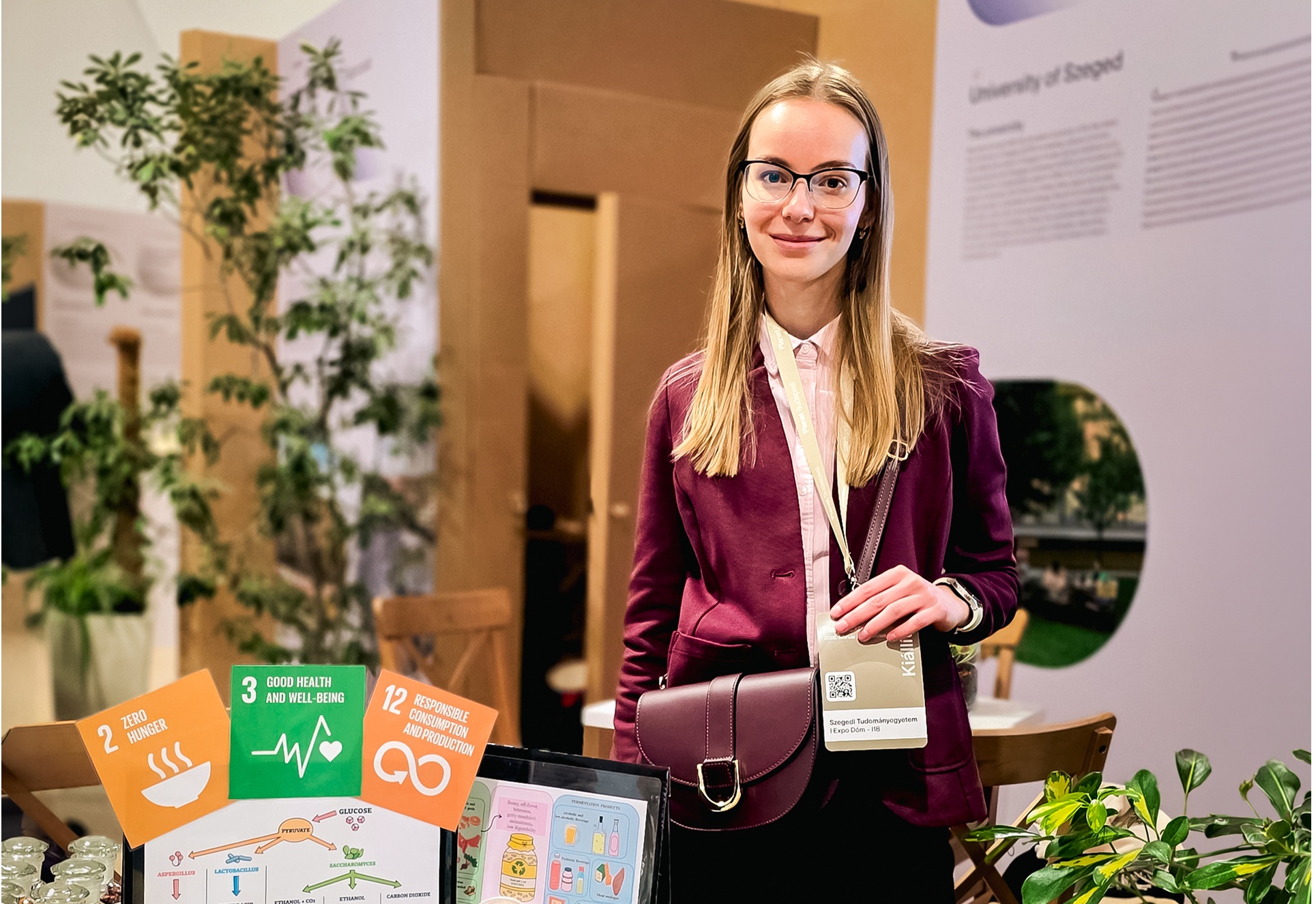
Q: From an engineering perspective, what experience at Planet Budapest proved most defining for you?
A: My first impression was striking: I found myself in a highly complex yet carefully structured environment where sustainability was presented not as a narrow discipline, but as a network of interconnected processes – from energy and water management to digitalization. As an engineer, I found that especially exciting. What impressed me most was the exhibition’s strong visual and practical dimension. Instead of relying solely on brochures, it featured human-scale working models and demonstration tools. As engineers, we often encounter innovation only through publications, whereas here these solutions were brought to life in an interactive and accessible way, without losing their professional depth. My strongest takeaway was that the engineering side of sustainability is no longer a vision of the future – it is already here, and it can be demonstrated in a tangible and compelling way.
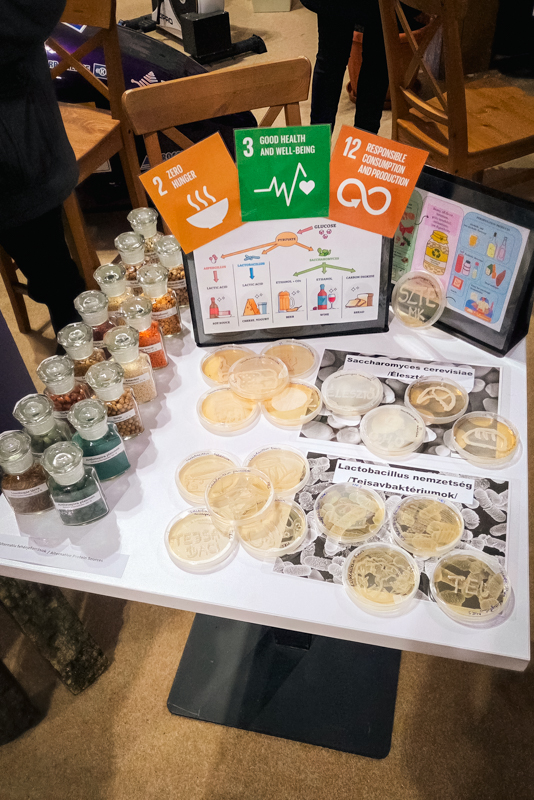
The engineering dimension of sustainability is already tangible – a visible direction of development. Photo: Réka Dobozi
Q: Previous exhibitions have focused on “tangible solutions.” To what extent did you see these featured this year?
A: Offering “tangibility” was once again one of the event’s greatest strengths. Rather than relying on theoretical slogans, the focus was on presenting solutions backed by real technology. I found the demonstrations of state-of-the-art water treatment processes particularly fascinating, especially since several exhibitors presented industrial prototypes closely related to my PhD research area – membrane technology. It was also interesting to see technologies aimed at the electrochemical utilization of carbon dioxide, which clearly showed that sustainability efforts are now emerging as concrete directions for development, even at the level of chemical industry processes.
It was also particularly insightful to see visitors getting involved in modeling the operation of Hungary’s electricity system, vividly revealing both its complexity and the delicate balance on which it depends. Examples like this show that sustainability becomes truly credible when it moves beyond the laboratory and takes a form that is accessible and meaningful to the wider public.
At the same time, tangibility was not confined to industrial or technological solutions. One particularly memorable example was a digital platform designed to integrate sustainability into everyday life, offering features such as an interactive map, an event calendar, practical tips, and community-based tools. I have actually continued using it regularly ever since, which in itself highlights its practical relevance: the exhibition presented not only complex technological systems, but also solutions that can be applied directly in everyday life.
Taken as a whole, the experience left me with the clear impression that the exhibition focused on solutions that are practical, tangible, and professionally relevant – rather than on abstract concepts or distant ambitions.
Q: The University of Szeged’s stand has long been associated with showcasing innovation. Which of this year’s developments sparked the strongest interest among visitors?
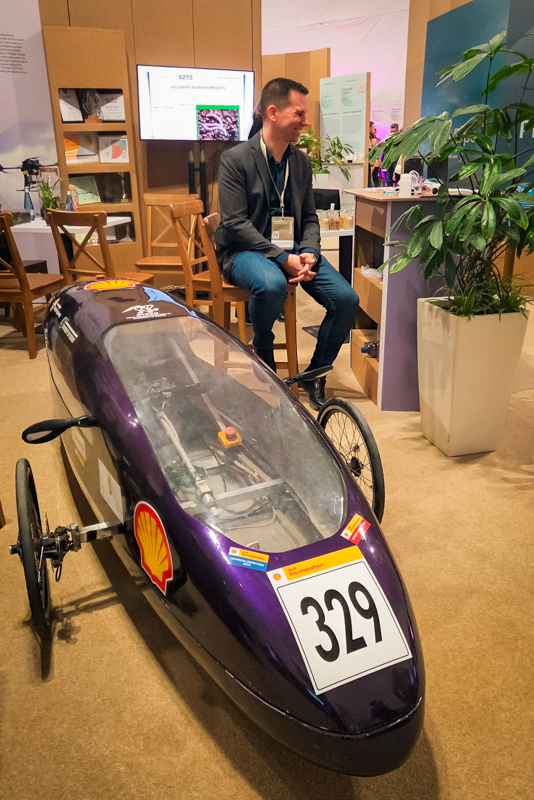
A: What made our stand particularly strong this year was its diversity. The Shell Eco-marathon car was, unsurprisingly, once again a crowd favorite, but the smaller, research-focused exhibits also generated significant interest. The catalytic brick, alternative protein sources, 3D printing, and the microbiological samples I presented all attracted considerable attention from visitors.
The Shell Eco-marathon car was once again a popular attraction. Photo: Réka Dobozi
Many visitors were drawn not only to individual exhibits, but also to the broader portfolio presented at our stand. The stationary bike that can charge a mobile phone proved especially popular, as it offered immediate, hands-on insight into the connection between human effort and energy use.
Q: Did you come across any industrial projects connected to the Faculty of Engineering’s research areas that could open the way to future collaboration?
A: Absolutely. The real value of events like this lies in conversations that can later develop into shared research directions. I would highlight the stand of the Hungarian Water and Wastewater Technology Association, where our colleagues were also present and where the faculty’s membrane filtration research generated strong interest. We also engaged in professional discussions with several companies active in drinking water and wastewater treatment, and many of these discussions have continued beyond the exhibition.
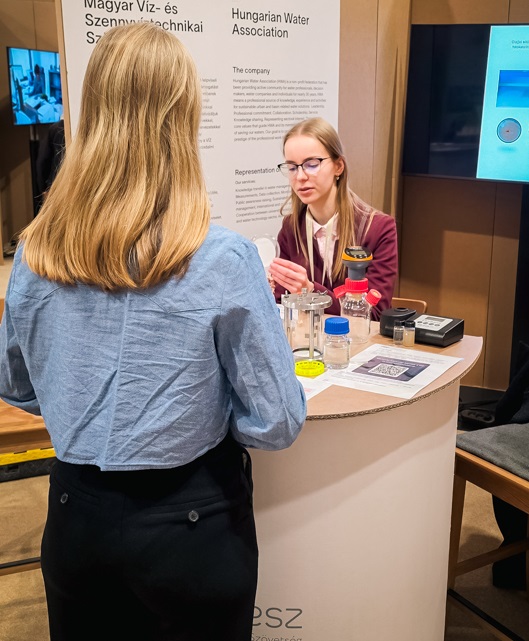
The faculty’s membrane filtration research drew significant attention. Photo: Réka Dobozi
Q: How prominently did food self-sufficiency feature in the conversations and displays at the event?
A: In my view, food self-sufficiency and alternative protein sources were prominent this year, not as a distinct thematic block but integrated across several related areas. At the University of Szeged’s stand, visitors were introduced to alternative protein sources including algae and legumes, the role of microorganisms in sustainable food production, and the utilization of by-products. Together, these examples point toward a future in which food systems must become more diversified, resource-efficient, and locally resilient.
From an engineering and food technology perspective, this is especially important, because identifying new protein sources is only the first step. They must also be transformed into forms that are stable, safe, acceptable to consumers, and economically viable. Accordingly, at the exhibition, the topic did not appear in isolation; rather, it was closely linked to related issues such as soil health, water use, composting, sustainable cultivation, and bio-based value chains.
This broader perspective was also reflected in the presence of stands showcasing vertical farming. These modular, small-scale growing systems – which can even be used in domestic settings – highlighted the growing importance of local, controlled-environment agriculture.
For me, all of this reinforced the idea that food self-sufficiency is not simply a matter of introducing new raw materials or technologies. It depends just as much on aligning local production capacity, sustainable resource use, and stable supply systems.
Q: How can these experiences be incorporated into the Faculty of Engineering’s curriculum?
A: Above all, sustainability should not appear as a standalone topic, but as a guiding principle integrated throughout the curriculum. Circular economy thinking, waste management, and resource efficiency are no longer supplementary concerns; they are now fundamental expectations. Students must also understand the economic and technical dimensions of emerging technologies so that they can enter the labor market prepared not only to adapt, but also to contribute meaningfully from the outset.
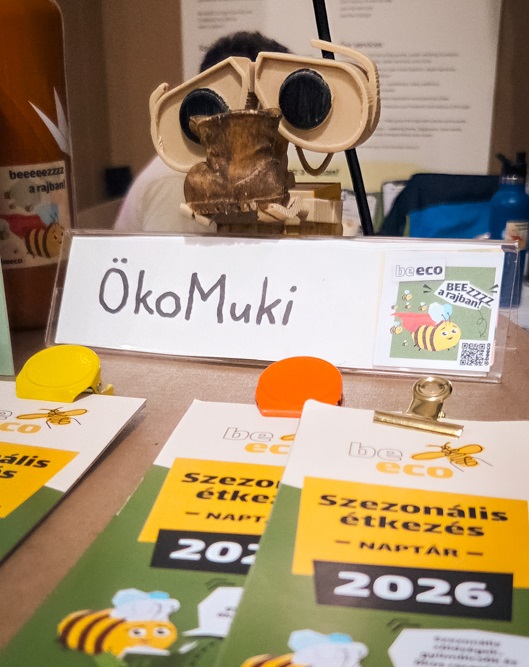
The Wall-E figure at the exhibition symbolized a simple but powerful message: Responsibility for our environment cannot be outsourced. Photo: Réka Dobozi
Q: If you had to name one key insight you brought back to your work, what would it be?
A: The clearest lesson I brought back is that sustainability permeates every aspect of our lives. As an educator, this means communicating these issues to students in a way that is both credible and accessible. Whether the topic is household water use, nutrition, or transportation, engineering knowledge should not remain confined to technical settings; it should also help inform everyday decisions.
For me, this message was powerfully embodied by the Wall-E figure at the exhibition: Responsibility for our environment cannot be outsourced. Both as engineers and as individuals, we must take an active role.
Original Hungarian article by Ádám Kovács-Jerney
Feature photo: Réka Dobozi