What the data reveal about global warming
One of the key organizations involved in assessing recent record-breaking global temperatures is Berkeley Earth, a California-based nonprofit research organization that has produced independent analyses of changes in global average temperatures since 2013. In its report on global mean temperatures for 2025, the organization concluded that 2025 was the third warmest year on record, surpassed only by 2024 and 2023, since systematic measurements began in 1850.
The analysis draws on an extensive dataset, combining 23 million monthly average thermometer readings from 57,685 meteorological stations with approximately 500 million ocean temperature observations collected by ships and buoys. The findings point to a striking trend: the 11 warmest years in the instrumental record have all occurred within the past 11 years, with the three hottest years recorded consecutively in the most recent three-year period.

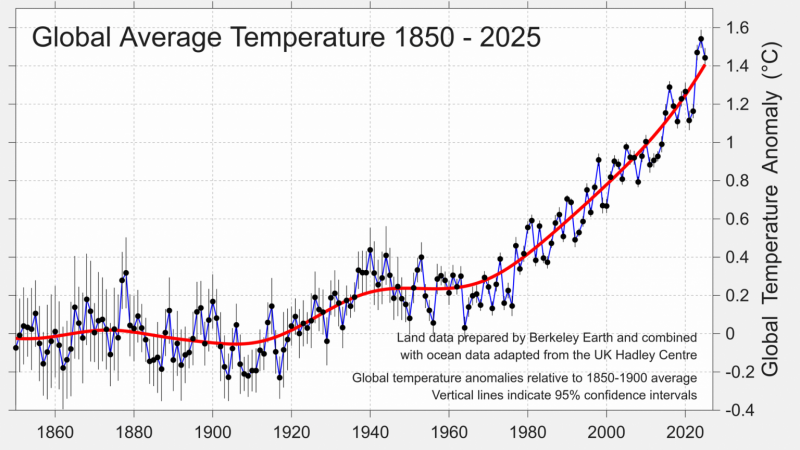
Global average temperature change, 1850–2025. The graph illustrates temperature anomalies relative to the pre-industrial average (1850–1900). The blue line shows year‑to‑year variability, while the red line indicates the long-term trend, clearly highlighting the acceleration of global warming in recent decades. Source: Berkeley Earth – Global Temperature Report for 2025
An increase in extreme weather across Europe
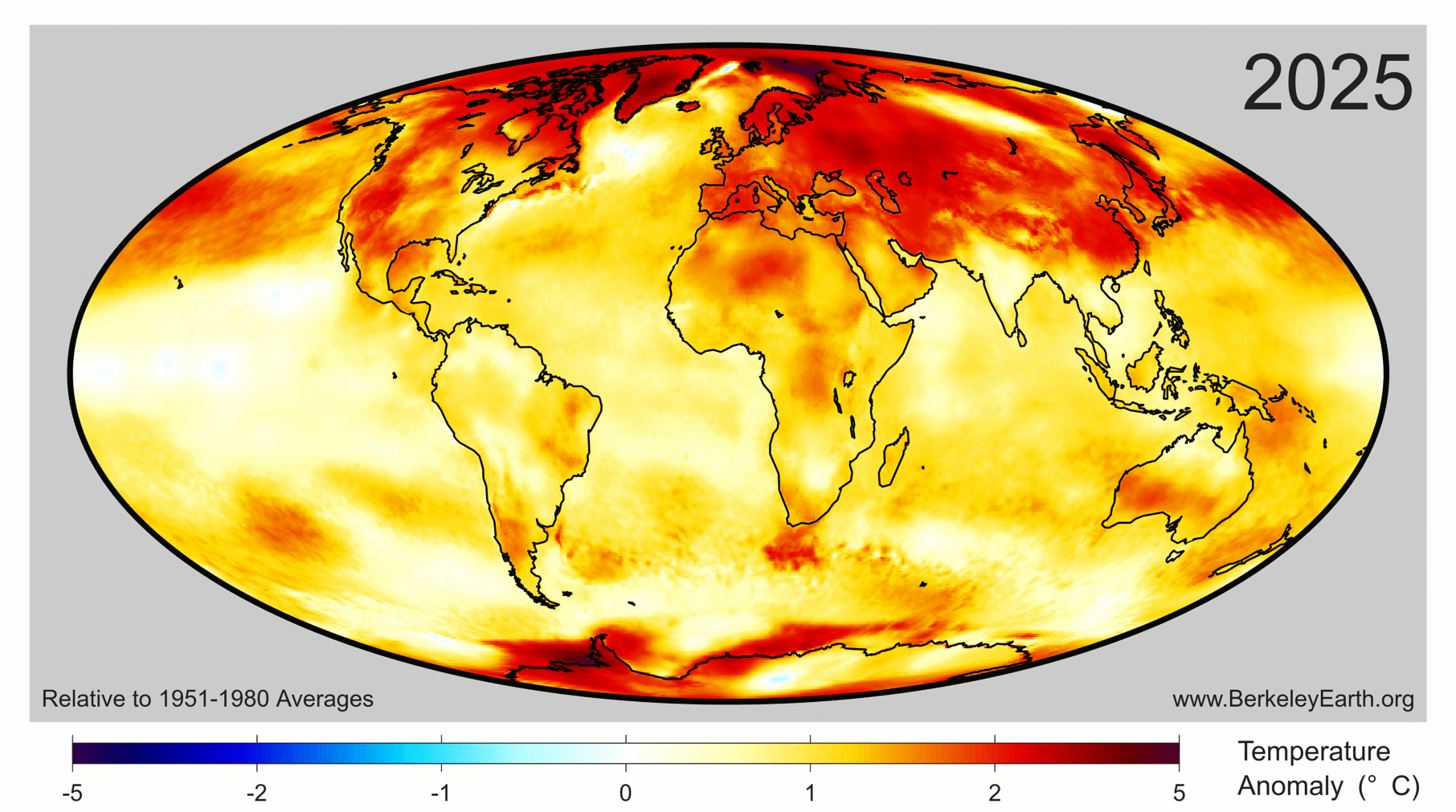
”The global report does not support claims that Europe experienced record-cold conditions on an annual scale. On the contrary, temperature maps show that most of the continent fell within a much warmer range compared with the 1951–1980 baseline period. At the same time, significant warming in the Arctic is intensifying weather extremes in the mid‑latitudes, including Europe, leading to more frequent swings between warmer-than-average and colder-than-average periods. This can create the impression of harsher winters, yet long‑term averages tell a different story: when viewed in context – particularly in the case of December 2025 – the warming trend remains unmistakable. In addition, although the La Niña phenomenon re-emerged toward the end of 2025, exerting a global cooling influence and altering atmospheric circulation patterns, its effects were limited to short-lived, regional cold spells. Over the year as a whole, no location on Earth recorded an unprecedently cold annual mean temperature. Also, despite subjective perceptions shaped by snow cover or brief cold periods, the report highlights a continued global retreat of ice and snow – an important factor that increases surface radiation absorption and further accelerates the warming process,” Professor Gál explains.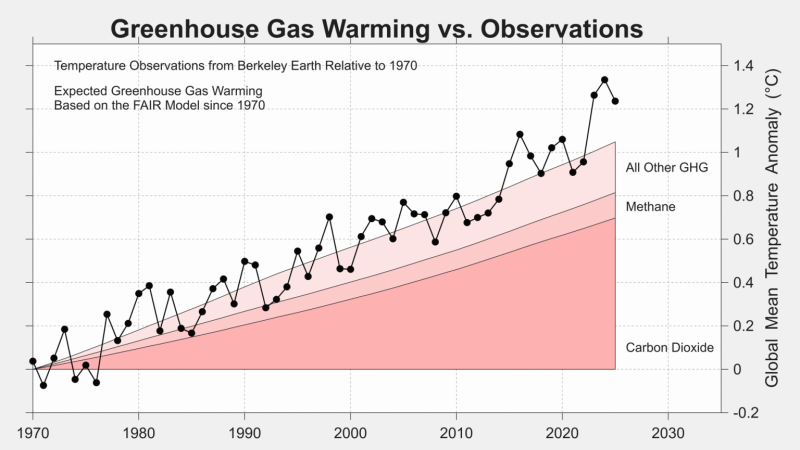
Comparison of observed warming and the modeled impact of greenhouse gases (1970–2024). The graph presents global temperature data measured by Berkeley Earth relative to the 1970 baseline (black line). The colored bands represent the estimated contributions of different greenhouse gases – carbon dioxide, methane, and other gases – based on the FAIR model. The figure highlights that the observed temperature increase closely aligns with values derived from rising greenhouse gas concentrations. Source: Berkeley Earth – Global Temperature Report for 2025
Increasing heat stress and decreasing rainfall in Hungary’s Southern Great Plain region
Examining data from Hungary’s Southern Great Plain, Tamás Gál has identified trends closely aligned with broader global climate processes.
“Measurements conducted in Szeged indicate that 2025 was a markedly warmer-than-average year in the Southern Great Plain, reflecting broader global patterns. In the city’s suburban areas, the annual mean temperature exceeded the long-term average by nearly one degree Celsius, while even higher values – reaching 13.81 °C – were recorded in the urban core. During summer heatwaves, maximum temperatures approached, and in outlying areas even reached, 39 °C. As a result, the number of days associated with increased demand for air conditioning rose sharply. In this context, the additional thermal burden caused by the urban heat island effect is clearly illustrated by the fact that only four tropical nights were recorded in suburban areas, compared with 32 in the densely built city center, where temperatures did not drop below 20 °C even by early morning. In addition to rising temperatures, the most serious challenge in the region was a severe precipitation deficit, with annual rainfall reaching only around 60–67% of the long-term average. This shortfall led to pronounced drought conditions, particularly during the summer months. Notably, rainfall in June – typically the wettest month of the year – was almost entirely absent, creating a critical situation across several sectors. The lack of precipitation was compounded by persistent atmospheric drought, marked by well-below-average relative humidity, which further intensified drying processes,” says Professor Gál.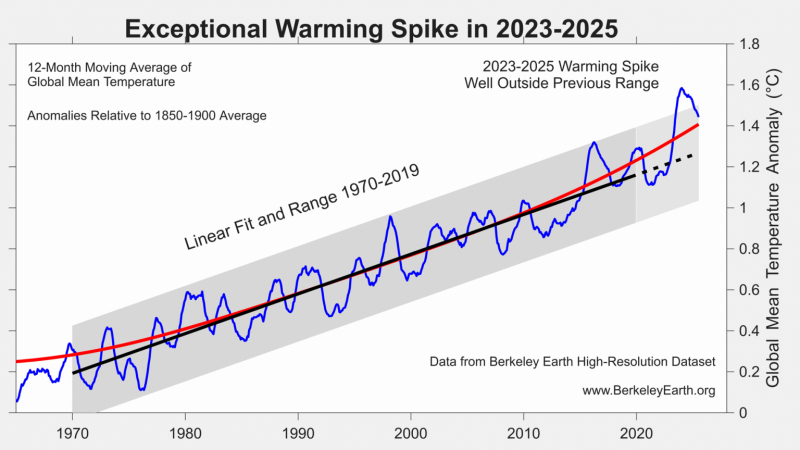
An exceptional warming peak during 2023–2025. The graph shows anomalies in the 12‑month moving average of global mean temperature relative to the 1850–1900 baseline period. The gray band represents the linear trend observed between 1970 and 2019, along with its associated range. The blue curve highlights that the warming peak beginning in 2023 extends well beyond this earlier range, rising markedly above the expected trend. Source: Berkeley Earth – Global Temperature Report for 2025
Climate in focus at SZTE: monitoring, data collection, research, and education
As reflected in the professional insights of Prof. Dr. Tamás Gál, the Department of Atmospheric and Geospatial Data Sciences at the Faculty of Science and Informatics of the University of Szeged plays an active role in monitoring local climatic conditions. This work includes the systematic observation of the urban heat island effect and precipitation patterns, as well as the continuous comparison of locally measured data with global climate trends.
These activities are closely integrated into education. As part of their training, students at SZTE work directly with real-time meteorological data, processing and analyzing datasets to gain hands-on experience with the methods and tools used in contemporary climate research. Through this practice-oriented approach, they engage with climate science not only at a theoretical level but also through practical scientific work, contributing to the assessment of climate change impacts at the local scale.
Recognizing the complexity of climate change, the University of Szeged has also established the Climate Change Interdisciplinary Research Group within its Center of Excellence for Interdisciplinary Research, Development, and Innovation. The initiative brings together expertise from across the University – ranging from legal studies to medical sciences – with the aim of connecting previously fragmented research efforts and fostering integrated, solution-oriented approaches.
Building on this interdisciplinary knowledge base, plans are currently underway for a project titled Decision Support for Climate Challenges. The project aims to establish structured cooperation and direct dialogue with decision-makers in Csongrád-Csanád County, supporting scientifically grounded and practically applicable responses to local climate-related challenges. Through these efforts, SZTE not only advances the understanding of climate processes but also acts as an active regional stakeholder, in line with its third-mission objectives, contributing to both climate adaptation and the mitigation of climate change impacts.
Original Hungarian article by Ferenc Lévai
Feature photo: Global temperature anomalies in 2025. The map illustrates deviations in average temperature for 2025 relative to the 1951–1980 baseline period. Red and orange shades indicate regions warmer than the long‑term average, while blue shades mark cooler areas, highlighting the global spatial pattern of warming. Source: Berkeley Earth