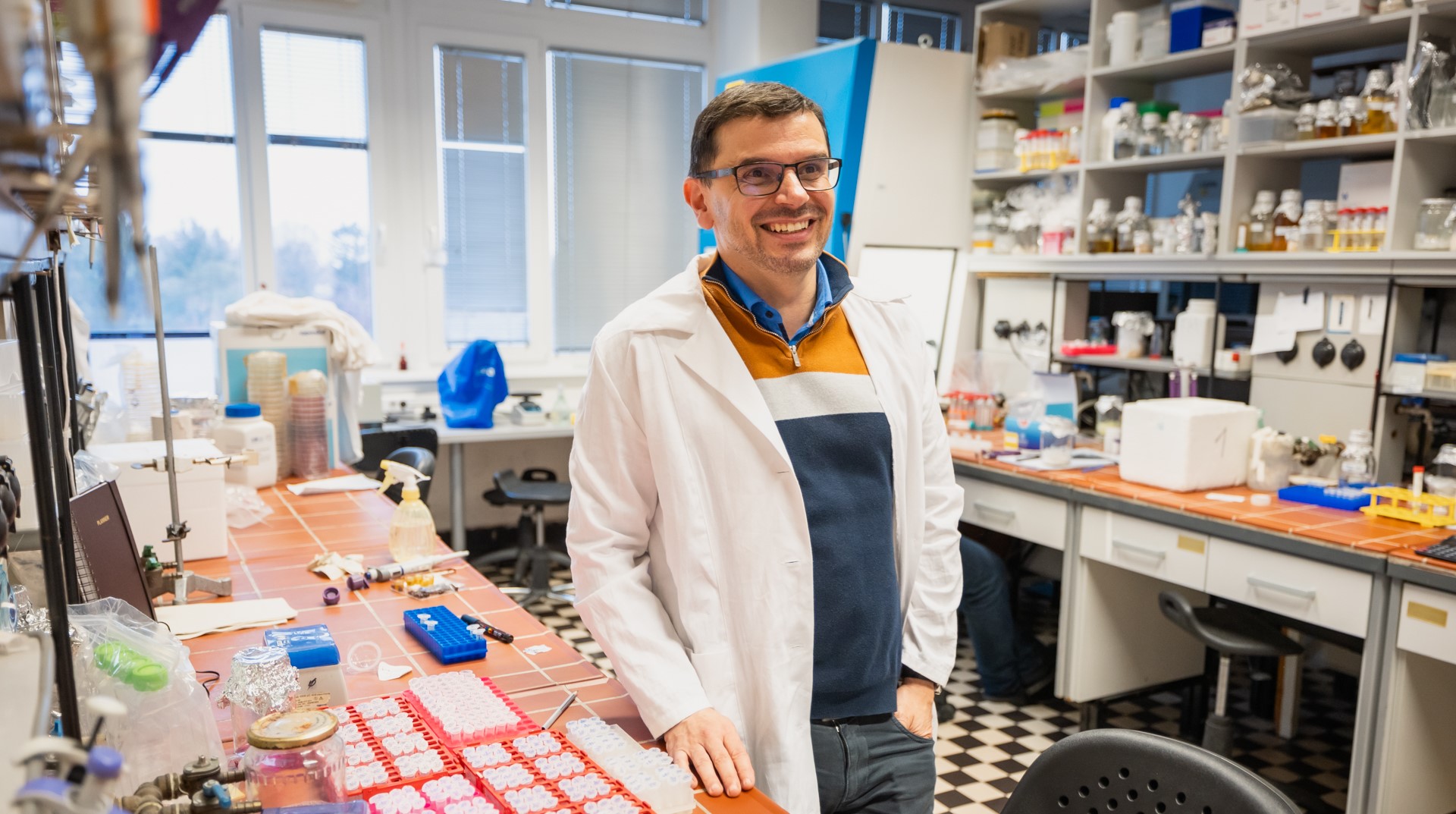
SZTE’s Center of Excellence for Interdisciplinary Research, Development, and Innovation is involved in a project that aims to determine whether cells’ natural DNA repair capacity can be enhanced in response to radiation damage sustained during space travel – a form of damage that is particularly difficult to repair. Despite the vast scale of the forces involved, the success of the experiment may ultimately depend on remarkably small details: a one-kilogram package, a precisely timed 14-minute window, and the requirement that the fruit flies traveling inside that package – after being cleared by a veterinarian – must not pass through airport security scanners, as even that could compromise the results.
Why space radiation poses a unique risk
Throughout our lives, our DNA is constantly exposed to a wide range of damaging stimuli. Of course, under normal circumstances, the body’s repair mechanisms can correct most of the damage. In space, however, the situation is dramatically different. Without the full protection of Earth’s magnetic field, high-energy cosmic particles – known as HZE particles – can cause multiple DNA breaks at once, often in very close proximity. Repairing such complex damage is extremely difficult – yet all the more necessary, as over time it may contribute to impaired cell function, cancerous changes, or accelerated aging.
Since the earliest days of space exploration, radiation exposure has been recognized as one of the most serious challenges facing astronauts. While the International Space Station still orbits relatively close to Earth and therefore benefits from partial shielding, future deep-space missions – for example to the Moon or Mars – will expose crews to far greater risks.
The focus of SZTE’s research
A research team led by Prof. Dr. Attila Gácser at the University of Szeged’s Institute of Biology is exploring whether cells can be given extra support in repairing radiation-induced damage. Their work focuses on how temporarily increasing the production of key DNA repair proteins during space travel could enhance the body’s natural ability to recover under extreme conditions.
To uncover how cells might better withstand radiation damage, the researchers rely on two complementary model systems. One is human cells, which provide direct insight into how human DNA responds under stress. The other is the fruit fly (Drosophila melanogaster), a tiny but extraordinarily powerful ‘tool’ in genetic research. Despite its size, the fruit fly shares a surprising amount of biological common ground with humans: roughly 60–75% of genes linked to human diseases have corresponding counterparts in its genome. Combined with its short life cycle, this makes it possible to track biological effects quickly and efficiently.
As part of the HUNOR mission, fruit flies at different stages of development were sent to the International Space Station, where all or part of their life cycle unfolded under the harsh conditions of real cosmic radiation. At the same time, parallel control experiments were conducted in Florida under otherwise identical conditions, but without radiation exposure. Once the samples returned to Earth, the next phase of the investigation began in Szeged: DNA-level analyses designed to reveal whether specimens that overproduced these repair proteins had in fact suffered less damage – or perhaps been able to avoid part of it altogether.
mRNA technology as a possible path forward
One of the project’s most intriguing long-term questions is whether mRNA-based technology could one day be used to temporarily enhance the production of DNA repair proteins during space travel. For now, the researchers stress, the work remains firmly in the realm of basic science: its primary goal is to uncover the underlying biological mechanisms in greater depth and, in doing so, lay the groundwork for addressing this far-reaching question more clearly in the future.
Even at this stage, however, the broader relevance of the findings is already coming into view. Beyond space research, the results could eventually prove valuable for medicine on Earth as well – for example, by helping to reduce the side effects of radiation therapy in cancer patients.
More than a scientific challenge
Behind the scientific question lies an equally demanding logistical operation. Every element in the space project had to be calibrated with extreme precision: a custom storage container built to NASA specifications, a strict one-kilogram weight limit for the entire experimental package, mandatory veterinary clearance, the transport of live fruit flies, and the complex administrative process needed to exempt the package from standard airport X-ray screening – which would have irradiated the samples and jeopardized the experiment. In a project like this, even the smallest misstep could put months of preparation at risk.
Beyond the logistical challenge, for the Szeged research team, the HUNOR program represents more than the possibility of a scientific breakthrough. It also offers Hungary a chance to play an active role in one of the most exciting frontiers in modern life sciences.
The first results of the study are expected in the summer of 2026. For now, one question remains at the heart of the research: could we one day prepare our cells for the extreme conditions of space? At the University of Szeged, the search for that answer begins with DNA – and may ultimately lead to discoveries that protect not only astronauts far from Earth, but patients down on the ground as well.
Source: SZTEinfo
Feature photo: Prof. Dr. Attila Gácser, biologist and head of the Institute of Biology at the University of Szeged’s Faculty of Science and Informatics. Photo: Ádám Kovács-Jerney