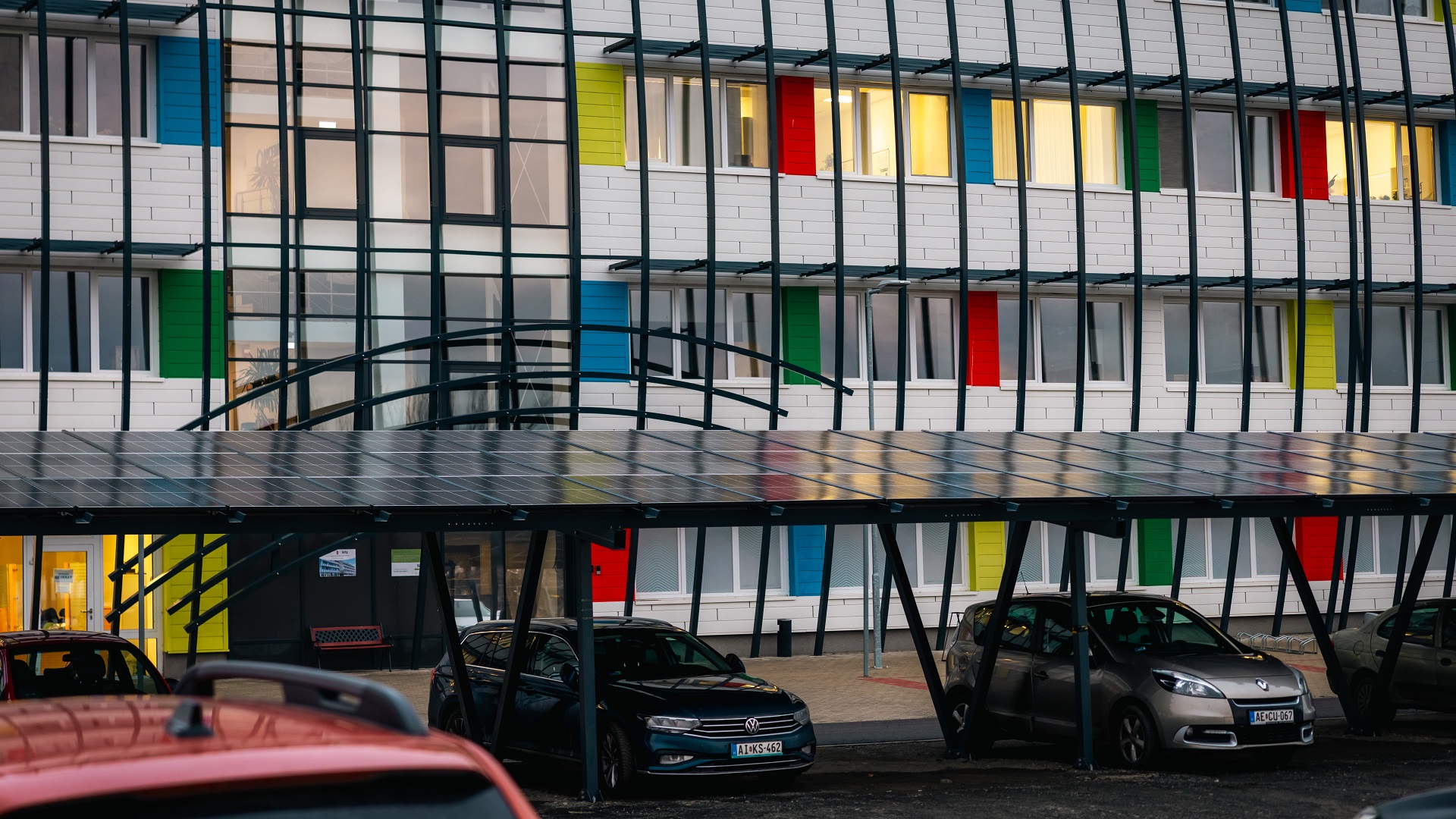
As part of its comprehensive energy development initiative titled “Installation and Expansion of Photovoltaic Systems and the Development of Geothermal Energy and Energy-Efficiency Solutions,” the University of Szeged has completed Subproject 1, expanding the institution’s renewable energy capacity through the installation of household-sized photovoltaic systems at seven university facilities.
The newly installed photovoltaic systems were commissioned at the University’s Incubator House; the SZTE Báthory István High School and Primary School for Teaching Practice; the Gellért Albert Educational Center of the Albert Szent-Györgyi Medical School; facilities of the Faculty of Law and Political Sciences and the Faculty of Humanities and Social Sciences; the Eötvös Student Residence Hall; and the main building of the Juhász Gyula Faculty of Education.

Construction under SZTE’s latest green energy project progressed according to schedule throughout the process, and the subproject was completed at the end of January 2026.
With a combined installed capacity of 300 kilowatts, the seven new solar systems mark a substantial expansion of the University’s renewable energy portfolio. The new installations are expected to generate approximately 330,000 kilowatt-hours of clean electricity annually, reflecting Hungary’s average solar yield of around 1,100 kilowatt-hours per installed kilowatt per year. In practical terms, this annual output is equivalent to the electricity consumption of more than 100 households in Szeged.
The environmental benefits of the investment are equally significant. In Hungary, generating one kilowatt-hour of electricity from conventional fossil fuel sources results in average carbon dioxide emissions of approximately 0.4 kilograms. Based on this estimate, the University of Szeged’s newly installed solar systems are expected to reduce carbon dioxide emissions by roughly 132 tons annually.
By steadily integrating renewable energy solutions into its infrastructure, the University of Szeged continues to translate its sustainability objectives into measurable results – reinforcing its role as a forward-looking and environmentally responsible institution.
Source: SZTEinfo
Photo: István Sahin-Tóth