The Fulbright Program was established in 1946 at the initiative of U.S. Senator J. William Fulbright. It is widely regarded as the flagship international educational exchange program of the United States, with a mission to foster mutual understanding and long-term cooperation between the people of the United States and those of other countries. Among the program’s various grants, the Fulbright Scholarship ranks as one of the most competitive international academic awards, with only a limited number of candidates selected each year. Recipients are chosen through a rigorous evaluation process based on academic excellence, leadership potential, and their capacity to make a meaningful contribution in an international context. Over the decades, the global Fulbright community has grown to include numerous distinguished figures – among them Nobel Prize laureates, Pulitzer Prize winners, and current or former heads of state and government.
The Fulbright Program is also firmly embedded in academic life in Szeged. As part of the program’s two-way Hungarian–American exchange framework, both university faculty members and PhD students are eligible to take part. Since 1992, a total of 70 Fulbright scholars from Szeged have spent research or teaching periods in the United States, while a comparable number of U.S.-based scholars and scientists have come to Szeged through the program.
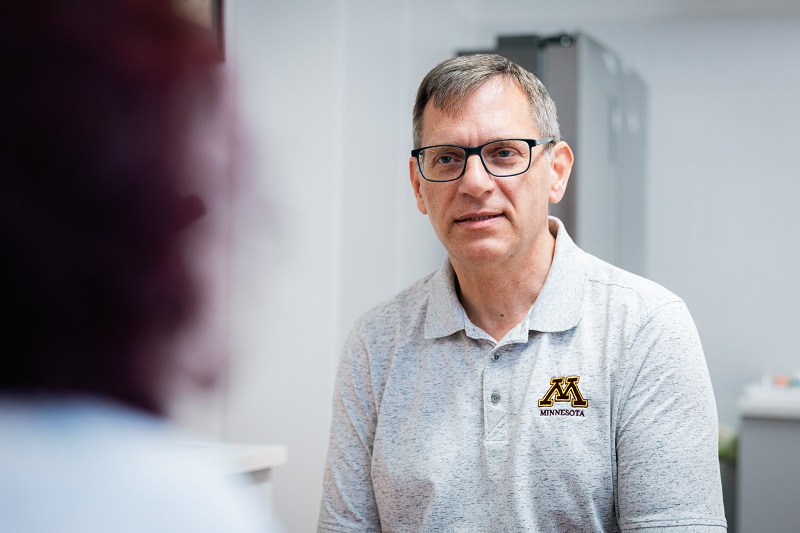
Prof. Dr. Brian Dingmann. Photo: Ádám Kovács-Jerney
A professional and personal honor
Brian Dingmann is among the most recent recipients of a Fulbright award, which enabled him to spend the fall semester at the University of Szeged as a visiting lecturer and researcher. The opportunity represented a significant distinction for the professor on both a professional and a personal level.
From a professional standpoint, the achievement is particularly noteworthy: more than 50 years after the founding of the University of Minnesota Crookston, Professor Dingmann is the institution’s first-ever Fulbright scholar. On a personal level, the award also marks a major milestone for him. Raised in a small town in central Minnesota and growing up on a farm, he is a first-generation college graduate who has gone on to earn an internationally recognized scholarship and pursue teaching and research in an international academic environment.
Professor Dingmann emphasized that he applied for the Fulbright Scholarship with a clear purpose – to come to Hungary and to work in close collaboration with Zsolt Datki.
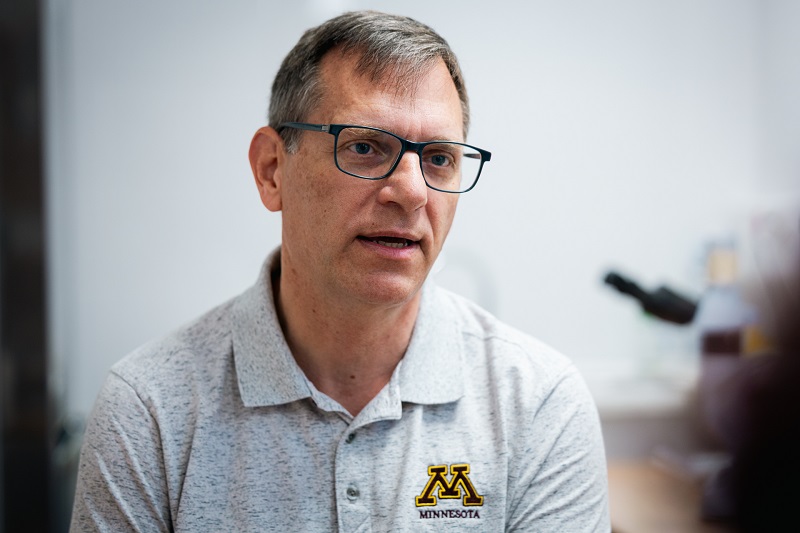
Prof. Dr. Brian Dingmann. Photo: Ádám Kovács-Jerney
“When I learned that I had been awarded the Fulbright Scholarship, I was extremely excited. Given my background as a first-generation college graduate, I see this as an exceptionally rare opportunity. Spending an extended period in a foreign country fundamentally changes one’s perspective. My time in Szeged has been not only a remarkable professional experience but also a deeply personal journey. Working with Zsolt Datki has been particularly enriching – he is both kind and exceptionally knowledgeable, as well as highly innovative in his field. The methods I learned from him are truly valuable. Overall, this experience has supported my professional development while also contributing significantly to my personal growth. I consider myself very fortunate to have had the opportunity to learn new techniques and take part in collaborative research projects,” said Brian Dingmann.
Rotifers under the microscope
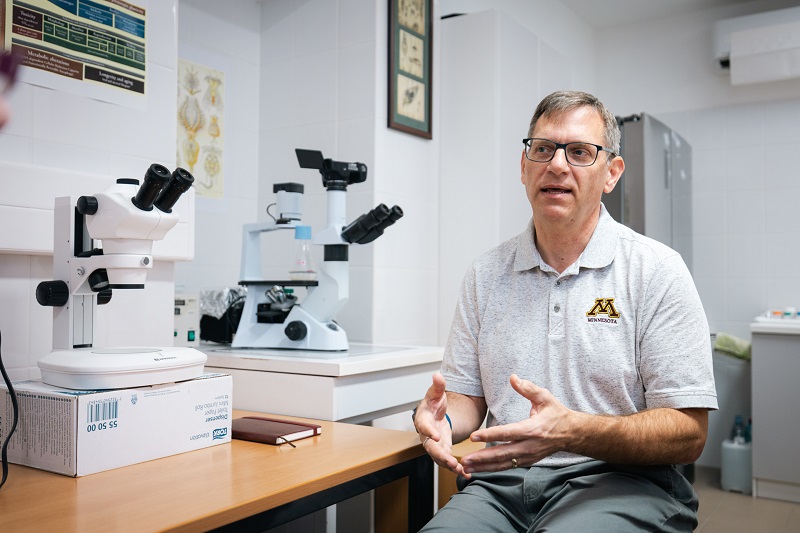
Prof. Dr. Brian Dingmann. Photo: Ádám Kovács-Jerney
What makes rotifers particularly intriguing to Brian Dingmann is how little they are studied worldwide. It is estimated that only around one percent of researchers focus on these microscopic organisms – amounting to roughly 300 specialists globally. Despite this limited attention, rotifers play a crucial role from a biotoxicological perspective, as they serve as reliable indicators of water quality.
As Zsolt Datki explained, rotifers are considered indicator species, meaning that changes in their populations accurately reflect the condition of natural aquatic environments. Occupying a central position in the food chain, rotifers consume smaller organisms and are themselves prey for larger ones. If rotifers disappear, a key link in this chain is lost, with potentially serious consequences for biodiversity.
“Successful reproduction requires males and females to find each other – a particularly demanding task for microscopic organisms in vast bodies of water,” Professor Datki noted. “If this process fails, rotifer populations begin to decline, which can lead to long-term ecological problems. Professor Dingmann focused on this very mechanism – specifically how males and females locate one another – while my research examined how this process can be explained.”
Fostering connections between students in Szeged and the United States
During his time in Szeged, Brian Dingmann taught ecotoxicology at the Institute of Biology at the Faculty of Science and Informatics. The course examined the ecological effects of toxic substances – focusing on how pollutants enter the environment, how they spread, and how they affect living organisms.
The course was delivered using the Collaborative Online International Learning (COIL) model, which connects students at the University of Minnesota Crookston and the University of Szeged. Through COIL-based collaboration, students from both institutions worked on joint projects, strengthened their intercultural competencies, and explored environmental challenges from a shared global perspective.
In his classes, Professor Dingmann used rotifers as a model species in ecotoxicology. These microscopic organisms play a key role in maintaining healthy aquatic food chains while also serving as highly sensitive indicators of environmental pollution, making them especially valuable for environmental research. When toxic effects appear in rotifers within a given ecosystem, this can signal broader risks to other organisms as well.
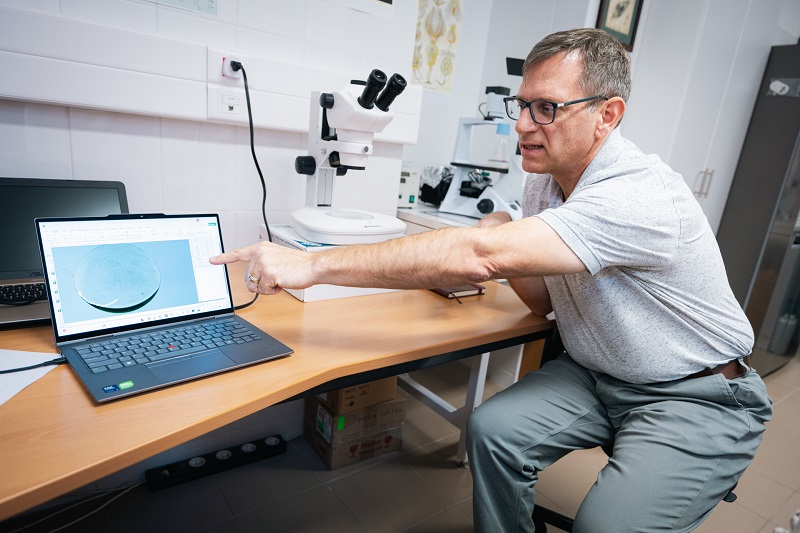
Prof. Dr. Brian Dingmann. Photo: Ádám Kovács-Jerney
World-first biopolymer discovery
As Brian Dingmann noted, his research in Szeged focused on a previously uncharacterized biopolymer produced by rotifers. In the early phase of the project, he worked with a specific rotifer species that earlier studies by Zsolt Datki had shown to release a specialized biopolymer into its surrounding environment. This substance plays a dual role: it supports food acquisition and also influences interactions between individual rotifers.
“My research focuses on a natural substance – a biopolymer – produced by both male and female rotifers during mating,” explained Brian Dingmann. “I was particularly interested in how males use this biopolymer to interact with females – which is why I came to Szeged.”
According to Professor Dingmann, preliminary findings suggest that this sticky substance plays a key role in helping males establish contact with females. However, researchers do not yet fully understand how or why the biopolymer is produced, what triggers its release, or the precise mechanisms through which it operates.
During the project, Professor Dingmann examined how the biopolymer influences mating and communication processes, its role in orientation and partner recognition, and the ways in which it may affect the behavior of female rotifers. These findings open new avenues for understanding microscopic communication and reproductive strategies in aquatic ecosystems.
The two researchers emphasized the unique nature of their collaboration. The biopolymer at the center of the project was discovered and identified for the first time worldwide by the research team led by Zsolt Datki. Building on this initial breakthrough, Brian Dingmann came to Szeged to investigate the molecule’s biological role, with a particular focus on its function in rotifer reproduction. Prior to the current phase of the research, several scientific papers had already been published on the topic, three of them jointly authored by the two researchers.
The discovery offers a potential explanation for one of the field’s long-standing questions: how microscopic organisms are able to locate one another and interact in vast natural bodies of water.
“This has been an open question in biology for a long time,” Professor Datki explained. “We believe this biopolymer may provide a possible answer. These filament-like substances carry both mechanical and biochemical signals, helping individuals orient themselves and establish contact. Our results so far may shed new light on understanding this behavior.”
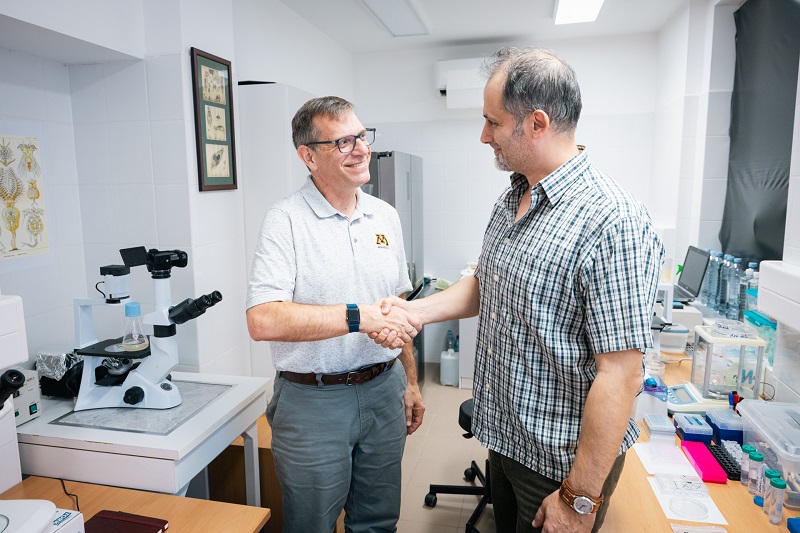
Prof. Dr. Brian Dingmann and Dr. Zsolt Datki. Photo: Ádám Kovács-Jerney
As the researchers pointed out, the biopolymer is produced primarily by female rotifers – and in remarkably large quantities.
“During our study, it became clear that males actually move along the biopolymer trail left behind by the female,” said Brian Dingmann. “I would never have thought to investigate this process in this way until Professor Datki began working with the biopolymer and demonstrated how it could be made visible. The substance is not inherently visible; it only becomes detectable using the method developed by Professor Datki. This has allowed us to visualize the biopolymer network and follow how males navigate along it.”
An unexpected turn
At one stage of the project, the research – as often happens in laboratory work – took an unexpected turn, prompting the team to revise its strategy. A year earlier, the laboratory’s rotifer cultures had been lost due to a malfunction in the temperature-control system, making it necessary to establish a new culture from the natural environment.
As Brian Dingmann explained, the original culture had been particularly well suited to the research because it contained male individuals – a feature that was missing from the newly established culture. Since the continuation of the study depended on the presence of males, the researchers set out to replenish the culture from a natural habitat.
Their efforts were ultimately successful: new rotifers were collected from the waters of Vértó, a pond in Szeged, allowing the research to continue.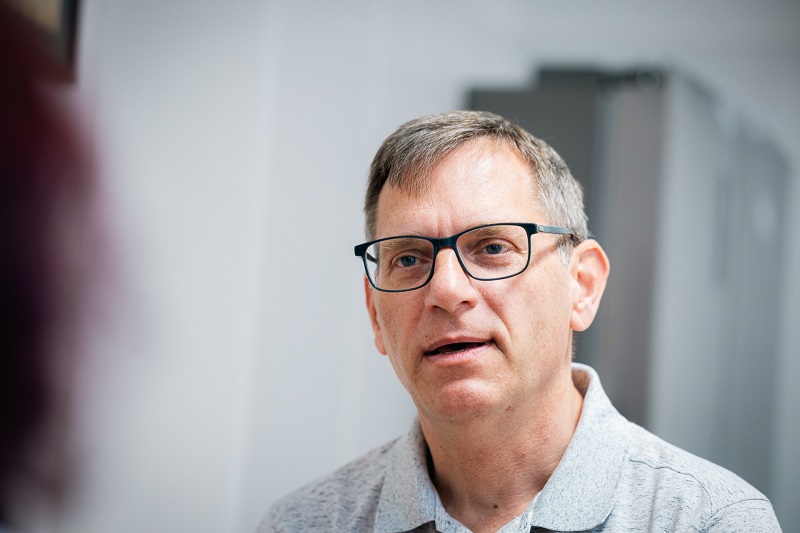
Prof. Dr. Brian Dingmann. Photo: Ádám Kovács-Jerney
Dr. Zsolt Datki added that the newly collected rotifers did not behave in exactly the same way as those in the earlier laboratory culture. Some of their traits appeared weaker or less pronounced – a difference that, in itself, raises new scientific questions.
“This is already an exciting research issue,” Professor Datki noted, “but there was not enough time within the scope of this project to examine it in depth. One of the most intriguing open questions, for example, is why male individuals do not appear in populations isolated in the spring. This could point toward entirely new research directions and may even form the basis of our next collaboration.”
Reflecting on the project as a whole, Brian Dingmann emphasized the importance of adaptability in research. “In the end, the project did not unfold exactly as I had initially imagined,” he said. “Fortunately, Professor Datki was extremely flexible, and together we were able to develop a strategy that resulted in a well-functioning and scientifically valuable project. I am very satisfied with where we are now.”
Science outreach and unforgettable experiences
Alongside his research and university teaching, Brian Dingmann also placed strong emphasis on science outreach. During his stay in Szeged, he collaborated with the American Corner Szeged, taking part in its English-language conversation club and leading science-focused sessions at several secondary schools in Szeged and the surrounding region. As part of these outreach activities, he visited Kőrösy József Economic Technical School, Gábor Dénes Technical School and Vocational High School, Tömörkény István Secondary School, Deák Ferenc Secondary School, Radnóti Miklós Experimental Secondary School, and Karolina Secondary School in Szeged, as well as Bethlen Gábor Reformed Secondary School in Hódmezővásárhely.
“As an educator, I especially enjoyed visiting secondary schools in and around Szeged,” Professor Dingmann said. “I genuinely like being among students and seeing how they engage in discussion and form their own opinions on different topics. It felt like a very natural role and environment for me.”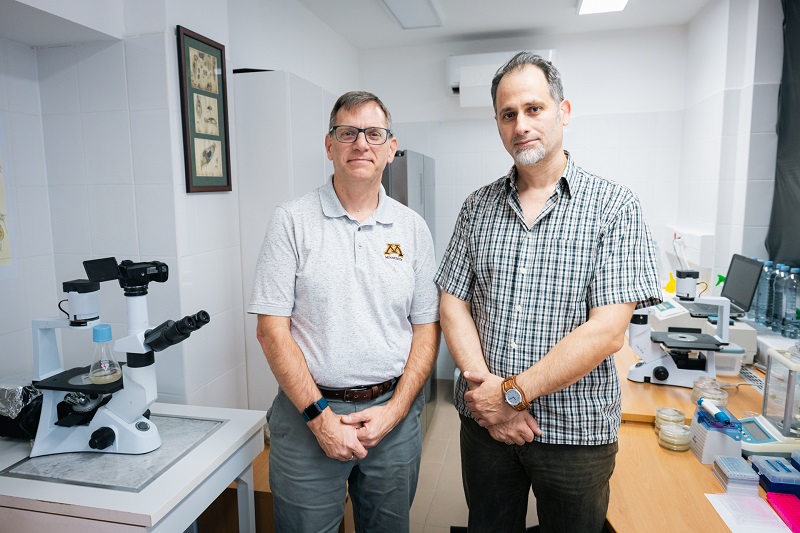
Prof. Dr. Brian Dingmann and Dr. Zsolt Datki. Photo: Ádám Kovács-Jerney
On a personal level, Professor Dingmann also spoke warmly about his time in Szeged. He grew deeply fond of the city, was impressed by its architecture, and embraced a wide range of cultural experiences. During his stay, he attended ballet and opera performances and followed local sports as well, including a home match of the Pick Szeged team at the Pick Arena. Beyond Szeged, he also visited Budapest and Debrecen, both of which left a lasting impression on him.
“I only wish I could have learned Hungarian as well, but unfortunately four months proved to be too short for that,” he said. “Not long ago, my wife and I were talking about how, from now on, we will always think of our lives in two parts – before Hungary and after Hungary. The time we spent here was truly one of the most significant chapters of our lives,” Brian Dingmann concluded.
Original Hungarian article by Tímea Fülöp
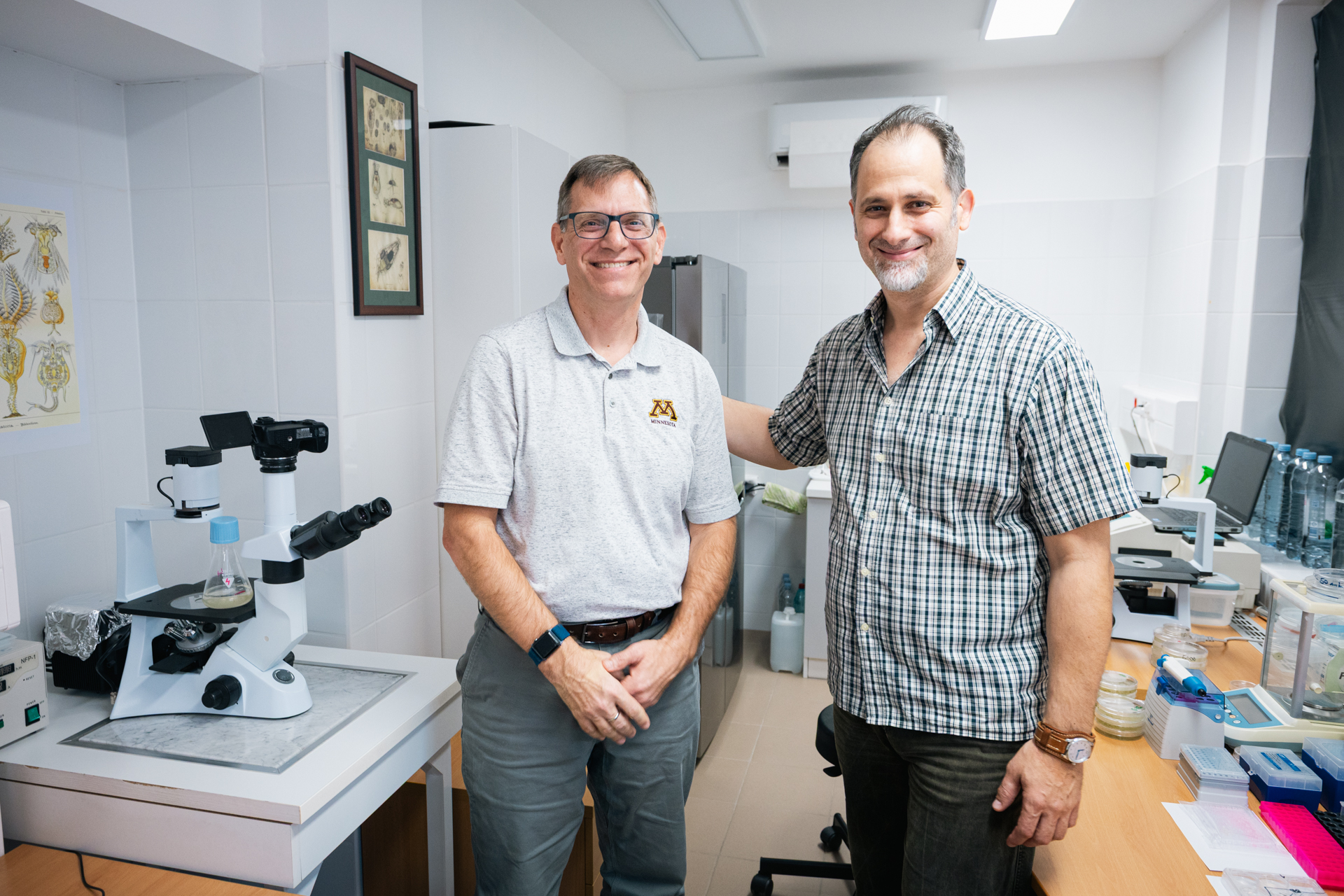
Feature photo: Prof. Dr. Brian Dingmann and Dr. Zsolt Datki. Photo: Ádám Kovács-Jerney