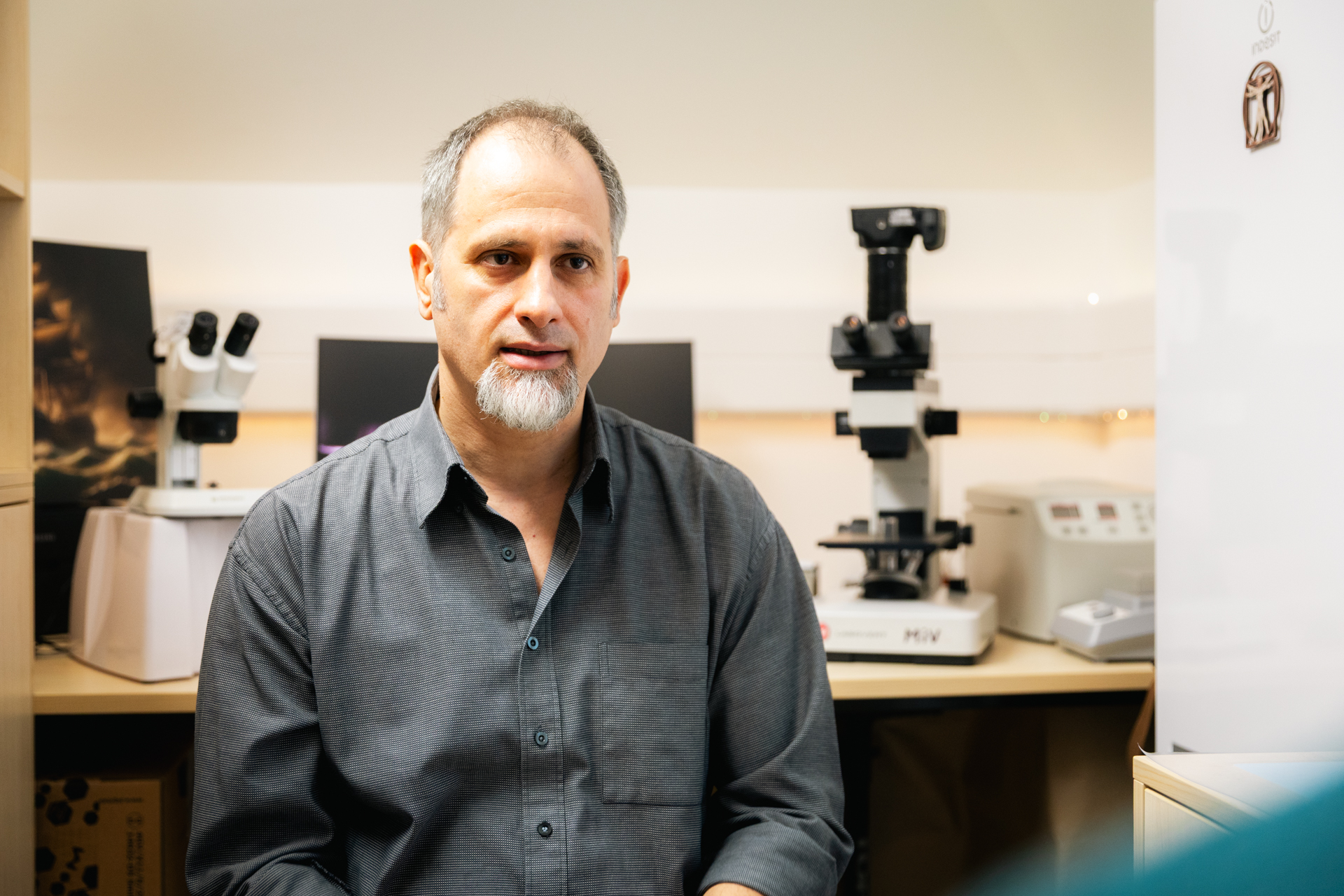
Dr. Zsolt Datki and his fellow researchers, Dr. Vilmos Bilicki and Dr. Zoltán Richárd Jánki, work with microscopic animals just a few millimeters in size, known as micrometazoans. By prompting these organisms to “draw” distinct movement patterns, the researchers can observe how a biological system responds to a given substance.
Explaining the Innovation Award-winning research, Zsolt Datki notes that within the laboratory environment they have developed, micrometazoans generate species-specific patterns through their movement and behavior. These emerging “drawings” serve as sensitive indicators of the organisms’ physiological state. When active substances, individual molecules, or complex compounds are introduced, they interact with the model organisms, and the resulting effects are encoded by the organisms themselves into the specially designed experimental environment.
“We use an ultrasensitive, AI-driven system,” the researcher explains. “We train the artificial intelligence and treat it like a specialist – expecting it to deliver an expert-level assessment.” In this context, ultrasensitive refers not only to speed but also to precision: the method can generate reliable results within a very short time and detect extremely small quantities of substances, reaching nano- and picomolar concentration levels.
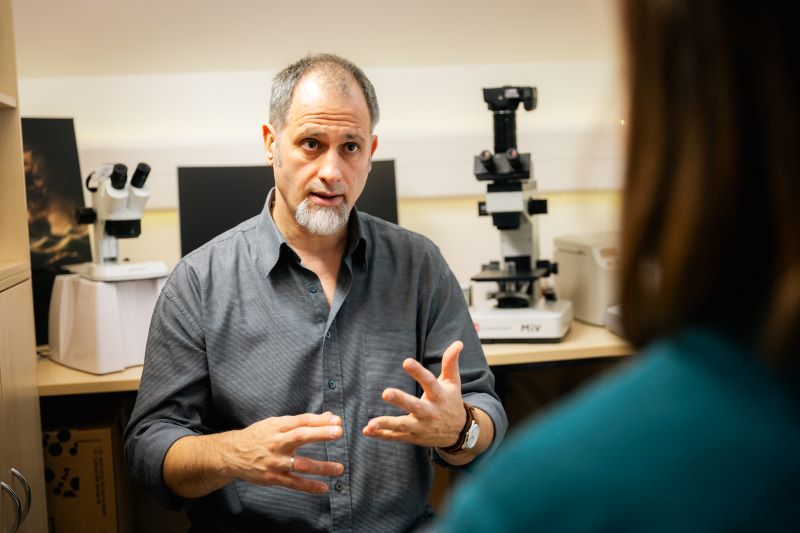
Photo: Ádám Kovács-Jerney
According to the lead researcher, the first question in any study is always whether the substance being examined has a biologically relevant effect. A compound can be toxic not only if it causes organisms to die, but also if it disrupts their homeostasis. The effect may be stimulatory or inhibitory, or there may be cases in which one species responds more quickly than another, potentially shifting the biological balance. Against this conceptual background, this new, innovative system is also well suited to modeling natural environments.
The researchers carry out their experiments using microscopic animals – the use of which does not require ethical approval – allowing them to work in parallel with three to ten different species at a time. As Zsolt Datki points out, this approach therefore represents a practical middle ground between traditional tissue culture methods and testing on vertebrate animals.
“Eleven years ago, I was working with cell and tissue cultures for my PhD research, while also conducting numerous experiments on rodents, including mice and rats,” the researcher recalls. “I began looking for a solution that would allow me to study entire organisms in a simpler, faster, and more cost-effective way, without raising ethical concerns,” he notes, adding that the cost of the current model and test organisms is only a fraction of that associated with vertebrate-based experimental systems. At the same time, the convergent data produced by the multispecies approach substantially increase the biological relevance of the results.
“If a substance has a stimulatory effect in nine out of ten species, there is more than a 90 percent probability that it will act in a similar way in mice, rats, or humans,” Zsolt Datki points out.
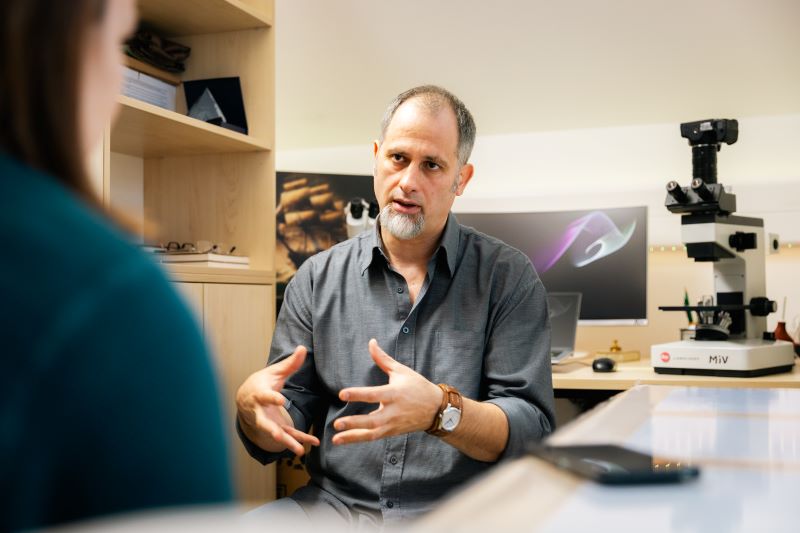
Photo: Ádám Kovács-Jerney
The research supported by Proof of Concept funding holds the promise of numerous practical applications. It can provide early, indicative insights relevant to pharmaceutical development and the cosmetics industry, while also enabling the assessment of lake water from an environmental protection perspective. To give a more tangible example, when a new mineral water source is discovered, toxicological testing can reveal whether the water poses any health risks – and whether it is suitable for further development as a commercial product.
“The results confirm that both the concept and the technology itself are working,” the expert says. “At this stage, we are fine-tuning the system to make it even more stable. It is far better to do this now than once the method is already in active use. Of course, further experience will bring new insights and allow us to continue improving it,” he adds, noting that he hopes to establish a company within the university in the near future to support the further development of the technology
The researcher says that, in many respects, the microworld mirrors the macroworld. It features ray-like organisms, tiny “sharks,” sea snake-like worms, predators reminiscent of large fish, as well as clearly identifiable herbivores and carnivores. In numerous cases, microscopic organisms resemble their macroscopic counterparts not only in biological function, but also in physical form.
“Just watching them under the microscope for a few minutes makes all the tension melt away,” the researcher says. He adds that becoming a professional scientist has, in many ways, rekindled a childhood passion in him. In 1990, when he was just eleven years old, he rigged his microscope to a camera using aluminum foil and took his very first black-and-white analog photographs – capturing the hidden worlds of a rotifer and a tardigrade.
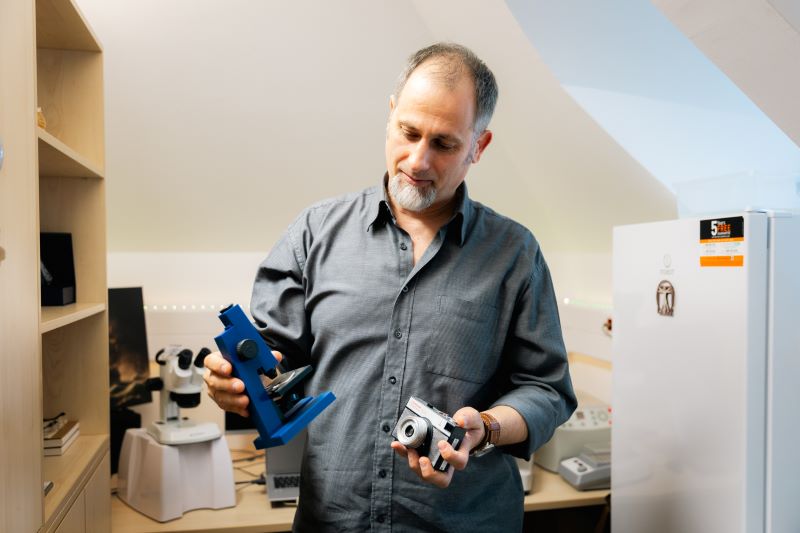
Dr. Zsolt Datki with his first microscope. Photo: Ádám Kovács-Jerney
Dr. Zsolt Datki also has a message for young researchers: rather than pursuing questions shaped by prior assumptions, he encourages them to “follow the phenomenon” – to carefully define what they observe and, if something unexpected emerges along the way, to pursue it, analyze it, and explore it in depth.
This mindset is known as serendipity-based research, an approach in which chance observations can open up entirely new scientific directions. Some of the most significant breakthroughs in science – including the discovery of penicillin and vaccines – have emerged precisely from such unforeseen findings.
“Unfortunately, today’s funding system often expects researchers to predict in advance what they are going to discover,” the researcher says. “In biological research, however, the rational basis for this is extremely limited,” he concludes.
Original Hungarian article by Helga Balog
Photos by Ádám Kovács-Jerney