The future of teaching Chinese as a foreign language was in focus in Szeged on April 1, 2026, at a conference that drew strong interest and outlined ambitious long-term plans – ranging from the launch of a Chinese language and culture program in Szeged to the establishment of a joint campus in China. Co-organized by the SZTE Confucius Institute and the Eötvös József High School and Primary School of Szeged, the event brought together regional education leaders and experts from BYD to explore new directions in teaching Chinese.
The conference on teaching Chinese as a foreign language, held at the ÁGOTA Cultural and Community Center, opened with a tai chi demonstration. This was followed by a traditional Chinese spring greeting performed by students from the Eötvös József High School and the Kossuth Lajos Primary School of Szeged, accompanied by traditional music.
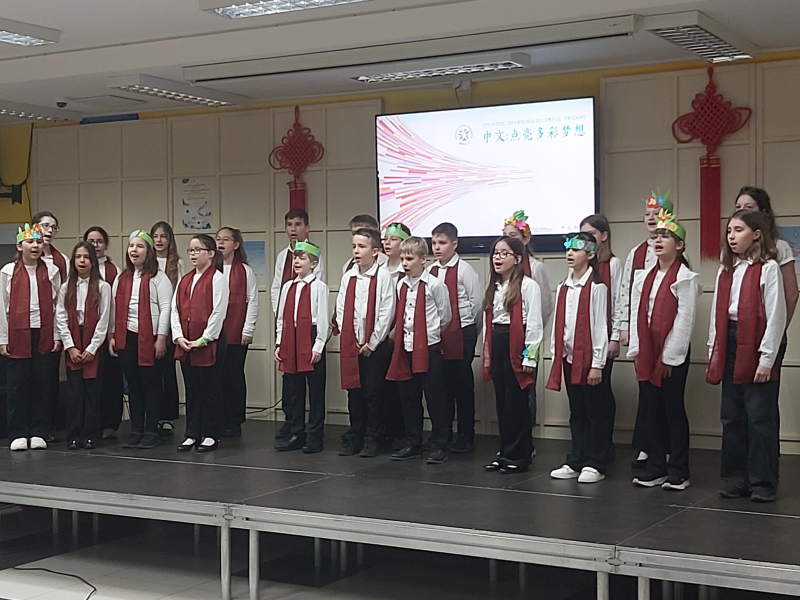
Students from Kossuth Lajos Primary School in Szeged set the tone for the event with a lively musical performance. Photo: Ferenc Lévai.
At the 6th Chinese Language Day conference, the opening remarks were delivered by Prof. Dr. Péter Zakar, Vice-Rector for International Affairs and Public Relations at the University of Szeged and Hungarian Director of the SZTE Confucius Institute, one of the event’s organizers. The significance of the event was underscored by the presence of Yang Xiuhua, First Counsellor for Education at the Embassy of the People’s Republic of China in Hungary, and Imre Bacsur, professional lead of the Szeged School District Center.

The venue was filled to capacity.
In his opening remarks, the vice-rector noted that the presence of a senior representative of the Chinese Embassy clearly signaled the event’s importance. He also outlined the University of Szeged’s growing academic engagement in China: it has already launched a program open to students nationwide and is currently running a joint computer science program with Shaanxi Normal University, in which successful students earn degrees from both institutions. Building on the success of this partnership, SZTE is now preparing additional joint programs with its Chinese partners. In the longer term, these collaborations could lead to the establishment of joint institutes – and ultimately even a shared campus in China.

Péter Zakar, speaking at the event, regularly travels to China to strengthen SZTE’s higher education partnerships with Asian universities.
“As a historian, I find myself deeply drawn to the culture of one of the world’s oldest civilizations – and especially to the richness and complexity of the Chinese language. Chinese is the most widely spoken native language in the world, a fact that underscores its global significance. In this context, when the Confucius Institute at the University of Szeged opened in 2012, it became the second of its kind in Hungary and the first outside Budapest. Since then, teaching Chinese, the promotion of Chinese culture, and Chinese–Hungarian academic exchange have all expanded steadily at the University. Today, more than 300 Chinese students are enrolled at SZTE. At the same time, major Chinese investments – including BYD-related developments in Hungary – are creating new opportunities for higher education, while also raising strategic questions. For the University of Szeged, the past three years have been particularly dynamic and successful: Katalin Karikó’s Nobel Prize placed the institution firmly in the international spotlight, significantly enhancing its global visibility. Against this backdrop of growing recognition, interest in learning Chinese has continued to rise year by year, and Chinese language examinations have become a regular feature of university life. Additionally, with the support of the Confucius Institute, the University has hosted a wide range of culturally and academically significant events. In particular, Chinese Language Day in Szeged has evolved into a nationally recognized occasion over the years, providing a shared platform for institutions and centers across Hungary engaged in the world of Chinese language and culture. I am confident that today’s event will prove both inspiring and professionally enriching,” Péter Zakar said.
At the opening ceremony, Yang Xiuhua, First Counsellor for Education at the Embassy of the People’s Republic of China in Hungary, conveyed the Embassy’s sincere thanks and heartfelt congratulations to the organizers and all those involved.
“Language builds bridges between civilizations, and the Chinese language is a living bearer of the wisdom of Chinese culture. On this day, aligned with Chinese Language Day established by the United Nations, we pay tribute to the creators of the Chinese writing system. We are witnessing a period of remarkable global expansion for the Chinese language: millions around the world are learning it, and their number continues to grow. At the same time, with the rise of artificial intelligence, new horizons are opening up for teaching Chinese as a foreign language worldwide. Confucius Institutes remain at the forefront of language education globally. Over the past 14 years, the Confucius Institute in Szeged has developed a network of 15 teaching sites, while the Confucius Classroom established at Eötvös High School in 2019 has become a nationally recognized model of excellence,” said Yang Xiuhua.
The morning program featured a series of plenary lectures. Among the day’s most important announcements, Sándor Papp, Head and Professor of the Department of Altaic Studies at the University of Szeged, outlined plans to establish a Chinese Department, placing the initiative in the context of the University’s traditions and the rapid expansion of teaching Chinese in Szeged. It was also announced that the University of Szeged’s Faculty of Humanities and Social Sciences will launch a BA program in Chinese Language and Culture in September 2027.

Dr. Sándor Papp’s lecture offered historical insights and practical lessons for all in attendance.
The next speaker, Anett Gulyás – assistant professor at the Chinese Department of Pázmány Péter Catholic University and a lecturer in the Chinese specialization program at the University of Szeged’s Faculty of Humanities and Social Sciences – delivered a thought-provoking presentation titled “Know the Old to Understand the New: Reflections and Possible Paths for Enhancing the Appeal of Chinese Language Education in Hungary.” Her talk explored how Chinese can be taught in Hungary in ways that are more engaging, relevant, and appealing to the next generation of learners.

Building on these future-focused themes, Alexandra Zoltai, former Hungarian Director of the SZTE Confucius Institute, turned the spotlight to artificial intelligence and its growing role in teaching Chinese. Now Director of Education and Research at the Hungarian–Chinese business and cultural relations development company CCTA Magyar–Kínai Kft., she delivered a presentation that drew strong interest from both instructors and students in the audience. In her talk, she examined the opportunities, risks, and key challenges of AI-assisted language learning, and highlighted that female learners of Chinese tend to be more open to using AI-based tools.

Having previously taken part in Chinese Language Day as an organizer, Alexandra Zoltai returned this year as a speaker.
The focus of the plenary session then shifted from technology to community-building, as Judit Éva Nagy, President of the Hungarian–Chinese Friendship Association, spoke about the role of civic diplomacy in shaping the future. The program concluded with a forward-looking presentation by Dr. Tibor Gera, Principal of the Eötvös József High School and Primary School of Szeged, titled “From an After-School Club to Bilingual Education: Teaching Chinese at the Eötvös József High School of Szeged.”
It was revealed at the conference that the school will launch a Hungarian–Chinese bilingual program in 2027. The new track will be open to both students who have already begun learning Chinese and those just starting out.
In the afternoon, the program continued with a roundtable discussion, where participants explored in greater depth the opportunities and challenges shaping Chinese language education in Hungary.

Bringing together education leaders, university experts, and industry representatives, the roundtable featured Dr. Péter Zakar, Vice-Rector for International Affairs and Public Relations at the University of Szeged and Hungarian Director of the SZTE Confucius Institute; Dr. Tao Qian, Chinese Director of the SZTE Confucius Institute; Dr. Anett Nagy, Principal of the Radnóti Miklós Experimental High School of Szeged; Andrea Bartókné Gyöngyösi, Principal of Kossuth Lajos Primary School of Szeged; Márta Gyömbér, Deputy Director General of the Szeged Vocational Education and Training Center; BYD representatives Zou Yinli, National HR Manager, and Csenge Csányi, International HR Specialist; as well as Dr. Tibor Gera, Principal of the Eötvös József High School and Primary School of Szeged.
Representatives of the region’s leading educational institutions, together with one of its most prominent Chinese companies, offered a compelling overview of how the teaching of Chinese is developing in Hungary. They addressed its relevance, its practical implementation, and its potential role in the years ahead. The discussion also highlighted the diverse ways in which institutions are already integrating AI into education. Representatives of BYD noted that while English will serve as the primary working language at the factory, the ability of employees to communicate in one another’s native languages can provide a significant advantage.

“Chinese Language Day has created a valuable platform for all those involved in teaching Chinese in Szeged to share knowledge, present their experiences, and outline future plans,” said Tibor Gera, Principal of the Eötvös József High School and Primary School of Szeged, reflecting on the 6th Chinese Language Day event.
“This conference holds special significance for the University of Szeged’s Confucius Institute, as it brings together experts from a wide range of fields to reflect on the dynamic growth of teaching Chinese in Szeged. At the same time, it reminds us that learning a foreign language goes far beyond mastering vocabulary or grammar – it broadens horizons, sharpens critical thinking, and helps young people turn their aspirations into reality. In the digital age, this is more important than ever. Human connections and intercultural communication are becoming increasingly vital. Successful cooperation across cultures calls for adaptability, cultural understanding, flexibility, and an open mind – and learning Chinese can help cultivate all of these,” concluded Tao Qian, Chinese Director of the University of Szeged’s Confucius Institute.

Original Hungarian article by Ferenc Lévai
Photos by István Sahin-Tóth