Led by Prof. Dr. Krisztina Karsai, Head of the Institute of Criminal Law and Criminal Science at the Faculty of Law and Political Sciences, a pioneering research project has been launched at the University of Szeged. Titled Algorithmic Sentencing (Human Smuggling), the initiative explores technological solutions that could represent a major step forward for the Hungarian justice system and, over time, may also influence judicial practice across Europe.
The five-member research group began its work in the second half of 2023 under the leadership of Professor Karsai. Its members include Dr. habil. Péter Kovács, Prof. Dr. Zsanett Fantoly, Dr. Andor Gál, and Dr. Bálint Kelemen. As part of the project, the researchers are, for the first time, combining machine learning-based approaches – including neural networks – with rule-based AI technologies to support sentencing decisions in criminal cases
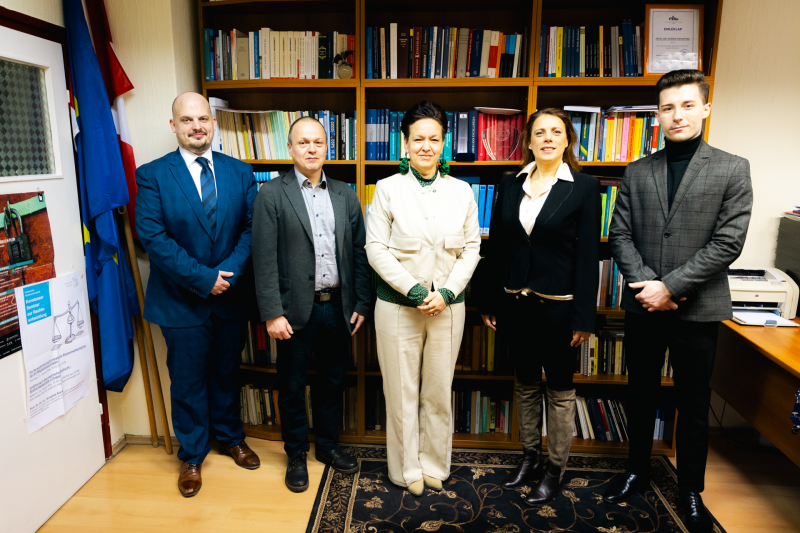
Members of the research group (from left to right): Dr. Andor Gál, Dr. habil. Péter Kovács, Prof. Dr. Krisztina Karsai, Prof. Dr. Zsanett Fantoly, and Dr. Bálint Kelemen.
The aim of the research is to develop an AI model capable of predicting judicial decisions in specific categories of criminal cases. Although court-ruling prediction and litigation analytics are among the fastest-growing areas of the international legaltech sector, most existing solutions focus primarily on civil or commercial disputes and offer little or no dedicated functionality for criminal law. This gap makes the work of researchers at the University of Szeged particularly significant and forward-looking, with the project initially concentrating on cases involving human smuggling.
“The choice was driven in part by the fact that these cases typically require consideration of a relatively limited set of factors in order to arrive at a well-grounded decision. An equally important aspect is their high degree of similarity: in the vast majority of cases, the same core characteristics recur. As a result, both the available ‘hard data’ describing these offences and the range of relevant sentencing factors are relatively narrow in scope. The model itself is built on the analysis of 541 human smuggling cases adjudicated by the Szeged District Court. At this stage of the project, the basic research phase has been completed: the theoretical framework has been fully explored, the case files have been systematically analyzed, and, drawing on these findings, a potential technological solution is now beginning to take shape,” said Prof. Dr. Krisztina Karsai.

The researchers’ long-term goal is to develop an algorithm-based decision-support system that could help make sentencing practices more transparent, more consistent, and fairer.
The researchers are currently working to establish the theoretical framework underlying the algorithm’s operation, a key milestone that the project leader expects to be completed later this year. Once finalized, the algorithm will process the selected cases and generate sentencing ‘recommendations,’ which will then be compared with the penalties actually imposed by the courts. The project will continue with the analysis of cases from additional district courts, allowing the algorithm to be further refined.
“One of the key outcomes of the research will be the identification of general criteria that allow for determining which types of criminal cases are suitable for algorithm-supported judicial decision-making. At present, the findings suggest that, in addition to human smuggling, this approach could also be applied to certain property-related offences and some traffic-related crimes. At the same time, it is important to emphasize that the algorithm – expected to reach a stage suitable for practical use by early 2027 and, subject to authorization, potentially within the courts – is intended solely to support judicial decision-making. Its purpose is to contribute to greater transparency, consistency, and fairness in sentencing practices. There is therefore no reason to fear that algorithms will determine who is sent to prison or for how long in the foreseeable future; current legislation would not permit such an outcome in any case,” added Prof. Dr. Krisztina Karsai.
There are also plans to develop a dynamic platform alongside the system currently under development at the University of Szeged, which could provide citizens seeking legal information with access to aggregated sentencing data. In doing so, the platform would support not only legal professionals but also the wider public in gaining a clearer understanding of how the criminal justice system operates – an understanding that is essential to strengthening transparency and fostering public trust.
The research project received the SZTE Innovation Award late last year in the category recognizing the most innovative research in the humanities and social sciences. Conducted within the Artificial Intelligence and the Legal Order research group of the Digital Society Competence Center at the Center of Excellence for Interdisciplinary Research, Development, and Innovation (IKIKK), the project reflects the University of Szeged’s commitment to advancing responsible, interdisciplinary AI research with the potential for long-term societal impact.
Source: SZTEinfo
Photos: Ádám Kovács-Jerney