With the grand auditorium of the University of Szeged’s József Attila Study and Information Center bathed in festive lights, the JATE Award made its debut on November 15, 2025, at an illustrious gala event. Established to honor tradition while also embracing a spirit of renewal, the new recognition was presented to three outstanding members of the university community: Márton Simon Czikkely, Ágota Tóth, and Mihály Ilia. Personal recollections and heartfelt tributes from the award’s founder, Nobel laureate Professor Katalin Karikó, transformed the evening into a celebration not only of individual excellence, but also of the shared values that unite the SZTE community.
The JATE Awards were presented for the first time on November 15, 2025, during a gala evening that lent a truly special atmosphere to the occasion. The ceremony took place in the Congress Hall of the University of Szeged’s József Attila Study and Information Center (TIK), where the Szeged University Choir, celebrating its centenary, opened the program with the choral piece Ünnepre jöttünk (We Have Come to Celebrate).
The three awardees – Márton Simon Czikkely, Ágota Tóth, and Mihály Ilia – were seated on one side of the stage, facing the leaders of the University of Szeged: Rector László Rovó; Chancellor Judit Fendler; Professor Gábor Szabó, Chair of the Board of Trustees of the Foundation for the University of Szeged; and, of course, the founder of the JATE Award, SZTE’s Nobel laureate professor, Katalin Karikó.

Honoring tradition and embracing innovation: the vision behind the JATE Award
“In my term as rector, I have consistently emphasized that it is only once we recognize our own values that we can rightfully expect others to appreciate us,” said Professor László Rovó, Rector of the University of Szeged, in his ceremonial address. “With this in mind, I consider it essential that exceptional members of our community – from applicants and new students to experienced researchers and faculty members – be acknowledged through awards instituted here at the university. That is why we have developed an incentive system that rewards excellence, a framework now considered unique in Hungary. It was therefore a particular honor for us that Katalin Karikó allocated the prize money associated with her Nobel Prize to this very purpose and established the JATE Award. In both its name and its spirit, the JATE Award merges deep respect for our traditions with a forward-looking commitment to innovation. Its name pays tribute to our past, while the award itself adds a new dimension to our system of distinctions by inviting members of our university community to nominate potential recipients.”
The rector emphasized that – in full agreement with Katalin Karikó – the university’s leadership regards understanding its institutional history and preserving its own traditions as equally vital tasks. He highlighted that the JATE Award stands as a prime example of how the integration of the higher education institutions in Szeged into a single university 25 years ago has strengthened every unit of the university as they work toward shared goals – enabling each to grow beyond its former self while continuing to preserve its unique character.
“Dear Katalin, thank you very much. We are proud to have you as part of our university community. This award sets an inspiring example, and I sincerely hope that our next Nobel laureate will make an equally remarkable contribution,” said László Rovó, expressing his deep appreciation to Katalin Karikó.
“How wonderful it is to be together!” – Reflections from Katalin Karikó
“Let me first address my fellow JATE alumni. Hello! How wonderful it is that you are here – that we are together!” Katalin Karikó said, following the Rector’s welcome address, as she greeted the audience gathered to celebrate her. She then invited those present to raise their hands if they had studied at JATE, and then, in turn, if they had studied at SZTE – and almost every hand went up. The Nobel laureate biochemist, professor at the University of Szeged, and former JATE student proceeded to explain what JATE has meant to her personally and why she felt it was important to create this award.
“As I travel the world, it always brings me great joy to meet fellow JATE alumni. Because of our shared past, there is an immediate sense of trust between us,” Professor Karikó said. “In recent years, I have had the chance to celebrate with JATE alumni in Brussels, Geneva, Dublin, Boston, and Stockholm. Several of our ambassadors – and even the current president of Hungary – are JATE graduates, too. László Krasznahorkai, this year’s Nobel Prize winner in Literature, also began his law studies here at JATE. We have every reason to be proud of our JATE peers.”
The Nobel laureate continued: “It is such a pleasure to look back on those days – our teachers, our fellow students, as well as our pranks, and all the happy years spent in the dorms. And remarkably, after so many years, even the cafeteria food – the layered cabbage casserole, spinach purée, or cabbage-and-tomato stew with meatballs – is still remembered with great fondness.”
Professor Karikó went on to say: “It’s not easy to put into words why I felt it was so important to preserve the name of our József Attila University – JATE, as we called it – through this award. I have always been proud to say I was a JATE student; that is who I wanted to be. For those of us who studied here from the 1960s through the 1990s, JATE was more than a university. It was our life – how we lived, how we came to know one another, how we supported each other and stood by each other. It was a true community. We learned a great deal, but we also had plenty of fun – going to clubs or watching contemporary films at the Auditorium Maximum or at the cinema in New Szeged. I actually met my husband at a JATE party held in the dining hall of the Szeged textile factory in 1977. Béla Francia and I got married here in Szeged at the town hall 45 years ago. Our daughter, Zsuzsi, was born here at the clinic. Béla worked at the Szeged Cable Factory, and I worked at the Szeged Biological Research Center. Everything good in our lives happened here in Szeged! We never wanted to leave – we certainly didn’t plan to go to America.”
“Be proud to be JATE alumni!”
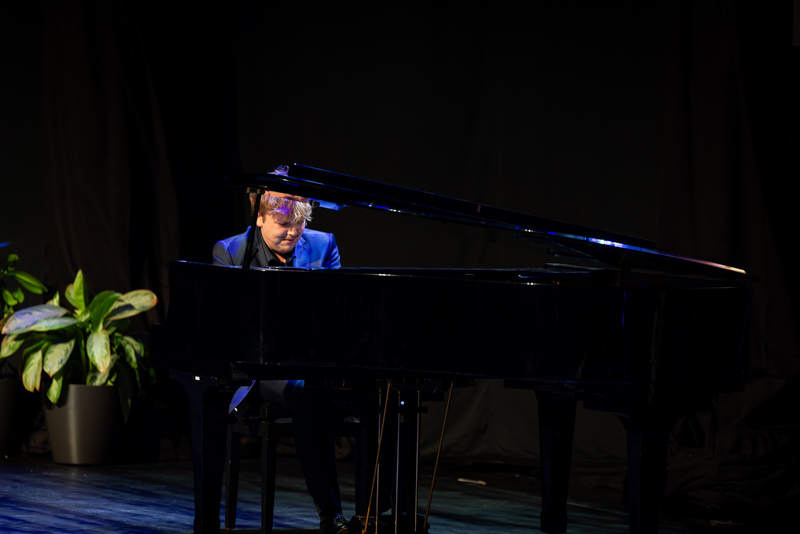
Pianist Soma Balázs-Piri at the JATE Award gala
Based on votes cast by the university community, the recipients of the JATE Award were selected by the JATE Award Committee – Professors Katalin Karikó, Gábor Szabó, and Attila Gácser. Each honoree received USD 5,000, a work of art, and a certificate of honor. To present the inaugural JATE Awards, Katalin Karikó invited former JATE students Márta Széll and Ferenc István Nagy; Eszter Meskó and János Wölfling; as well as Tibor Zalán and János Géczi.
Márton Simon Czikkely – Winner in the Student Excellence Category
The inaugural recipient of the JATE Award in the Student Excellence Category was Márton Simon Czikkely, a Doctor of Medicine at SZTE’s Albert Szent-Györgyi Medical School and a PhD candidate at the Doctoral School of Multidisciplinary Medical Sciences. He received the distinction in recognition of the remarkable momentum that defines his scientific achievements and his strong commitment to publicly promoting and disseminating science.

Márton Simon Czikkely, winner in the Student Excellence Category, with Katalin Karikó, Márta Széll, and Ferenc István Nagy
Márton Simon Czikkely’s uninterrupted scientific career began 14 years ago, while he was still in high school, when he won first prize at the Bolyai Youth Science Competition with a paper on artificial evolution. This achievement opened the door for him to join the research group of Csaba Pál – Member of the Hungarian Academy of Sciences – at the HUN-REN Biological Research Center in Szeged.
During his studies at the University of Szeged’s Albert Szent-Györgyi Medical School, Márton Simon Czikkely was admitted to the National Academy of Scientist Education, where he was able to directly draw inspiration from visiting Nobel laureates.
The awardee has distinguished himself not only in the laboratory but also through his commitment to making science accessible to the public. He actively challenges common misconceptions and presents scientific findings in a clear, understandable, and pedagogically sound way. He also founded the MEMO Science and Innovation events and, together with László Róbert Zsíros, co-hosted the popular educational program Ha jobban belegondolsz (“If You Think About It”). Today, he continues to collaborate with SCUP scientific programs for high school students, helping to showcase just how inspiring medical and research careers can be.
Márton Simon Czikkely’s achievements have already earned him several prestigious national and international honors, including the Krisztinicz Iván Prize of the Hungarian Medical Association of America and the Stephen W. Kuffler Research Fellowship.
The award was presented to the young scientist by three former JATE students: Katalin Karikó, founder of the JATE Award; Márta Széll, Vice-Rector for Strategy at the University of Szeged; and Ferenc István Nagy, Director-General of the HUN-REN Szeged Biological Research Center.
Ágota Tóth – Winner in the Teaching and Research Excellence Category
The first recipient of the JATE Award in the Teaching and Research Excellence Category was chemist and university professor Ágota Tóth. As Head of the Department of Physical Chemistry and Materials Science at the University of Szeged, she was recognized for an outstanding academic and teaching career that has greatly enriched both JATE and the University of Szeged.

Katalin Karikó and Ágota Tóth, winner in the Teaching and Research Excellence Category, together with Eszter Meskó and János Wölfling
Ágota Tóth completed her studies in the Mathematics–Physics program at Katona József High School in Kecskemét before earning her chemistry degree from József Attila University (JATE) in 1990. She then continued her academic training at the doctoral school of West Virginia University, where she earned her PhD with a dissertation titled Chemical Waves: The Effects of Geometrical Constraints.
After a highly productive period of research in the United States, the scientist returned to JATE in 1995 and has since served as a faculty member and researcher at the University of Szeged. Under her leadership – and thanks to her strategic vision and her ability to attract outstanding colleagues – the Department of Physical Chemistry and Materials Science has grown into a highly regarded research hub with strong international standing. To date, researchers in her department have secured three ERC (European Research Council) and seven Lendület (Momentum) grants from the Hungarian Academy of Sciences – an exceptional accomplishment.
Ágota Tóth is an internationally recognized researcher in nonlinear chemical dynamics. She has co-authored 117 scientific papers in leading international journals, which have together received more than 2,100 independent citations.
In addition to her research, the scientist oversees the training of future generations of chemists, serving both as head of the chemical engineering program and as director of the Doctoral School of Chemistry. Her exceptional success in teaching is reflected in the fact that students have awarded her the SZTE Faculty of Science and Informatics Golden Chalk Award three times. Generations of students have learned from her not only physical chemistry but also humanity, professional dedication, and a genuine passion for science.
The award was presented to Ágota Tóth by three former JATE students: Katalin Karikó, founder of the JATE Award; Eszter Meskó, retired deputy director-general of SZTE’s Klebelsberg Library and Archives; and János Wölfling, retired university professor and former head of the Department of Organic Chemistry at the university’s Faculty of Science and Informatics.
Mihály Ilia – Winner in the Alumni Category
Mihály Ilia, literary historian and honorary professor at the University of Szeged, was named the first recipient of the JATE Award in the Alumni Category. The award recognizes one of the most influential and formative figures in the university’s intellectual life – an educator, literary critic, and editor whose work has shaped generations at both József Attila University and the University of Szeged.

Katalin Karikó and Mihály Ilia, winner in the Alumni Category, alongside Tibor Zalán and János Géczi
Mihály Ilia’s life and work are deeply intertwined with the University of Szeged.
He completed his secondary studies at Baross Gábor High School in Szeged – today known as Radnóti Miklós Experimental High School – and in 1953 was admitted to the Hungarian Language and Literature program at the university in Szeged. His mentors included such distinguished professors as Előd Halász and Dezső Baróti, as well as Gedeon Mészöly and Sándor Bálint from the Hungarian university in Cluj (Kolozsvár) – the latter being among the first students educated at the university after its relocation to Szeged. In this respect, Ilia’s work can also be seen as carrying forward the scholarly traditions of the Cluj universitas, founded in the 16th century by István Báthory, the Transylvanian prince and later King of Poland.
As an educator, Mihály Ilia built a genuine school of thought through teaching 20th-century Hungarian literature. He passed on his knowledge not only from the lecture podium but also through countless personal conversations, guiding generations of Hungarian language teachers. As he later remarked with pride, “Had I ever left Szeged, by evening I would have ended up somewhere where one of my former students worked.”
Mihály Ilia’s scholarly and editorial work is no less remarkable. He spent 17 years working for the Tiszatáj literary journal in Szeged, and his tenure as editor-in-chief (1972–1974) left a lasting imprint on Hungarian literary history: under his direction, Tiszatáj evolved from a regional periodical into a nationally recognized literary journal edited in Szeged. Through his extensive correspondence, he built bridges between writers and literary historians across the Carpathian Basin and the West. As a researcher, his studies on the first generation of the Nyugat (The West) literary circle – and on figures such as Gyula Juhász and Endre Ady – stand out among his most significant contributions.
Mihály Ilia – known to many in Szeged simply as ‘The Professor’ – has been widely recognized for his work, receiving both the József Attila Prize and the Széchenyi Prize, and earning the title of Honorary Citizen of Szeged.
The JATE Award was presented to Mihály Ilia by three former JATE students: Katalin Karikó, founder of the JATE Award; Tibor Zalán, writer and poet, recipient of the József Attila Prize and Hungary’s Laurel Wreath Award; and János Géczi, writer, poet, cultural historian, and visual artist, likewise a recipient of the József Attila Prize.

Words of gratitude from the awardees
Following the presentation of the awards, it was Professor Ágota Tóth who took the floor on behalf of the awardees and shared her thoughts with the audience:
“On behalf of all three JATE Award recipients, I would like to express our heartfelt thanks for this honor. It is a privilege that, from 115 nominees, the JATE Award Committee chose the three of us. It is an even greater privilege to be the first to stand here at the inaugural JATE Award gala and to witness the birth of a tradition made possible by Nobel laureate Katalin Karikó’s generous initiative and the university’s support,” said Ágota Tóth.

“On behalf of the first JATE Award recipients, we are grateful for this honor and pledge to represent the spirit of the award with pride,” said Professor Ágota Tóth.
“We are grateful to our colleagues for the nomination, to the members of the JATE Award Committee for their trust, and to everyone here today for the attention and recognition they have shown us. We also understand that receiving the JATE Award carries with it a responsibility: to represent, with dignity, everything this honor stands for. Indeed, receiving this honor, I am reminded of the spirit embodied by Katalin Karikó – a spirit that rises above individual interests to serve the community. As you have seen, the design of the JATE Award reflects our university’s Transylvanian roots and Klebelsberg’s legacy in Szeged, while also conveying simplicity, modernity, and a distinctly 21st-century character. On behalf of all three of us, I would like to thank our loved ones and families for their unwavering support. I also wish to express my personal gratitude to my colleagues and to my current and former students, whose achievements have made it possible for me to stand here today. Finally, we – the first recipients of the JATE Award – thank you all for this honor, and we promise to carry its spirit forward with pride,” concluded Professor Ágota Tóth.
In addition to the inspiring speeches, the gala evening also featured a rich artistic program, with musical performances adding a fitting celebratory dimension to the event.
First, the Szeged-based a cappella ensemble Fool Moon took the stage with a special arrangement of Gyémánt és arany (Diamond and Gold) by the famous Hungarian singer-songwriter Zorán – a song particularly dear to Katalin Karikó. The musical program continued with a piece by pianist Soma Balázs-Piri, followed by a vocal performance from Flora Tandi, who – joined by Fool Moon member Gábor Molnár – delivered a moving rendition of Smile.
The inaugural JATE Award gala concluded with a collective sing-along, as the university choir and the performing artists were joined on stage by the awardees and invited guests. The celebration then continued with a formal dinner in the grand atrium of the József Attila Study and Information Center, where the awardees and their families, guests, university leaders, and other attendees spent the evening together in a warm and convivial atmosphere.
Original Hungarian article by Imre Vida-Szűcs and Fruzsina Nánai
Photos by István Sahin-Tóth and Ádám Kovács-Jerney
Feature photo: Mihály Ilia, literary historian and professor emeritus; Katalin Karikó, Nobel laureate and SZTE professor, founder of the JATE Award; Ágota Tóth, chemist and university professor; and Márton Simon Czikkely, medical doctor and PhD student