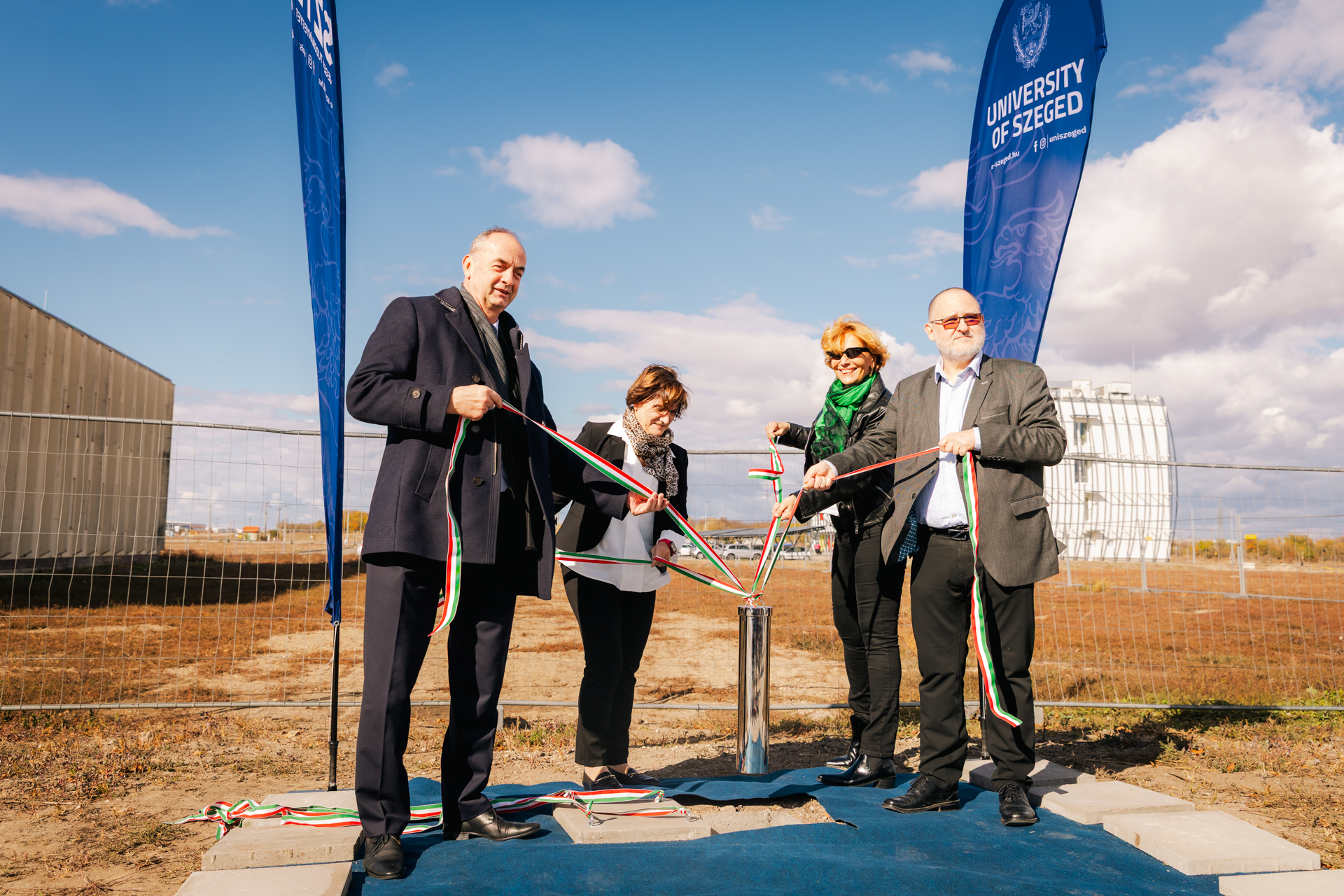
The Sustainable Mobility Industrial Relations Center represents the University of Szeged’s latest major investment, officially presented by Prof. Dr. Zoltán Kónya, Vice-Rector for Scientific Affairs and Innovation and Professional Director of the SZTE Center of Excellence for Interdisciplinary Research, Development, and Innovation (IKIKK), on the occasion of a time capsule ceremony held at the SZTE Science Park.
“At the Science Park, the University of Szeged aims to conduct research and development activities that support the advancement of the city and the wider region, in close cooperation with its industrial partners,” said Prof. Dr. Zoltán Kónya. “The new center under construction will focus on the green energy sector and electromobility – two of the most defining fields of the 21st century. It will function as an industrial relations hub, where SZTE researchers will collaborate on joint industrial, research, and educational development projects with new partners such as BYD and Rheinmetall, alongside long-standing collaborators of ours, including MOL, Audi Hungaria, and 4iG Nyrt.,” he added.
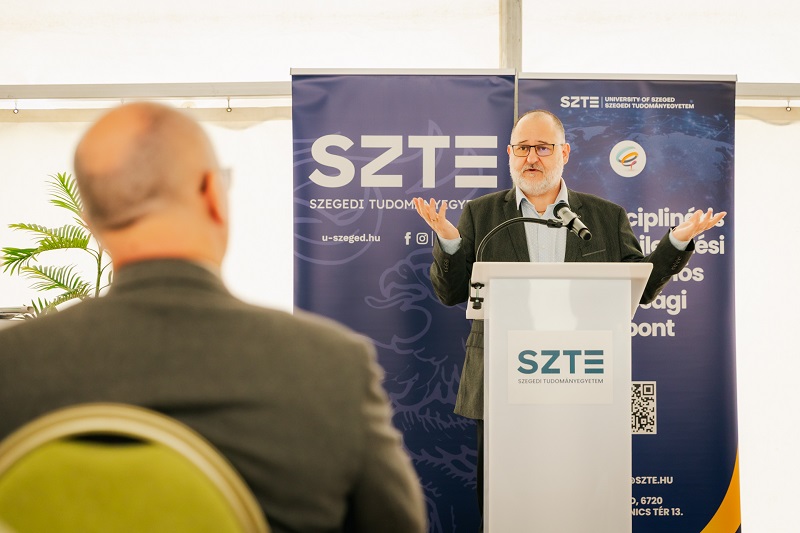 Prof. Dr. Zoltán Kónya, Vice-Rector for Scientific Affairs and Innovation
Photo by Ádám Kovács-Jerney
According to the Vice-Rector, the university’s new facility will house accredited laboratories spanning all areas of materials science, along with testing and measurement capabilities focused on electromobility and the vehicle industry. Educational activities will also form an integral part of the complex’s mission: Prof. Kónya emphasized that the research and development laboratories will serve as ideal training environments for students, integrating education directly into the university’s innovation ecosystem.
As Head of the University of Szeged’s Center of Excellence for Interdisciplinary Research, Development, and Innovation, the Vice-Rector highlighted the strong momentum the university has gained in infrastructure development. He noted that SZTE recently inaugurated a supercomputer dedicated to AI-driven data processing and announced the establishment of a cryo-electron microscopy center – a facility unique within the broader international region. “In the field of research and innovation, the University of Szeged is currently the leading university in Hungary,” Professor Kónya noted.
In her address, Dr. Judit Fendler, Chancellor of the University of Szeged, stated that the Sustainable Mobility Industrial Relations Center represents a HUF 3 billion investment. She explained that the project is financed in part through funds provided by the Government of Hungary under the university’s public service financing agreement and is further supported by grant funding and SZTE’s own resources.
“The development of the new center is crucial for strengthening the university’s capabilities,” the Chancellor emphasized. “FMIKK will become an integral part of the dynamic, symbiotic relationship that the University of Szeged has already built with the companies operating in the Science Park, particularly in the fields of research and education.”
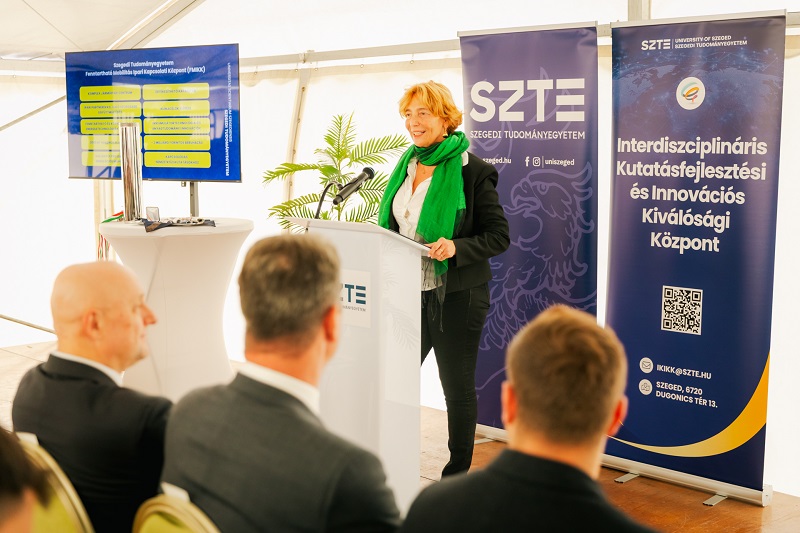
Dr. Judit Fendler, Chancellor of the University of Szeged
Photo by Ádám Kovács-Jerney
Chancellor Dr. Judit Fendler recalled that the new hub will be created by repurposing a decommissioned theater building on the site of a former Soviet–Russian military base – a site for which possible future uses had long been a matter of discussion among the university’s leadership.
“For a long time, we considered converting the building into a conference center,” the Chancellor said. “However, that plan was ultimately not realized, as it would not have been sustainable – and at the University of Szeged, we strive to ensure that every investment is sustainable. Our developments are guided not only by the needs of our own researchers and faculty, but also by the expectations of our industrial partners and research collaborators.”
According to Prof. Dr. Ildikó Csóka, Director-General for Strategy and Development at the University of Szeged, SZTE has been constantly developing its Science Park over the past ten years. The 100-hectare site has undergone land preparation in two phases in recent years, supported by more than HUF 12 billion in state funding, and it has now reached the point where industrial partners are beginning to establish a presence. The University of Szeged has also consolidated its own research and innovation capacity within a center of excellence, ensuring that its activities remain closely aligned with industrial applications.
“Physically, this area represents the meeting point between the university’s applied research and industrial application,” explained Prof. Dr. Ildikó Csóka. “To support this, we have also created a concentration of knowledge within the university. As an organizational innovation, we established the SZTE Center of Excellence for Interdisciplinary Research, Development, and Innovation, which brings together all of our applied research made available to industrial partners. As part of this, we have clustered the basic research conducted across our 12 faculties, the patents and know-how generated through PhD programs, and the innovation projects with potential value for industry. Within this ecosystem, the Sustainable Mobility Industrial Relations Center will operate under the Cluster for Physical Sciences, and its accredited laboratories will also function as key Advanced Core Facilities – which we hope will benefit as many industrial partners as possible,” emphasized Professor Csóka.
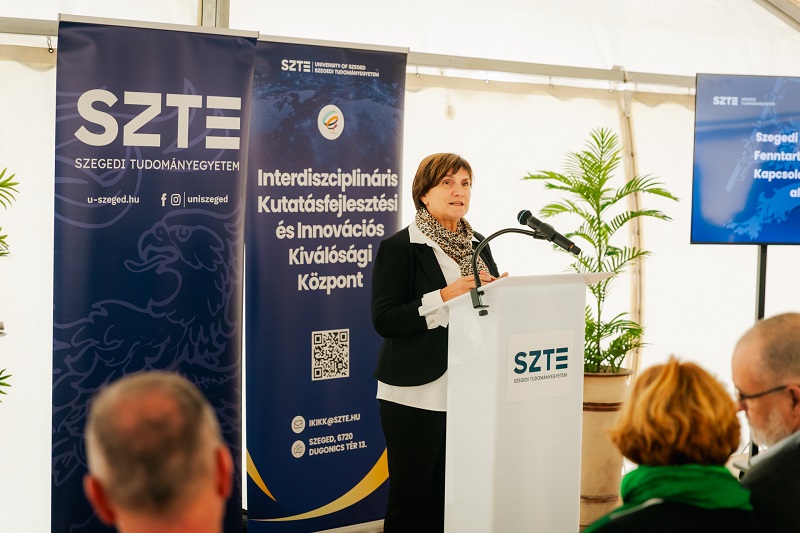
University of Szeged
Photo by Ádám Kovács-Jerney
The FMIKK facility will serve as an experimental and development space, designed to host high-quality prototype laboratories and testing systems for research groups at the University of Szeged. It will also be equipped with state-of-the-art photoacoustic measurement instruments to support BYD and other industrial partners in reducing pollutant emissions, monitoring air contaminants, and advancing green technologies.
FMIKK will additionally house the University of Szeged’s new IT server room and data center, which – with its TIER 3 certification – will position the university as a regional leader in artificial intelligence applications, simulations, and big data analysis.
The facility will also be home to SZTE’s National Laboratory for Renewable Energies, operating within the Center of Excellence for Interdisciplinary Research, Development, and Innovation. This laboratory focuses on low-footprint energy technologies, including the production, transport, and storage of green hydrogen, as well as CO₂ utilization.
Guests at the founding ceremony for the Sustainable Mobility Industrial Relations Center included Ferenc Bodrogi, Managing Director of Bodrogi Bau Kft., the company responsible for constructing the new building; Sándor Nagy, Deputy Mayor of Szeged for Urban Planning and Development; Béla Mihálffy, Member of Parliament; and Levente Farkas, Member of the Municipal Assembly of Szeged and leader of one of its municipal assembly groups. Representatives of Rheinmetall Hungary Zrt. and BYD Auto Hungary Kft. were also in attendance.
The time capsule set in place for the facility contains the building’s blueprints, visual designs, and construction plans, along with a commemorative medal honoring SZTE’s Nobel laureate professor, Katalin Karikó, and a current issue of a daily newspaper.
Original Hungarian text by Sándor Panek
Feature photo: Ferenc Bodrogi, Managing Director of the construction company Bodrogi Bau Kft.; Prof. Dr. Ildikó Csóka, Director-General for Strategy and Development at the University of Szeged; Dr. Judit Fendler, Chancellor of the University of Szeged; and Prof. Dr. Zoltán Kónya, Vice-Rector for Scientific Affairs and Innovation, taking part in the time capsule ceremony for the SZTE Sustainable Mobility Industrial Relations Center.
Photo by Ádám Kovács-Jerney