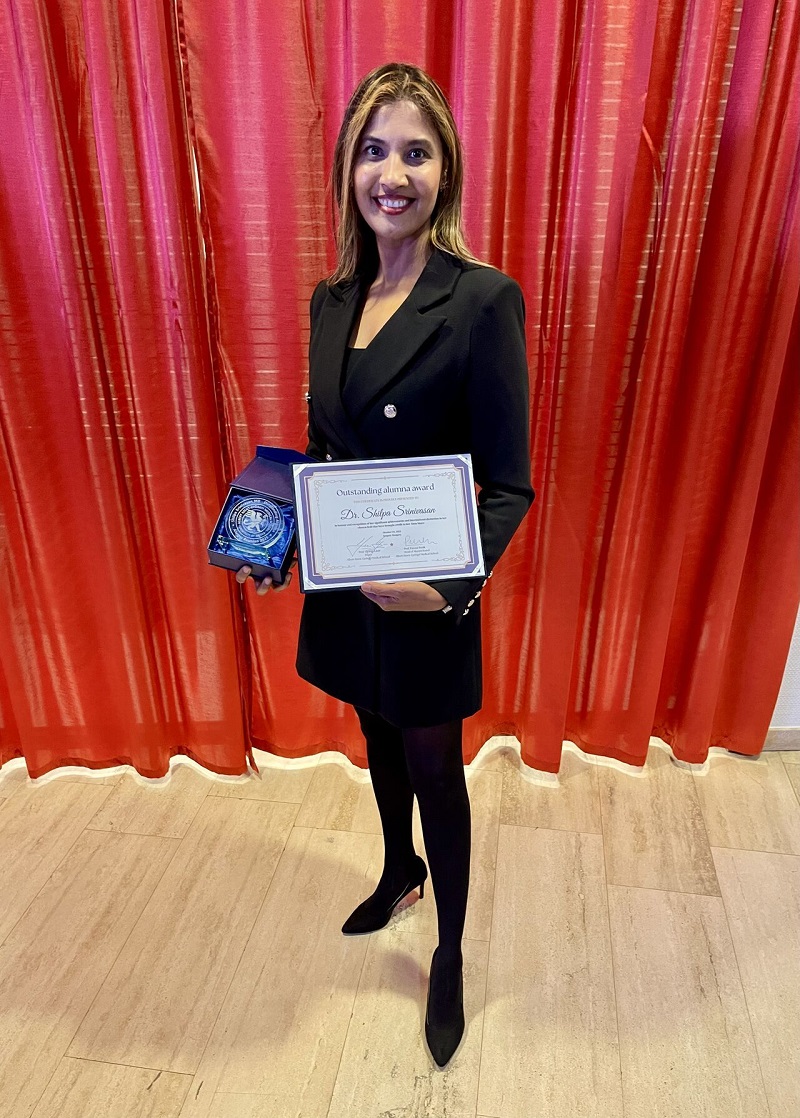
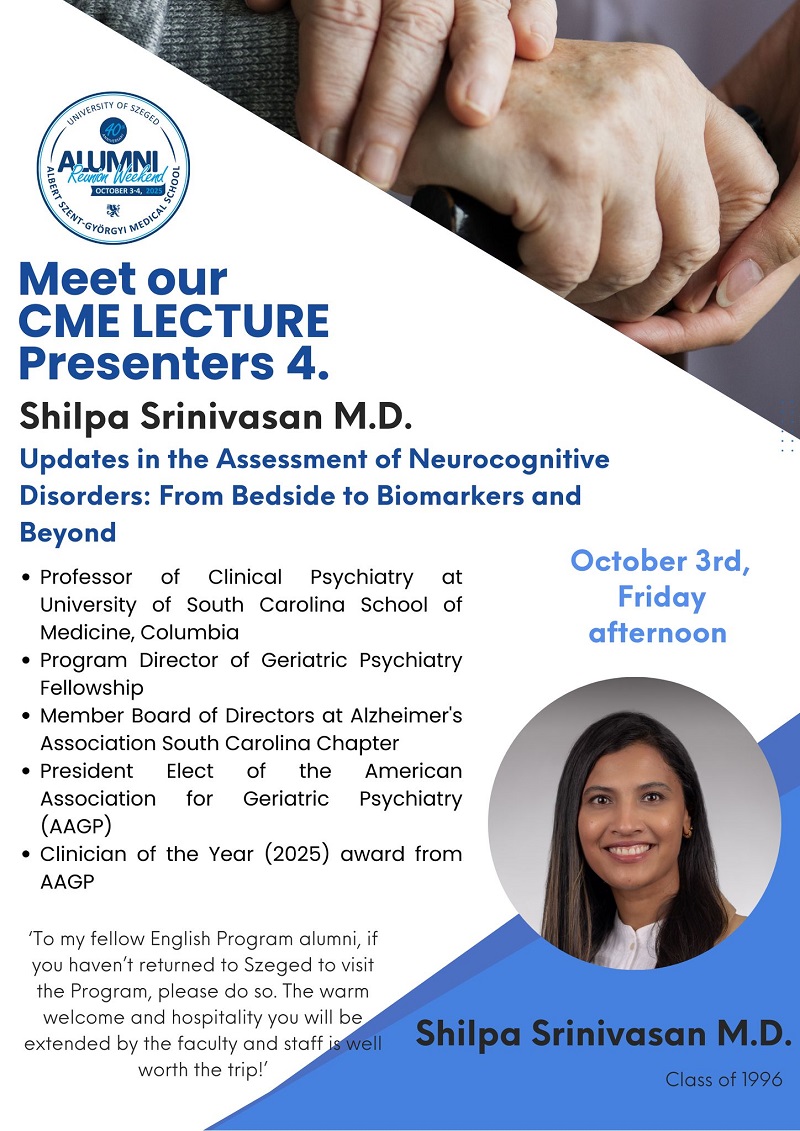
Shilpa Srinivasan, M.D., DFAPA, DFAAGP is a Professor of Psychiatry at Prisma Health at the University of South Carolina School of Medicine in Columbia, South Carolina (USA). A board-certified geriatric and general adult psychiatrist, she has built an impressive career spanning clinical practice, medical education, and leadership. In October 2025, she returned to the Albert Szent-Györgyi Medical School at the University of Szeged for the Medical Alumni Reunion, where she was honored with the Outstanding Alumna Award and offered insights on geriatric psychiatry to fellow alumni. Calling the occasion “an honor, privilege, and a full-circle moment,” she celebrated the joy of reconnecting with colleagues, and friends – some of whom she had not seen in decades.In this interview, Dr. Srinivasan reflects on her path from her childhood in Dubai to her formative years at the University of Szeged, and on the journey to becoming an influential voice in geriatric psychiatry in the United States.
Q: To begin, could you tell us about yourself and what drew you into the field of psychiatry?
A: My name is Shilpa Srinivasan. I am a geriatric and general adult psychiatrist by training and board certification, and I serve as a Professor of Psychiatry at Prisma Health, affiliated with the University of South Carolina School of Medicine in Columbia, South Carolina. I have been in clinical practice for nearly twenty years.
My family of origin is from India, but I was raised in Dubai in the United Arab Emirates. I come from a family deeply rooted in the culture of higher education – many of my relatives are engineers and lawyers. My great-grandfather was a physician; but there weren’t many doctors in my immediate family. Still, even as a child, I had a clear sense that I wanted to pursue the sciences. I was fascinated by medicine and the biological sciences, so both culturally and personally, I was naturally guided in that direction.
Q: What led you to choose the University of Szeged for your medical studies?
A: When I graduated from high school, there were very few institutions of higher education in Dubai, so I knew I would have to go abroad to study medicine. India was an option, but since I had never lived there, I also considered the United Kingdom, Australia, and the United States. However, most programs had age restrictions – I actually graduated shortly before I turned sixteen, and many institutions required students to be at least eighteen. Around that time, I heard from family friends about English-language medical programs opening in Eastern Europe as the geopolitical landscape was changing. Through them, I learned about Hungary. They had begun their medical studies there and spoke very positively about their experiences, so I decided to apply. I was waitlisted in Budapest at the Semmelweis University but accepted at SZOTE [Albert Szent-Györgyi Medical University, predecessor of SZTE’s medical faculty] in Szeged. All things considered, it was a courageous decision by my parents to let their teenage daughter move to a different country and continent, but I’m incredibly grateful to them. It truly turned out to be the best educational and professional decision of my life.
Q: When you first came to Hungary, what cultural differences or moments of culture shock felt most striking to you?
A: On multiple levels, there was definitely some culture shock. First and foremost, there was an environmental and meteorological shock – coming from the Middle East, a desert region that is extremely hot, to Hungary, which was beautifully green and temperate. I still remember being struck by the parks, the squares, particularly Széchenyi square in Szeged, and the trees everywhere. It was just so green, and the architecture was striking as well. Visually, it was a sharp contrast to the very urban environment I was used to in the Middle East.
Culturally, Hungary at that time was in a fascinating transition: emerging from communism and socialism into early democracy. The country was opening up in many ways, both literally and figuratively. For me, everyday things like figuring out public transport or shopping for groceries were new challenges, especially since everything was in Hungarian – and this was before cell phones or Google Translate! So, there was a lot of trial and error, but those challenges were also deeply formative. The only way to grow is to experience new things, to be challenged, and to step outside your comfort zone. And that can only happen when we allow ourselves to engage with something beyond what we already know.
Q: Did you have a teacher or mentor at the University of Szeged who particularly influenced or supported you – even if in small but meaningful ways?
A: There were many teachers and faculty members who helped me navigate life more easily. My Hungarian language teacher, Valéria Máté, was phenomenal. She had an excellent grasp of English and really knew how to teach. She was also very strict – she expected effort, and I appreciated that, because Hungarian is not similar to any Latin-based language. Through her teaching, I learned not just medical Hungarian, but everyday Hungarian, discovering how to manage daily life, talk to people, and integrate into the culture.
I also remember Zsuzsanna Bőti, one of the preclinical lecturers, who made us feel warmly welcomed and familiarized us with many cultural elements. And of course, Dr. Bertalan Csillik, our legendary anatomy professor – larger than life, internationally renowned, and so passionate about education. Seeing that level of dedication helped solidify my belief that I had made the right choice in coming to Szeged.
I also fondly remember Dr. György Benedek, Dr. Zoltán Janka, Dr. Ferenc Bari, Dr. László Vécsei, Dr. Gyula Szabó, and Dr. Botond Penke, along with several other amazing professors.
We had a wonderful international micro-community as well. I lived in housing for foreign students, surrounded by other international students. We cooked together, studied together, and supported one another. That created a true sense of belonging and turned what could have been isolation into a shared journey – because we were all in the same boat.
Q: From all these experiences, is there a particular memory that you cherish the most?
A: I have so many! One memory that stands out is from my neurology studies with Dr. Vécsei. He’s a very well-known and respected instructor and scientist, though at the time I didn’t realize just how prominent he was internationally. All we knew about him was what we observed in class. I also vividly remember my final exam with him. There was one topic I had desperately hoped to avoid – and of course, that was the one I picked! I remember being absolutely terrified, and he distinctly noticed my reaction. But I gathered myself, prepared as best I could, and then gave my presentation. Fortunately, it went well. That mix of pressure, respect, and determination made it one of the most memorable moments of my studies.
Another unforgettable figure was Dr. Janka, our professor of psychiatry. It was through him and Dr. Vécsei that my interest in neuroscience really began to take shape. More than a decade later, I ran into Professor Janka at the American Psychiatric Association’s annual conference in Canada. I recognized him immediately – he is very distinctive – and, astoundingly, he remembered me as well. He was so gracious and kind, and that moment brought back all my best memories of Szeged.
Q: Once you completed your studies in Szeged, how did your professional journey unfold?
A: I knew I wanted to specialize in psychiatry, so in my final year of medical school I did clinical rotations in the United States, including at Tulane University School of Medicine in New Orleans. I later matched there for residency and completed a four-year psychiatry program, serving as chief resident in my final year. After that, I worked in public psychiatry in Georgia for three years but found myself increasingly drawn to geriatric psychiatry – working with older adults with dementia, mood-, or anxiety disorders. I realized I needed more formal training, so I returned to academics for a one-year fellowship in geriatric psychiatry at LSU Health Sciences Center in New Orleans. After completing my fellowship, I joined the faculty in Columbia, South Carolina, where I’ve remained ever since.
I’m now the Program Director of the Geriatric Psychiatry Fellowship Program and also guide the senior medical student experience in psychiatry. Beyond my clinical and educational roles, I serve as Vice Chair for Medical Staff, overseeing quality and patient safety in my department. One of the organizations I belong to is the American Association for Geriatric Psychiatry (AAGP). My fellowship program director at LSU, Dr. Ken Sakauye, introduced me to the organization and encouraged me to join while I was a fellow. AAGP has truly become my professional home, allowing me to develop both my leadership and academic portfolio through engagement.
Q: The American Association for Geriatric Psychiatry honored you with a prestigious award – what aspects of your work or contributions do you feel led to this recognition?
A: The American Association for Geriatric Psychiatry is really the premier U.S. organization for geriatric psychiatry and for the mental health of older adults. It promotes education, research, and advocacy, which aligns perfectly with my passions. I see myself as both a clinician and educator, shaped by the incredible teachers I had at the Szeged Medical School and during residency. My mentors truly shepherded and supported me throughout that journey.
Through AAGP, I had the chance to meet people whose names I had only seen in scientific journals. Sitting beside them at conferences felt surreal – they were heroes in the field, yet so approachable and kind. That welcoming spirit is part of what makes geriatric psychiatry so special. We’re a small community, and we genuinely support one another. That sense of shared purpose and mentorship has become my professional lodestone. And being able to pay forward what others so generously gave to me is one of the greatest honors of my career.
Q: As someone deeply involved in clinical work as well as medical education, how do you balance patient care, teaching, and research in your day-to-day life?
A: Most of my teaching happens in the clinical setting, at the bedside, if you will. I do formal lectures, too, but I really love the practical, real-time learning that takes place while caring for patients. We also have dedicated time for lectures, seminars, didactics, which helps me balance the different aspects of my work.
I’m not a traditional researcher running clinical trials, but I focus on healthcare outcomes and curriculum development, which allows me to blend education with patient care. That’s part of why I’ve stayed in academic medicine rather than going into private practice. I find the academic environment to be full of shared enthusiasm for teaching, clinical care, and scientific work. Even as a professor, I’m constantly learning from my students, residents, fellows, and patients. I often say that my patients give me more than I can ever give them. That continual exchange is what keeps me inspired.
Q: What goals or plans are you focusing on as you look ahead?
A: My goal is to continue providing geriatric patient care, and to help grow the geriatric psychiatry pipeline by training new fellows to enter the field. I am currently the President‑Elect of the American Association for Geriatric Psychiatry and will become President in April 2026, which is both exciting and humbling. So, the coming year will be very busy and very exciting from that standpoint.
On a personal level, I deeply value my roles as daughter, wife, and mother. My family is my foundation and they are my north star. And last but not least, as the Medical Alumni Reunion and reconnecting with my Alma Mater was such an energizing experience, I would love to continue that relationship and, in some way, give back to the university that gave me so much.
Q: If you could share one piece of advice with current medical students, what would it be?
A: Here is what I would tell them: Believe it or not, it goes by very quickly. Live each moment, enjoy it, learn from it. Remember that at this stage, your greatest asset is your ability and determination, and your greatest opportunity for growth lies in building your confidence.
Text: Bianka Móró
Photo: Bianka Móró, Ádám Kovács-Jerney, Medical Alumni Reunion staff