At its fall conference, the Hungarian Geographical Society – founded in 1872 and regarded as one of Europe’s oldest and most prestigious professional organizations – elected Prof. Dr. Zoltán Kovács, professor at the Institute of Geography and Geosciences of the University of Szeged, as its new president for the 2025–2029 term. He is the first professor from Szeged ever to hold this distinguished position in the Society’s history.
Founded in 1872, the Hungarian Geographical Society ranks among the oldest professional scientific organizations not only in Hungary but in Europe as well. With hundreds of active members, the Society promotes the advancement of geographical research in Hungary, works to strengthen the role of geography and earth sciences in public and higher education, supports young professionals, and actively contributes to scientific and public discourse through a variety of community programs. Throughout its distinguished history, the Society’s members have provided expert guidance on issues of global importance – for example, contributing to the study and route planning of the Panama Canal.
As part of its regular leadership elections, held every four years, the Hungarian Geographical Society elected Prof. Dr. Zoltán Kovács, faculty member at the Institute of Geography and Geosciences of the University of Szeged, as its President for the 2025–2029 term. A member of the Hungarian Academy of Sciences, Prof. Kovács previously served as the Society’s Secretary from 2005 to 2009, and then as Vice-President for two consecutive terms between 2009 and 2017.
We spoke with Professor Kovács about his new role and his plans for the coming years.

Q: How is the Institute of Geography and Geosciences at SZTE involved in advancing the aims and activities of the Hungarian Geographical Society?
A: Very closely. Most of our colleagues engaged in geographical research – especially the senior staff – are active members of the Society. In fact, the Szeged Section of the Hungarian Geographical Society operates under the auspices of the Institute itself. The section is chaired by Dr. László Mucsi, with Dr. Viktor Pál serving as secretary – both esteemed members of our academic staff. They regularly organize scientific lectures, commemorative events, and exhibitions. Most recently, the Jenő Cholnoky Heritage Exhibition, hosted at the University of Szeged’s József Attila Study and Information Center, was made possible through the dedicated work of the Szeged Section.
Q: How did you learn that you had been elected president?
A: The leadership election took place on September 20, during the Society’s General Assembly at the headquarters of the Szeged Committee of the Hungarian Academy of Sciences (SZAB). A total of 68 registered members cast their votes by secret ballot, with at least two candidates standing for each position, as required by the Society’s regulations. The results were announced on site immediately after the vote.

Instructors and researchers from SZTE’s Institute of Geography and Geosciences are also actively involved in producing national atlases.
Photo by Ádám Kovács-Jerney
Q: Who are some of the prominent figures who have led the Society before you? Has anyone from Szeged ever held the position?
A: The Society’s first president was János Hunfalvy, followed by Ármin Vámbéry, and later Lajos Lóczy. Another key figure was Jenő Cholnoky, who served as president from 1914 to 1945. Until now, however, the Society has never had a president from Szeged. So, my election marks a first in its long history.
Q: What are your plans in your new position?
A: I would like to infuse the Society’s activities with a new kind of dynamism and find ways to strengthen its connection with the younger generation – students and early-career professionals alike – helping them recognize the value of engaging with such a long-established professional community. At the same time, one of our main challenges will be adapting the Society’s traditionally grounded goals and operations to the realities of the digital age.
Q: How might your election as president influence SZTE’s Institute of Geography and Geosciences, its students, and research activities?
A: I sincerely hope it will have a positive impact. The Szeged Section has already been one of the most active regional divisions of the Society, but I believe there is still room for further engagement. I also see great potential for growth if the Hungarian Geographical Society becomes more effectively involved in public education – for instance, by supporting academic competitions, engaging geography teachers, and organizing programs that promote geography and the geosciences more broadly. If we can reach students at an earlier stage and present the field in an exciting way, we may see a rise in the number of young people interested in pursuing geography. I think the Society can contribute to public education in many meaningful ways and help make geography and geographical knowledge more accessible and appealing beyond the rigid frameworks of the standard curriculum.
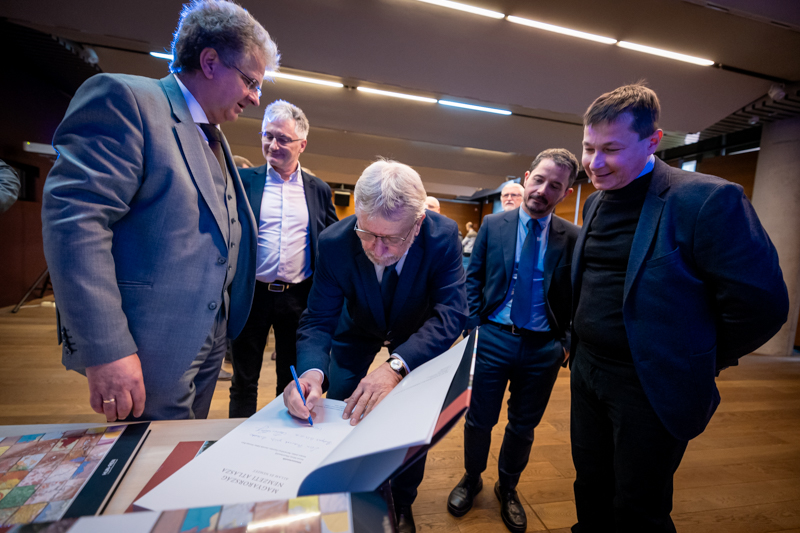
Prof. Dr. Zoltán Kovács, Professor at the University of Szeged’s Institute of Geography and Geosciences and Member of the Hungarian Academy of Sciences, signs copies as editor of State and Nation, part of the National Atlas of Hungary series – joined by the editor-in-chief and Szeged-based authors at the book launch event in Budapest, December 2024.
Photo by Ádám Kovács-Jerney
Original Hungarian article by Ferenc Lévai
Photo by Ádám Kovács-Jerney