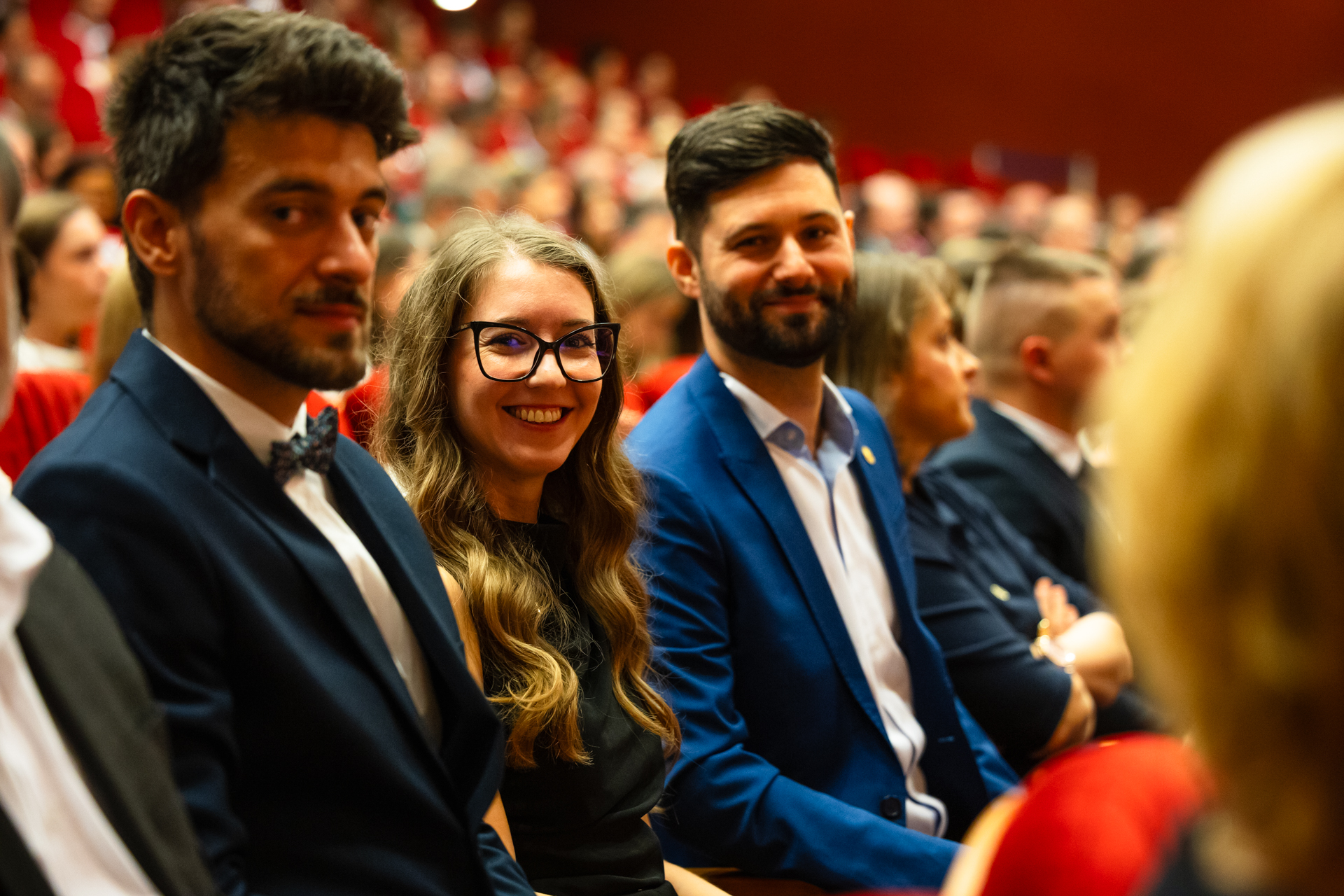
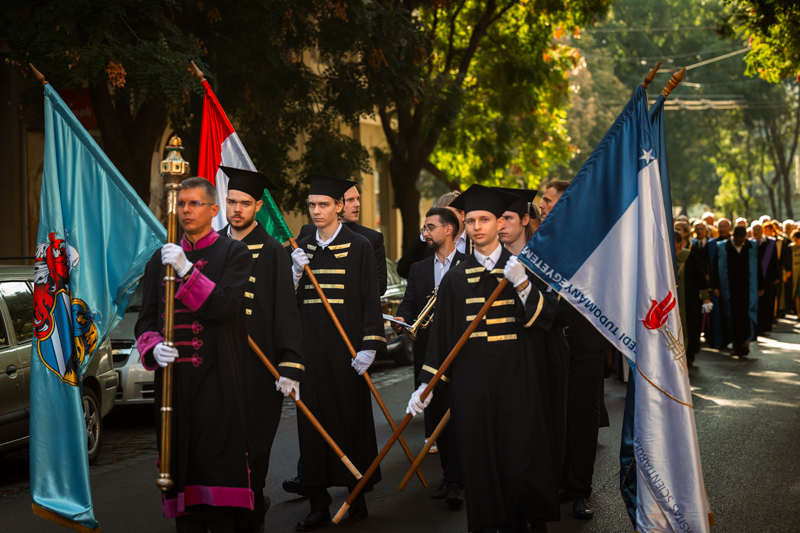
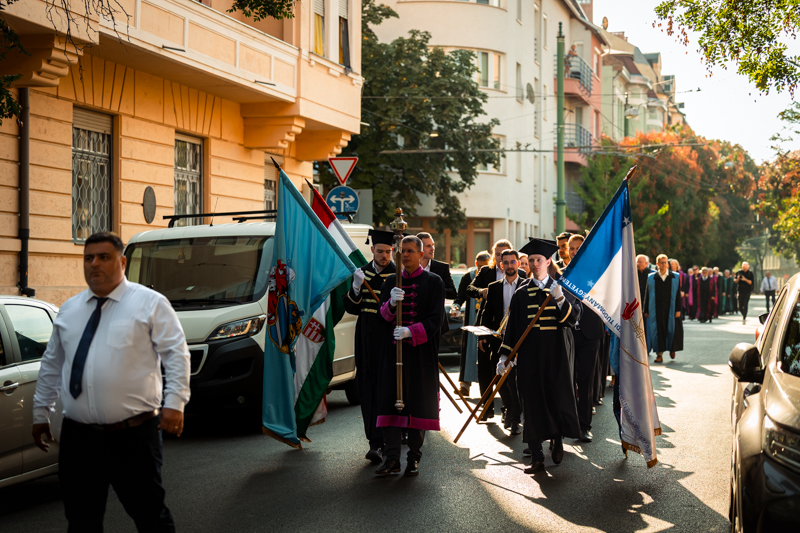
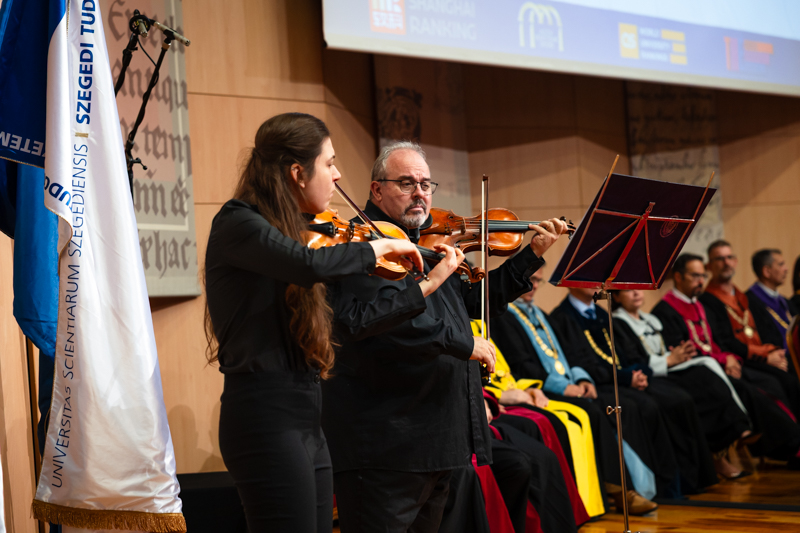
Escorted by a brass ensemble, the University of Szeged’s professorial procession made its way through the city center on Friday, September 5, marking the start of the 2025–2026 academic year. This was followed by the Senate’s ceremonial session in the Study and Information Center, where the university conferred high honors and outlined new international collaborations. The guest of honor was Csaba Lantos, Hungary’s Minister of Energy. In keeping with tradition, first-year students took their oath and were welcomed as members of the university community – with a handshake from the Rector.
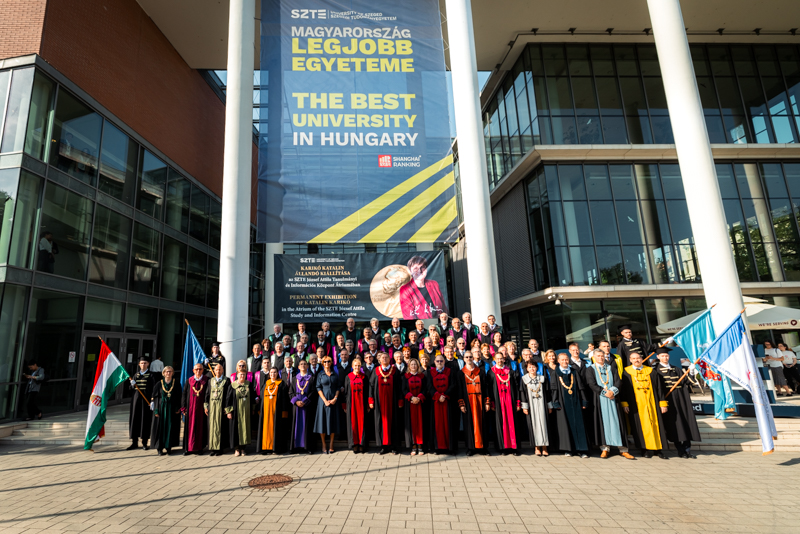
The University of Szeged opened the 2025–2026 academic year on Friday, September 5, with a ceremonial procession that set off from the Main Building on Dugonics Square and proceeded along an expanded route to the Study and Information Center (TIK). The professors marched under the university flag, alongside the European, Hungarian, and city flags, accompanied by a brass ensemble. The procession concluded with the participants gathering for a group photo in front of TIK.
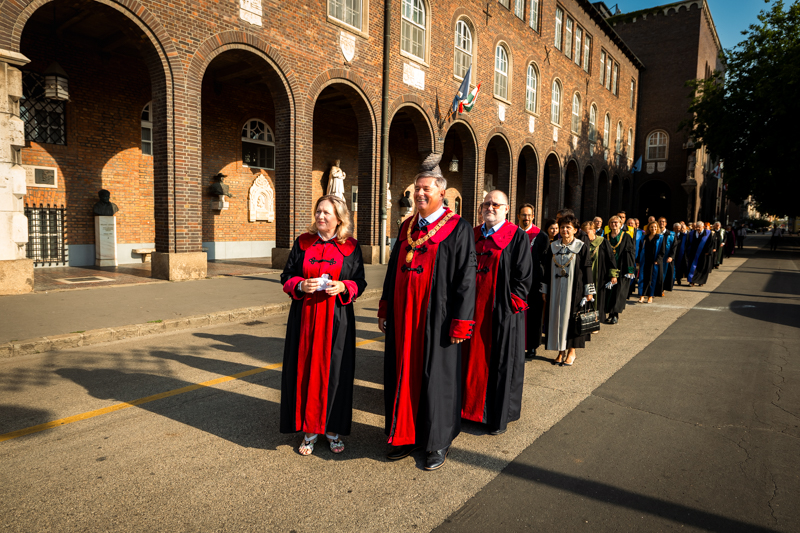 On September 5, the professorial procession proceeded along a new route, passing through Dóm Square to the sound of the musical clock marking the hour with a melody.
At 10:00 a.m., the university beadle’s ceremonial knock signaled the start of the Senate session in TIK’s packed congress hall. Guests at the head table included Energy Minister Csaba Lantos; Prof. Dr. László Rovó, Rector; Prof. Dr. Gábor Szabó, Chair of the Board of Trustees of the Foundation for the University of Szeged; Dr. Judit Fendler, Chancellor; and László Kiss-Rigó, the Bishop of Szeged-Csanád.
Among Hungary’s best in global rankings
“This past year carried forward a trend that has defined us for more than a decade – we achieved outstanding results in objective, reputable international rankings,” said Rector Prof. Dr. László Rovó. “In the Academic Ranking of World Universities (ARWU), the University of Szeged once again ranked first in Hungary and – uniquely among domestic institutions – placed within the world’s top 500.” He added that at the University of the Year 2025 gala, SZTE won first prize in the Innovation category. The Rector also highlighted a milestone for internationalization: nearly 1,500 new international students are starting their studies in Szeged this year – a 25 percent increase over last year.
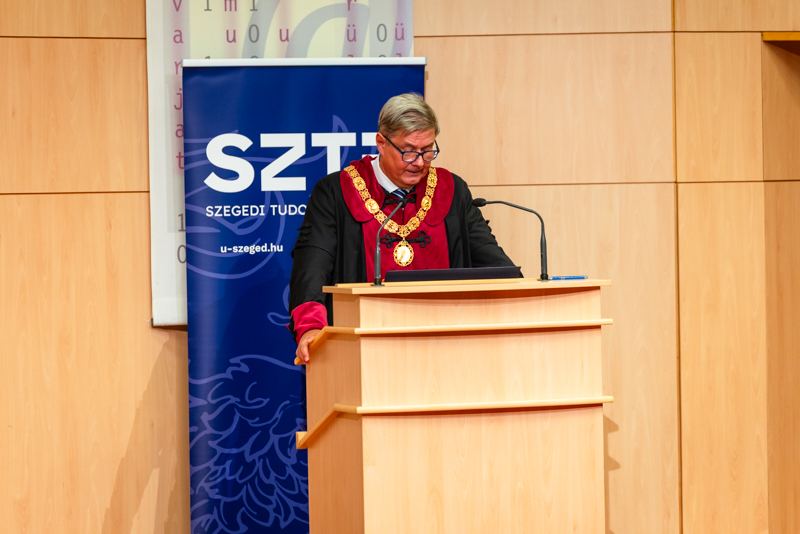
The number of international students at SZTE has grown by 25 percent year-on-year, the Rector noted.
Opening ceremony live streamed in China
When highlighting research and education ties, the Rector pointed to one of the university’s newest and most ambitious collaborations: a joint program with Shaanxi Normal University that sets a new standard for Hungarian–Chinese higher-education relations. “The four-year bachelor’s program starting in September includes three years in China and one in Hungary. This program, with national-level admissions, awards international degrees – a distinctive feature even in China,” he explained. The opening ceremony was live streamed to students in China, with the Rector extending special greetings both to them and to Prof. Dr. Péter Zakar, Vice-Rector for International and Public Relations, who is presently in China.
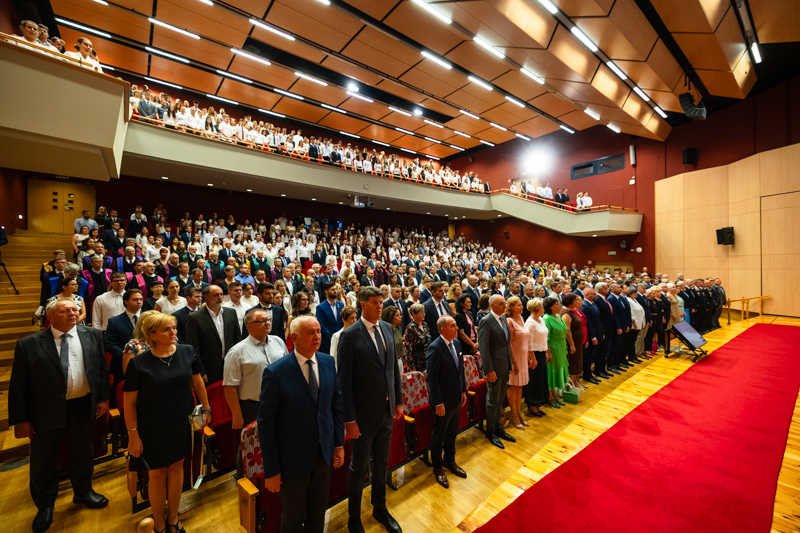
AI-Supported learning for everyone at SZTE
“We are a founding member of EUGLOH, a network of excellent European universities. We consider this alliance strategically important – it could even form the basis of a future European ‘super-university,’” Rector Rovó said. He went on to highlight SZTE’s personalized, AI-supported Coursera pathways, which allow members of the university community to take courses from the world’s leading universities and global companies free of charge.
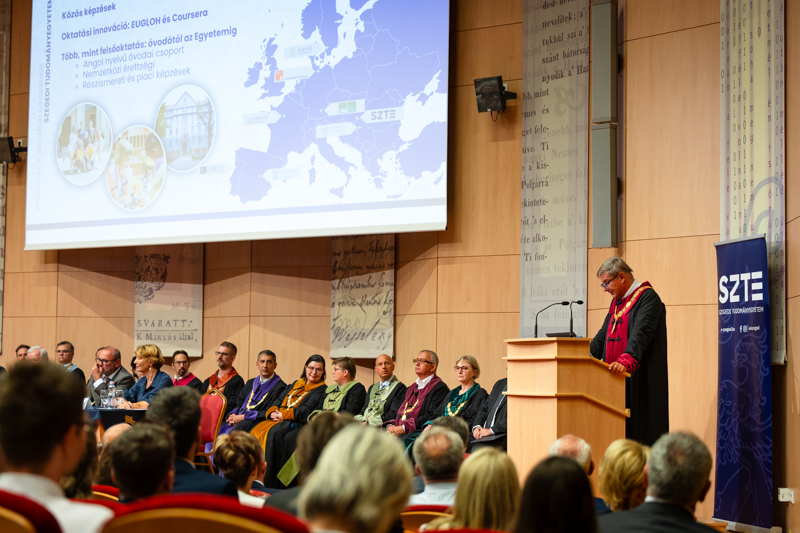 SZTE Rector László Rovó highlighted the university’s newest educational and research partnerships and infrastructure projects.
Advancing research
The Rector noted the university’s growing innovation visibility: the World Health Organization has asked SZTE to coordinate innovation activities across its European collaboration centers. In the same spirit, reflecting strong research performance and international standing, SZTE is also moving steadily toward full membership in the Pasteur Network.
“Research is inconceivable without modern infrastructure – and we have made major strides in this area over the past decade,” the Rector said. Among the highlights: a specialized animal facility opened in May with the support of Katalin Karikó, dedicated to mRNA technology development; the SZTE Biobank; a state-of-the-art supercomputer for AI research – still rare even in Europe; and the expanding Science Park. Coming in 2026: the Cryo-Electron Microscopy Instrumentation Center at SZTE. Cryo-EM will enable investigations at the level of biological samples, molecules, and complex structures – proteins, viruses, and other biomolecules – at resolutions available only at a handful of sites worldwide and unprecedented in Hungary.
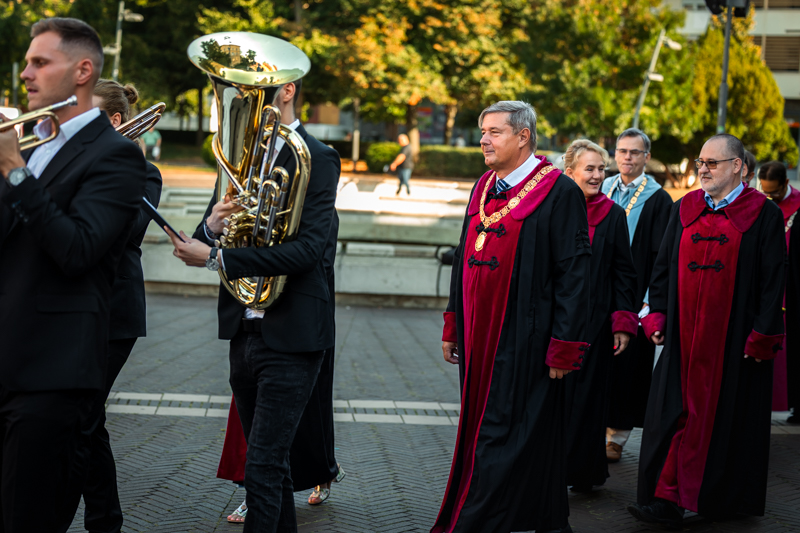  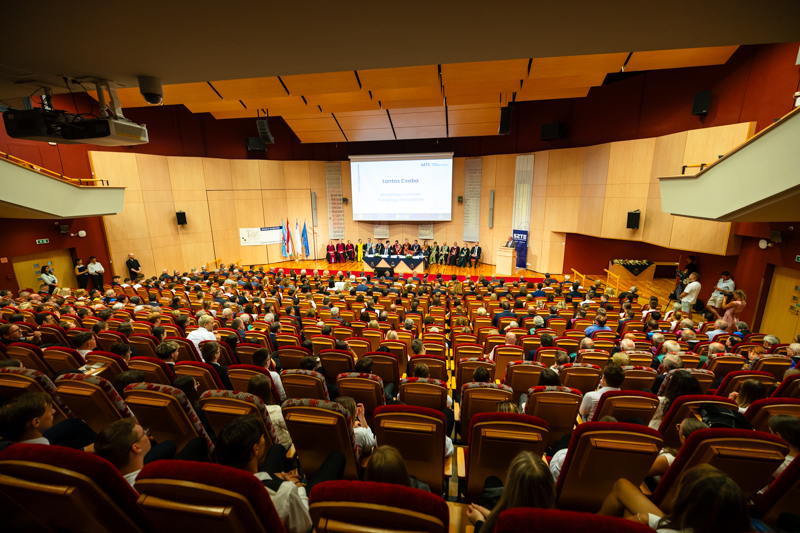  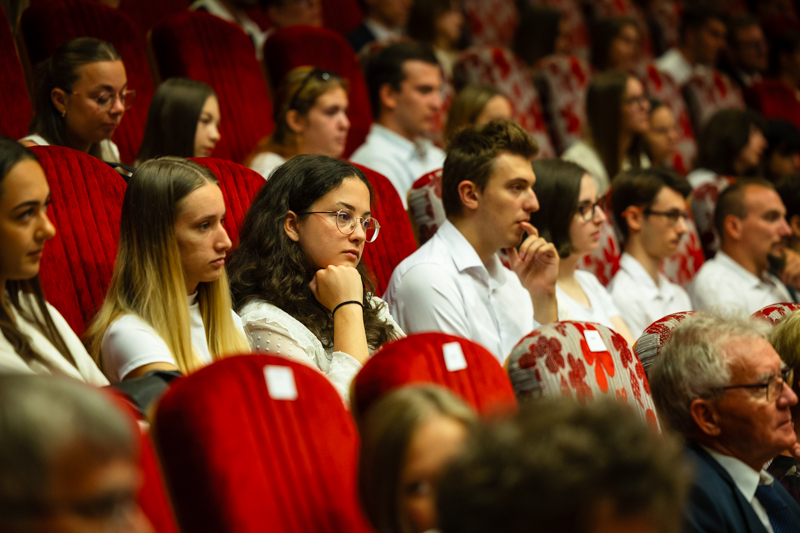 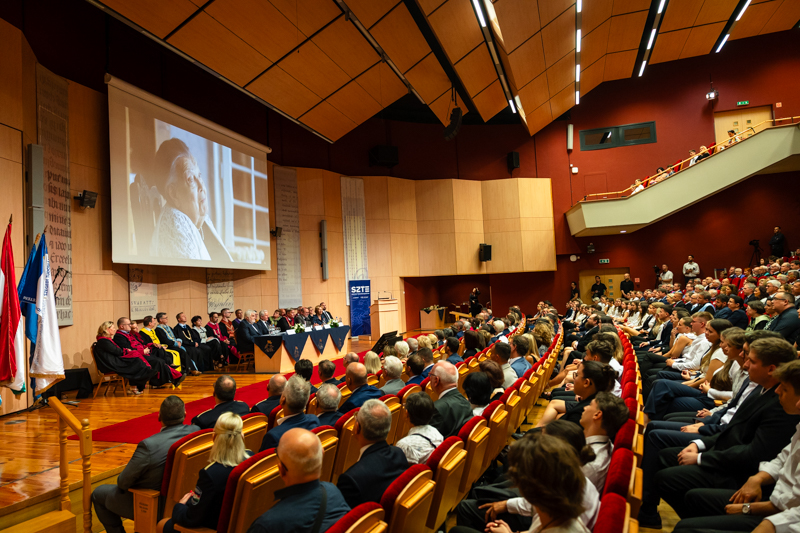  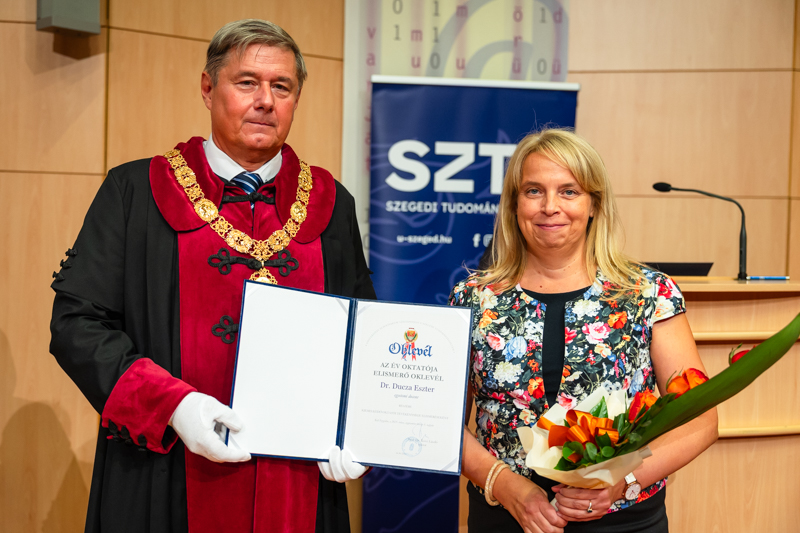  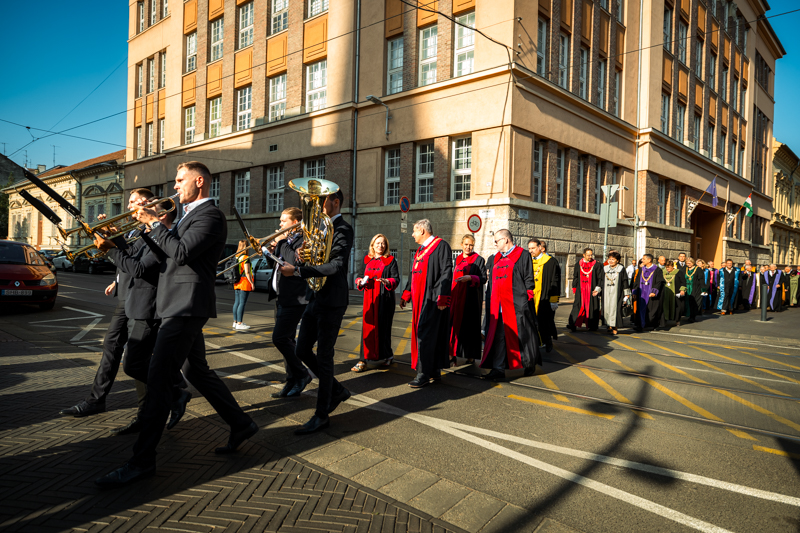 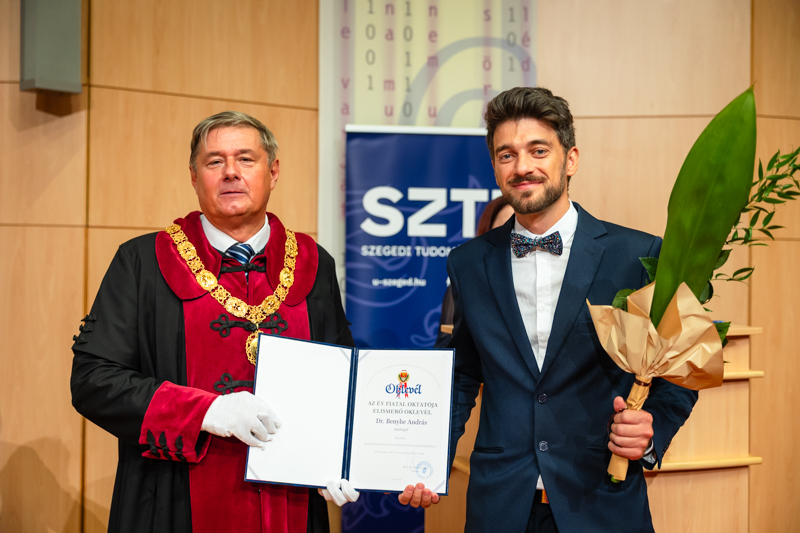 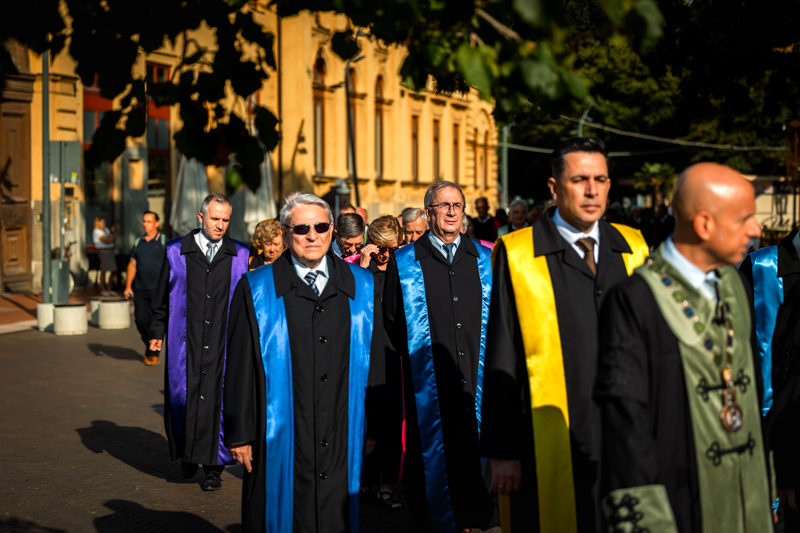 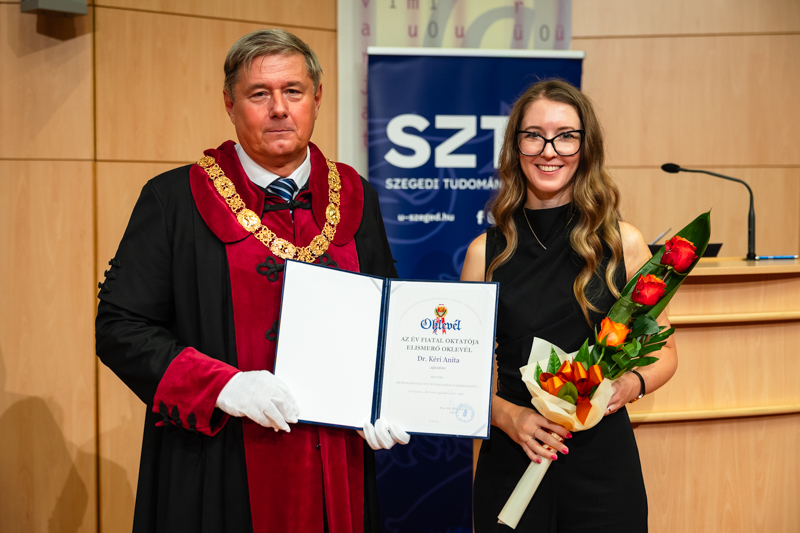  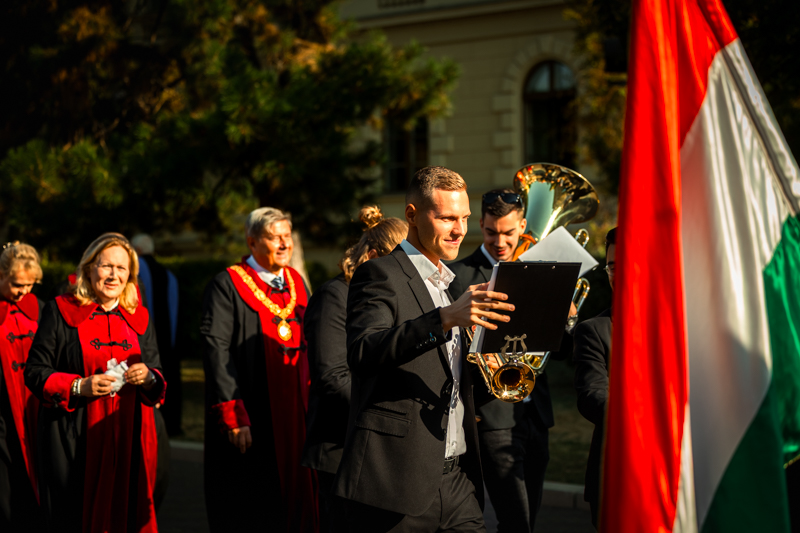  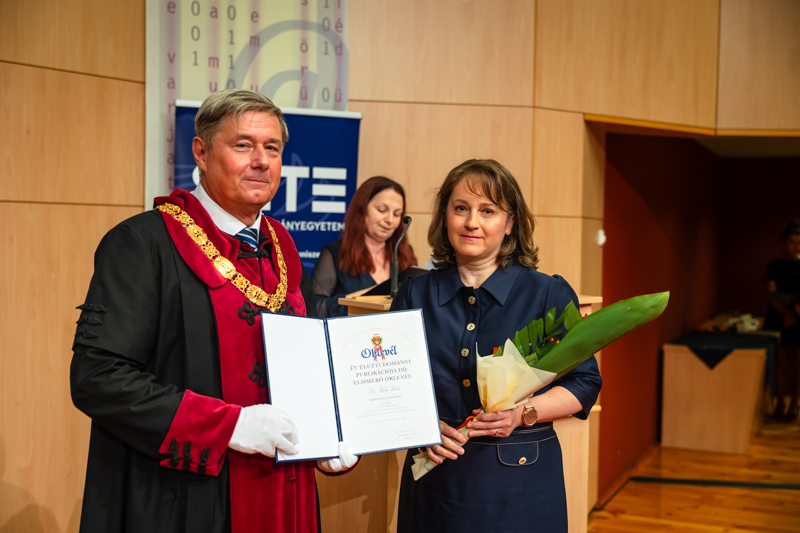  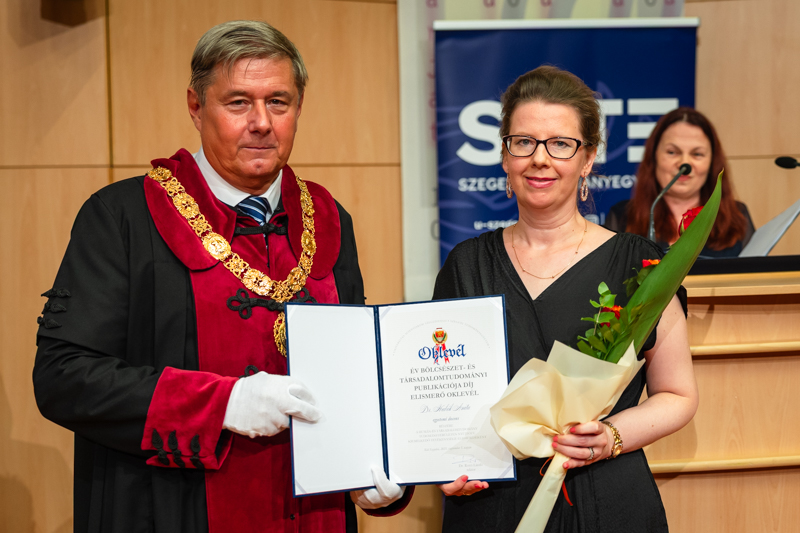 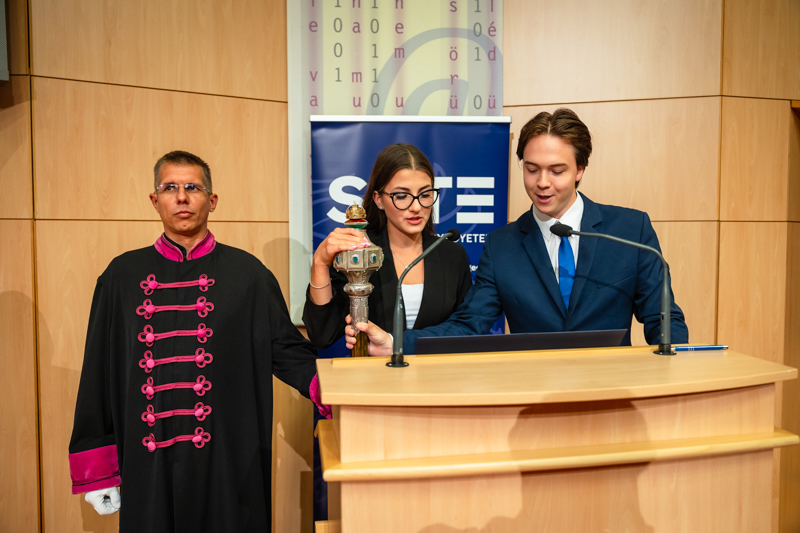  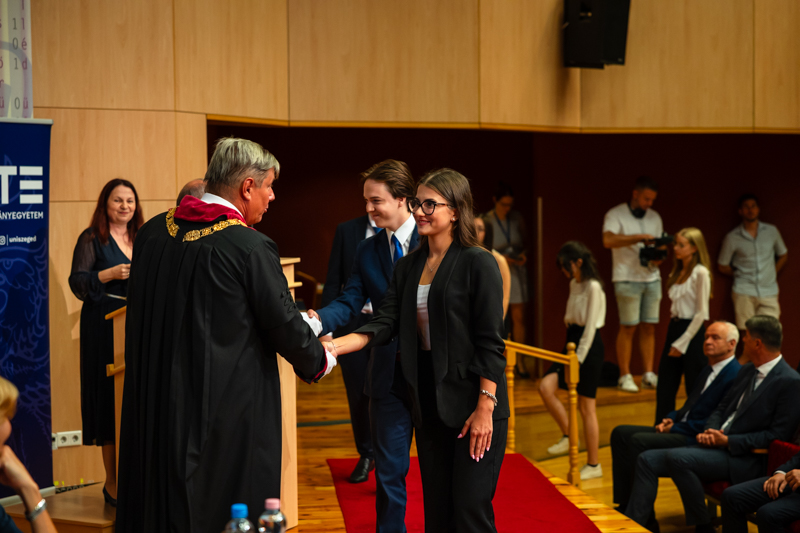 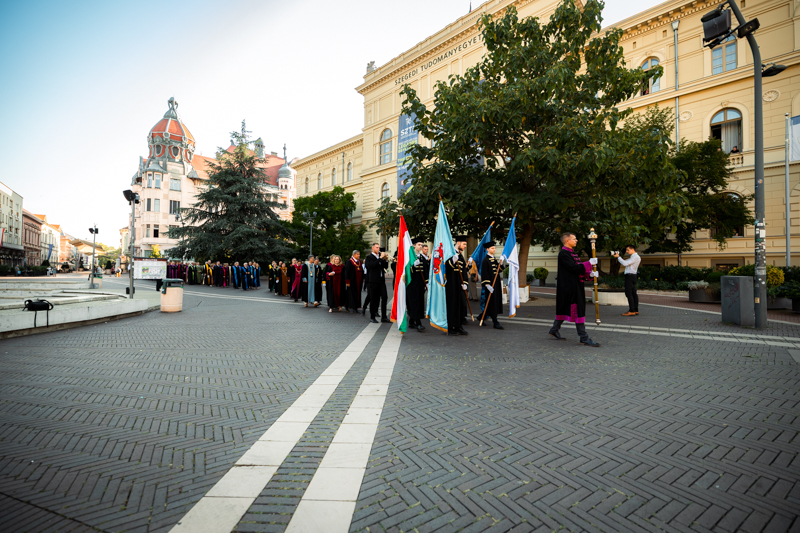 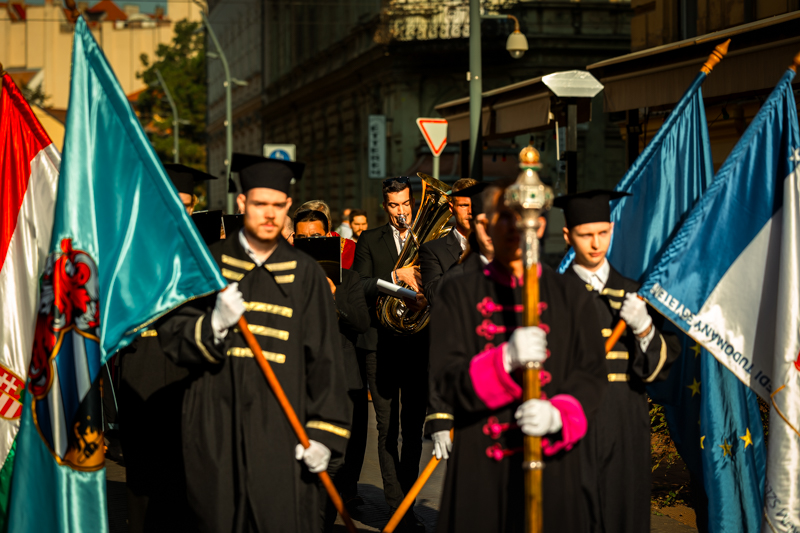 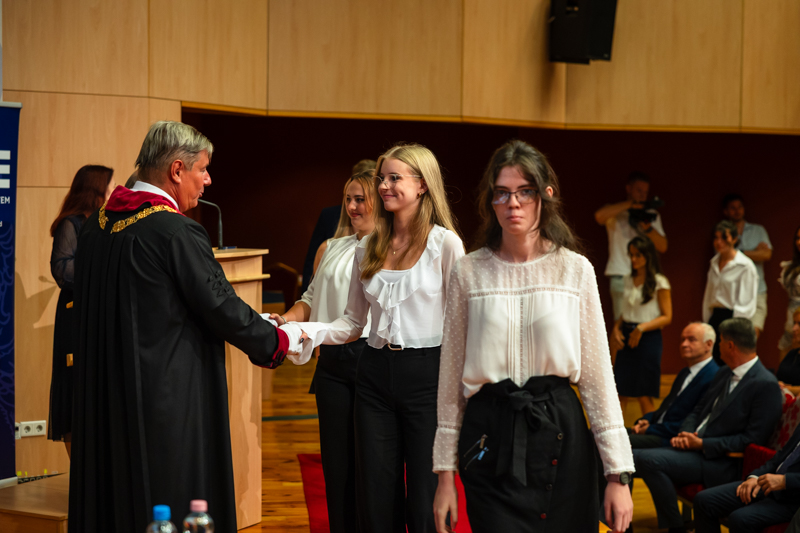   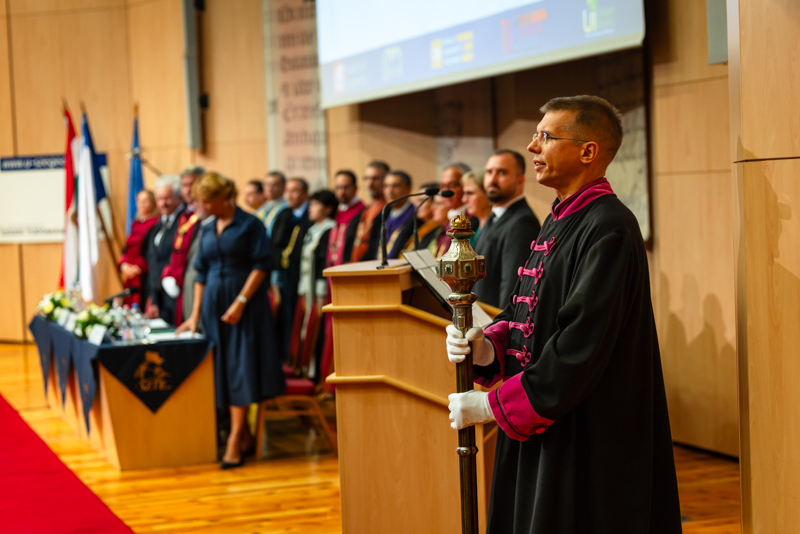 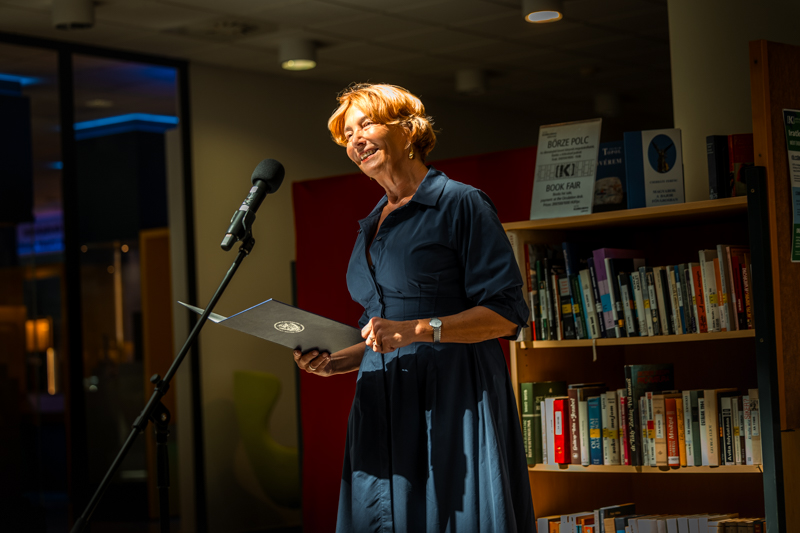 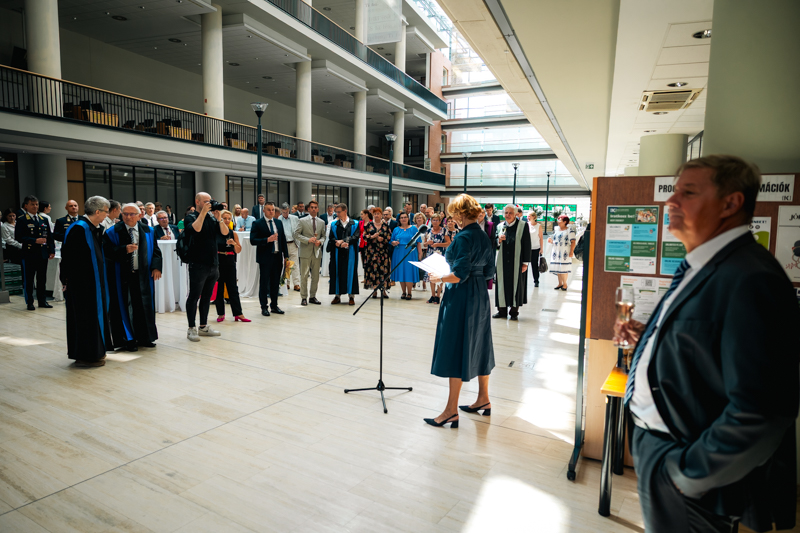  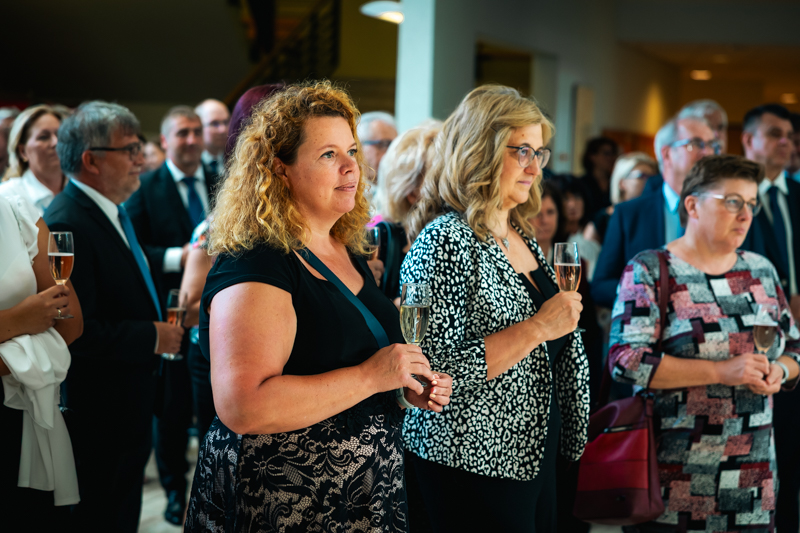 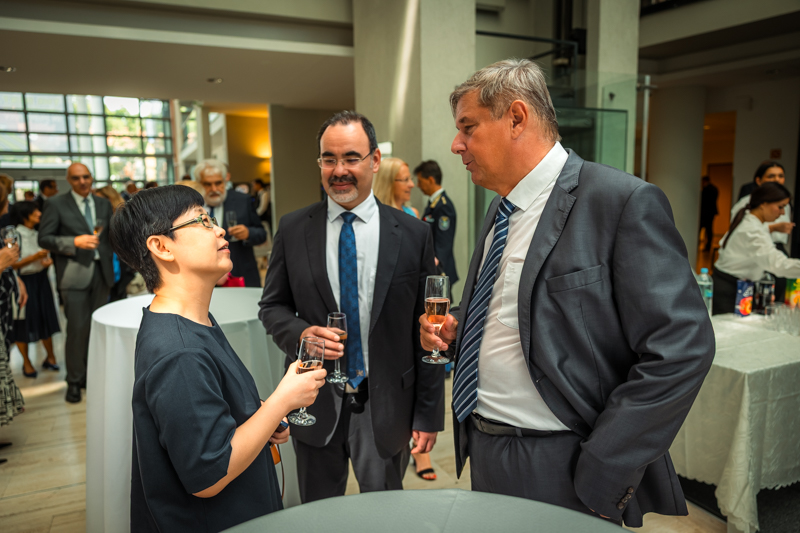  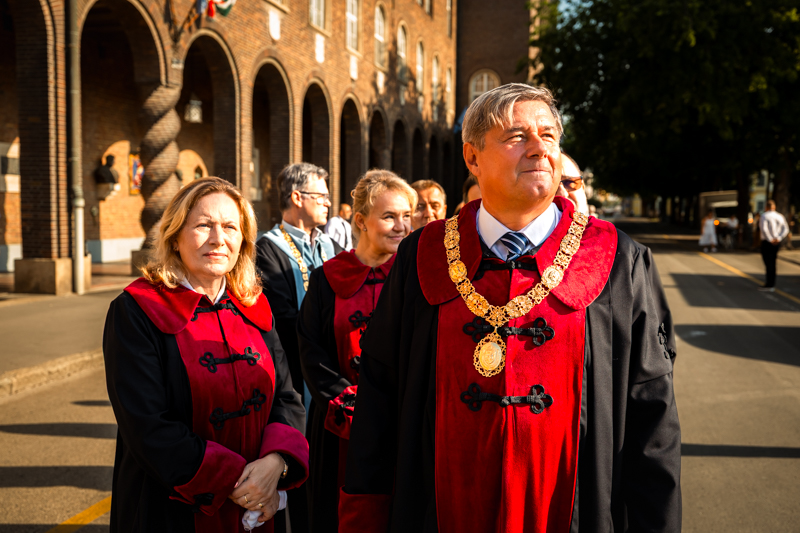      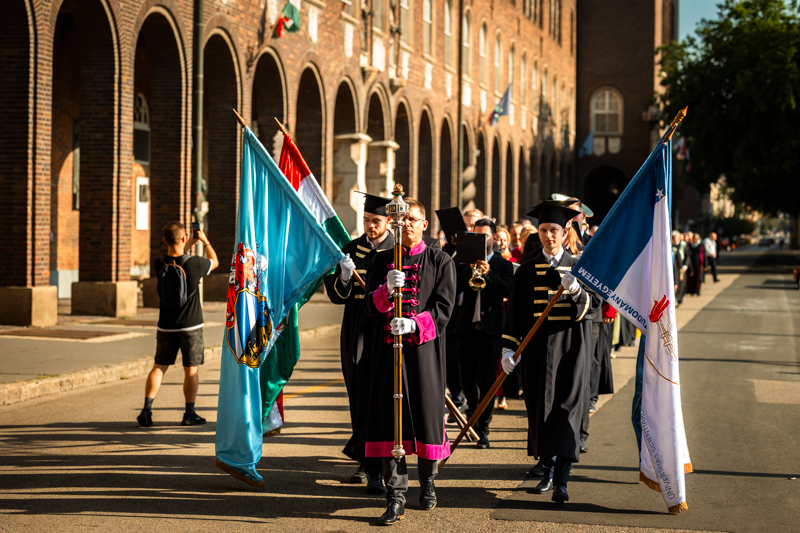 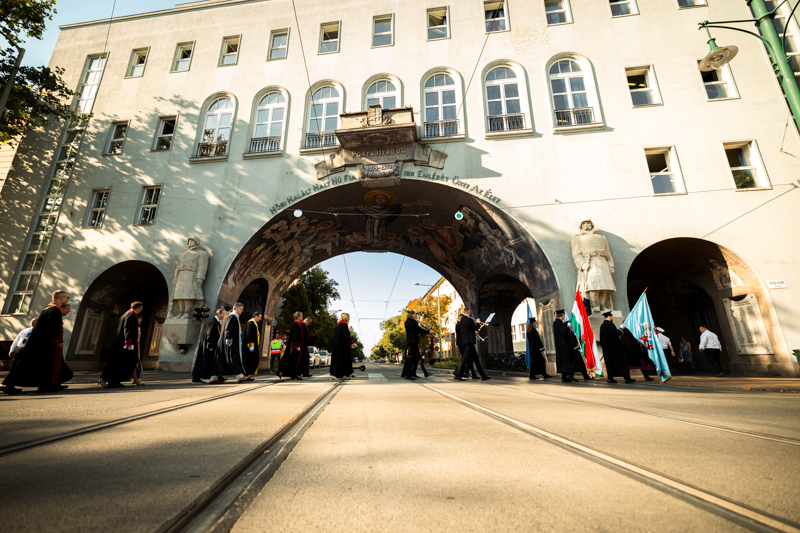  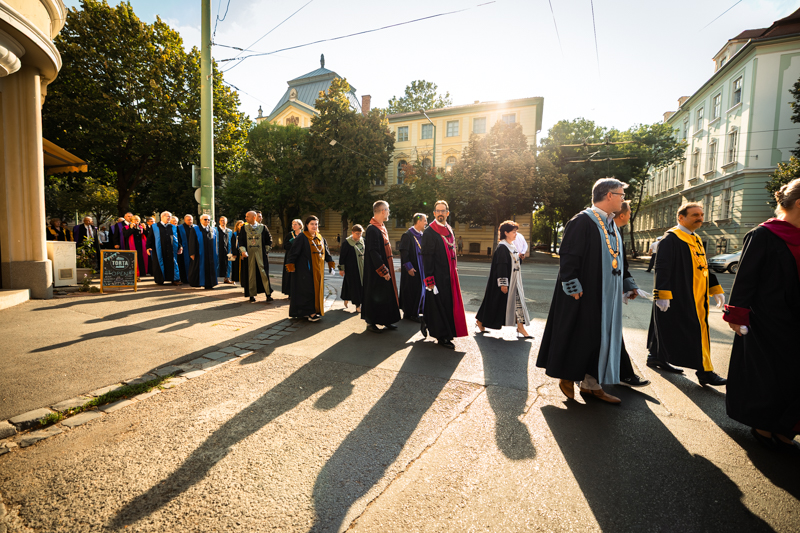          |
| Professorial procession in downtown Szeged and ceremonial Senate session at the University of Szeged on September 5, 2025 Photo Gallery: Ádám Kovács-Jerney and István Sahin-Tóth |
Minister Csaba Lantos on green energy
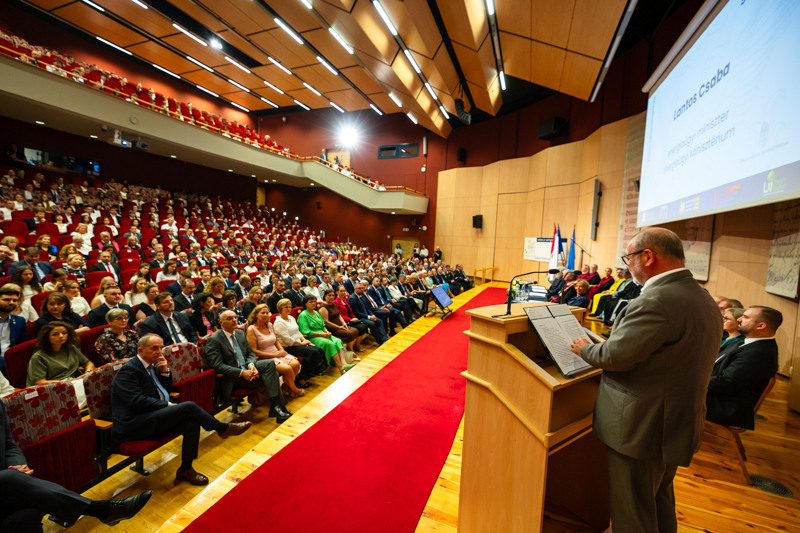
At the ceremonial Senate session, Energy Minister Csaba Lantos delivered the guest address. The minister – closely connected to several energy innovation and development projects at the University of Szeged – conveyed the Hungarian government’s appreciation to researchers whose work advances not only Hungarian but also global science. He emphasized that Kuno Klebelsberg, the minister of culture instrumental in founding the university in Szeged, was ahead of his time in maintaining that only research universities could be considered full-fledged institutions.
“That is why he brought Albert Szent-Györgyi back to Hungary, why he drafted the country’s first science policy, and why he supported science with every means at his disposal. He was also convinced that – in today’s terms – linking scientific research and development with the economy was the key to achieving real results. In this regard, the University of Szeged has since grown into a defining Hungarian institution in science, healthcare, education, and innovation, as well as a prominent player in international research and development,” the minister said.
 Minister Csaba Lantos: The University of Szeged has become a defining Hungarian institution in science, healthcare, education, and innovation.
Minister Csaba Lantos also stressed that the research-driven, innovative mindset at the university also calls for excellent teaching, since students are being prepared for a future the contours of which are only just beginning to emerge. This is an enormous responsibility, the minister explained, as students must be equipped with knowledge that will allow them to stand their ground amid rapid change. The minister also praised the University of Szeged’s successful green-energy development projects.
“According to our conservative government, research and development, education, boosting economic competitiveness, and the swift, effective resolution of energy and water-management challenges must go hand in hand. A key goal in the transition to a green economy is not only the production but also the storage of renewable energy. We are convinced that this is how we can ensure our future success. Indeed, Hungary already has strong results to show, particularly in solar power. Last year, solar accounted for 25 percent of all electricity generated in the country – placing Hungary first in the world. Hungary now exports electricity in a green way. The challenge, however, is to store this energy so it can also be used for domestic consumption in the evening. That is the direction we are taking, and we are launching numerous programs to support it. The major initiative of the next decade will be energy storage. I am proud that, with the support of my ministry, the SZTE Science Park has received 24 billion forints in funding, enabling new developments in green-energy storage.”
Prof. Dr. Gábor Szabó: Not just graduates – intellectuals
“Allow me to address first and foremost our new students,” began physicist Prof. Dr. Gábor Szabó, Pro-Rector of the University of Szeged and Chair of the Board of Trustees of the Foundation for the University of Szeged. “At this opening ceremony, you were not called ‘storks’ – the traditional Hungarian nickname for first-year students. And with good reason! Storks are not particularly intelligent, and their migratory habits are of questionable value. I do, however, like the American English term freshmen, because it suggests that you bring fresh energy and fresh strength to the university community – and that is something we need very much.”

“First-year students bring fresh energy and fresh strength to the university community”, said Prof. Dr. Gábor Szabó, Chair of the Board of Trustees of the Foundation for the University of Szeged.
Prof. Dr. Gábor Szabó emphasized that a good university is built on collaboration between researchers, teachers, and students. “No one can – and no one should – attempt to teach you passively what must be learned at university. Success is only possible if you actively engage. At the best universities, it is often the students themselves who inspire their teachers to go further and share more of their expertise,” he said.
And how can we tell if a university is truly good? Prof. Szabó suggested that one need only look at the University of Szeged’s website. The reports there showcase the breadth of the institution’s scientific life: a major physiology conference in Szeged; an international symposium on Altaic studies; a climate-change research group’s conference; an archaeogenetic discovery linking Sarmatians near the Urals with those who migrated to the Carpathian Basin; an award-winning biology student project shedding light on genetic factors behind human infertility; a thank-you letter from a grateful patient to the Department of Ophthalmology; and the fact that SZTE once again ranked as Hungary’s top university in the ARWU list. Together, these examples capture the rich diversity of the University of Szeged’s research, teaching, and community life.
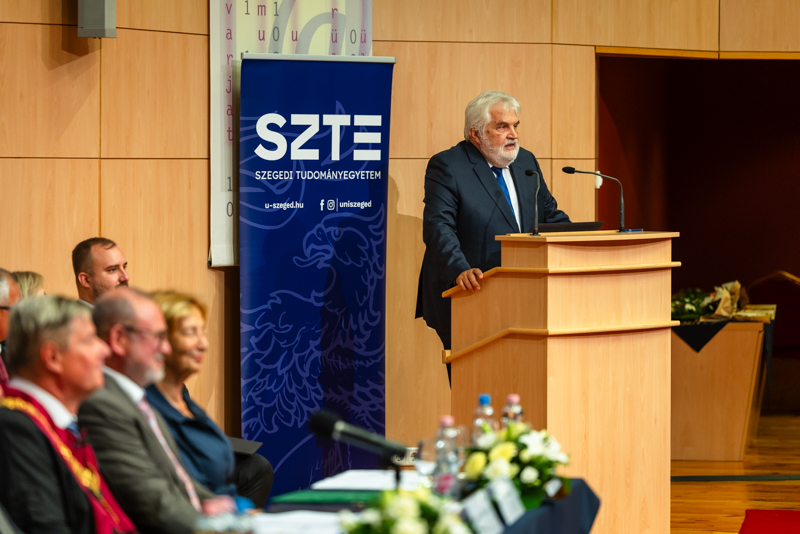 “Within the University of Szeged there is a ‘small international city,’ so students need not travel far to put their English skills to the test,” noted the university’s former Rector.
Prof. Dr. Gábor Szabó pointed to the 25 percent increase in international students at the University of Szeged this year as an expansion of opportunities.
“Take advantage of the fact,” he told the first-year students, “that some 5,000 international students live in Szeged! Within the university there is a small international city. You don’t have to travel far if you want to put your English skills to the test. And it is worth testing them – better to try your English in a pub, among peers, than to attempt it for the first time at a conference, which could lead to some awkward surprises. The University of Szeged offers this potential – make use of it! Another great advantage is the diversity of fields represented here. Students and teaching staff alike are engaged in so many areas that you can meet well-prepared people in virtually any discipline.”
In closing, Prof. Dr. Gábor Szabó directly addressed the students of the University of Szeged: “As a parting thought, older generations usually tell young people things they themselves never followed. Still, I urge you: when you graduate, do not be content with simply holding a degree – become intellectuals.”
A message from SZTE’s first female department head, now 100
Alongside the ceremonial speeches and honors, the occasion also featured a special greeting: a video message from Dr. Ilona Béládi, the University of Szeged’s first female department chair, who recently turned 100. Appointed in 1974 at the predecessor of today’s Albert Szent-Györgyi Medical School, she led the Institute of Microbiology for two decades, advancing virus and interferon research with lasting practical impact. In her centenary message, Professor Béládi urged students and professors to “recognize what truly interests them and pursue it – then work becomes a joy rather than a duty.”
Honors for instructors and publications of the year
At the opening Senate session, the university also presented its annual awards.
The traditional handshake
In keeping with tradition, at the ceremony opening the 2025–2026 academic year, first-year students took their enrollment oath before the Senate and the body of professors. The oath was read by Anna Kádár, a first-year student at the Faculty of Law and Political Sciences, and Kristóf Tamás Nagy, a first-year student at the Albert Szent-Györgyi Medical School. The young people beginning their university studies were then welcomed into the university community with a handshake from the Rector.
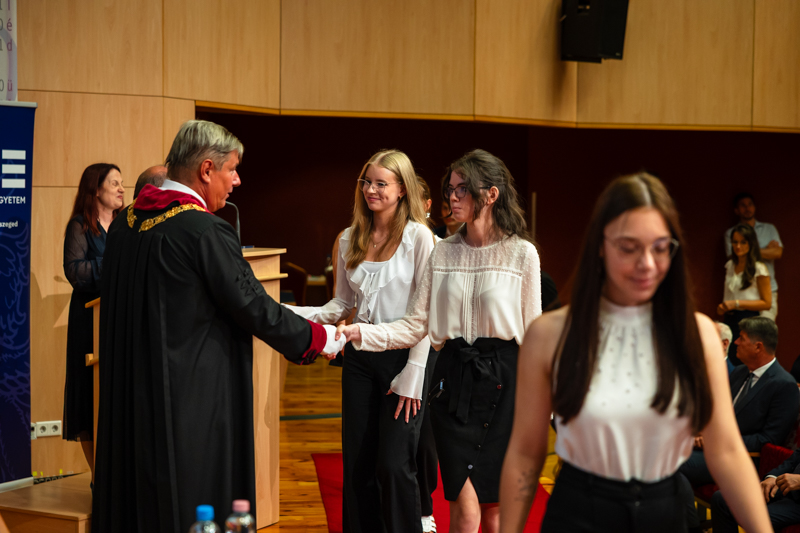 I hereby admit you as students,” said Professor László Rovó as he formally welcomed the first-year students into the university community with a handshake.
SZTE offers both knowledge and support
“This day marks not only the beginning of a new academic year, but also the opening of a defining chapter in your lives,” said Sándor Szentesi, President of the University of Szeged’s Student Union (EHÖK), in his address to first-year students. “From now on, you are not just students – you are members of a community built on knowledge, openness, diligence, and solidarity. In the years ahead, you will not only learn but also make friends, build communities, and shape both your own future and that of our university. I know that at the start of this journey you may have many questions, but I assure you: the University of Szeged provides not only knowledge, but support as well. The leadership of the university, the faculties, and the Student Union are all working to ensure that your years here are memorable and rich in experience. My wish for you is that you have the courage to seek new opportunities, the confidence to learn from mistakes, and the faith that here in Szeged you can bring out the very best in yourselves.”
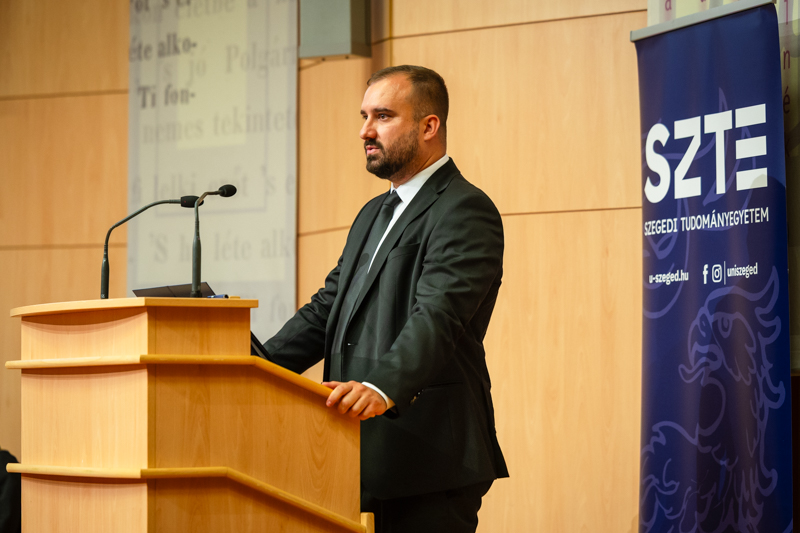
Sándor Szentesi, President of the University of Szeged Student Union (EHÖK), also greeted the first-year students in the congress hall of SZTE’s Study and Information Center.
Dr. Judit Fendler: Continuous adaptation is our greatest strength
After the opening ceremony, a reception was held in the grand atrium of TIK, where Dr. Judit Fendler, Chancellor of the University of Szeged, delivered a toast.

Chancellor Dr. Judit Fendler and Rector Prof. Dr. László Rovó. At her tenth academic year opening ceremony, the Chancellor emphasized that SZTE continues to achieve its goals even in unpredictable and uncertain times – thanks to the shared efforts of its community.
“The Rector’s speech, the achievements of our honorees, and the enthusiasm and expectations of so many talented new students give us tremendous strength to begin the coming academic year with even greater momentum. We have plans, concrete goals, and indicators – some we set for ourselves, others we must meet in order to remain financially sound. Some of these overlap, and of course there are smaller successes not even worth mentioning here. But for me, the greatest success is that the university stands together. This is my tenth academic year opening. If I were to list all the external and internal factors that could have diverted us from our upward path, we would still be here listening tomorrow. Concepts and promises have come and gone, as have crises, reorganizations, and changes in paradigms and governance models. Yet I can say, quoting the poet Attila József – whose statue stands just a few hundred meters from us, in front of our main building – ‘We are guided by excellence from within.’ This work is also a responsibility. The oft-quoted words of Albert Szent-Györgyi’s inaugural address already define our mission – with no need for indicators: ‘The task of the University of Szeged is to be the intellectual center of the Hungarian Great Plain – not only to teach, but to guide society as well.’ Indeed, we are continuously adapting, even in a context that modern management literature describes with the acronym VUCA: volatility, uncertainty, complexity, and ambiguity. And this is where we are strongest. Every indicator and every partner’s feedback attests to it. So, I wish to thank each and every member of our university community for bringing us this far, and my only wish is that the trend may continue. We run and do not tire; we walk and do not grow weary,” said the Chancellor of the University of Szeged.
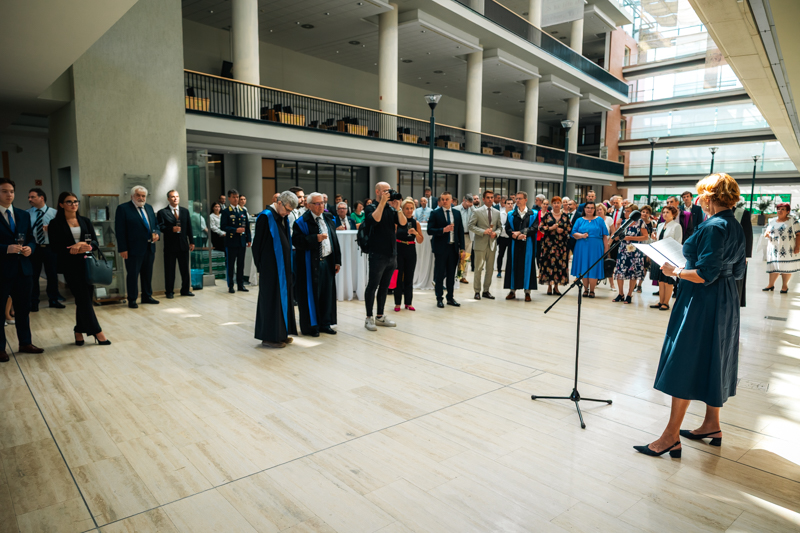
“Continuous adaptation is our strength – every indicator and partner’s feedback attests to it,” said Dr. Judit Fendler.
Original Hungarian text by Sándor Panek and Imre Vida-Szűcs
Photos by Ádám Kovács-Jerney and István Sahin-Tóth