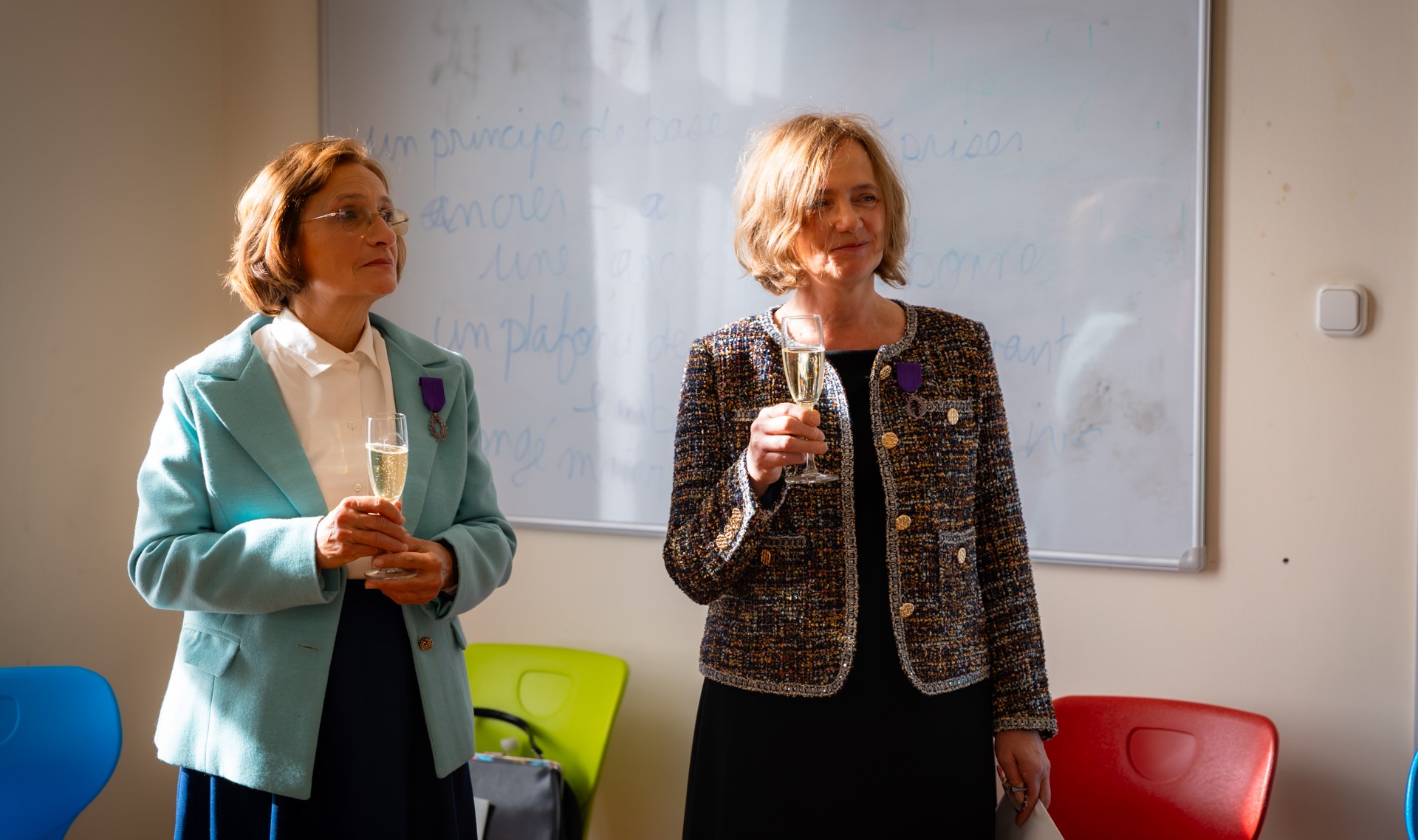
At the Francophone University Center of the University of Szeged, literary scholar and associate professor Timea Gyimesi, Head of the French Department at the Faculty of Humanities and Social Sciences, and Ildikó Farkas, specialist interpreter and retired senior assistant professor at the department, received the Knight’s Rank of the French Order of Academic Palms from Jonathan Lacôte, Ambassador of France to Hungary.
Two staff members of the University of Szeged’s French Department – Timea Gyimesi, head of department and habilitated associate professor, and Ildikó Farkas, specialist interpreter and retired senior assistant professor – have received the Knight’s Rank of the French Order of Academic Palms, a French state honor. The distinction, awarded to the two scholars for promoting the French language and culture, was presented by Jonathan Lacôte, Ambassador of France to Hungary, at a ceremony held at the Francophone University Center of the University of Szeged. The event was also attended by Matthieu Berton, Cultural Counsellor at the French Embassy and Director of the French Institute in Hungary, as well as Maud Launay, Attaché for Educational Cooperation.
The three ranks of the Order of Academic Palms are awarded to French and foreign individuals who have made exceptional contributions to the promotion of the French language and culture throughout their careers. Within the professional circles of the French Department of the University of Szeged and its partner institutions – the academic community that forms Szeged’s francophone scene – a remarkably high number of scholars, linguists, and literary researchers have been honored with this French state distinction to date.
Szeged-based recipients of The Knight’s Rank of the Order of Academic Palms include Mária Lovas, staff member of the Alliance Française; Péter Kruzslicz, Director of the Francophone University Center; secondary school teachers György Józsa, Beáta Pignitzky, and Dezső Kiss from the university’s affiliated high school; anthropologist György Pálfi for his work with the Alliance Française; as well as several instructors of SZTE’s French Department – Jenő Újfalusi Németh, Sándor Albert, and Zsuzsanna Gécseg. The Officer’s Rank of the order was previously awarded to Miklós Pálfy, Olga Penke, and later Géza Szász, while the highest distinction, the Commander’s Rank, was conferred on Sándor Csernus, medievalist and former director of the Hungarian Institute in Paris. These distinctions demonstrate that the French government continues to recognize and value Szeged’s francophone community – especially the work of the French Department, which plays a key role in fostering the French language and culture.
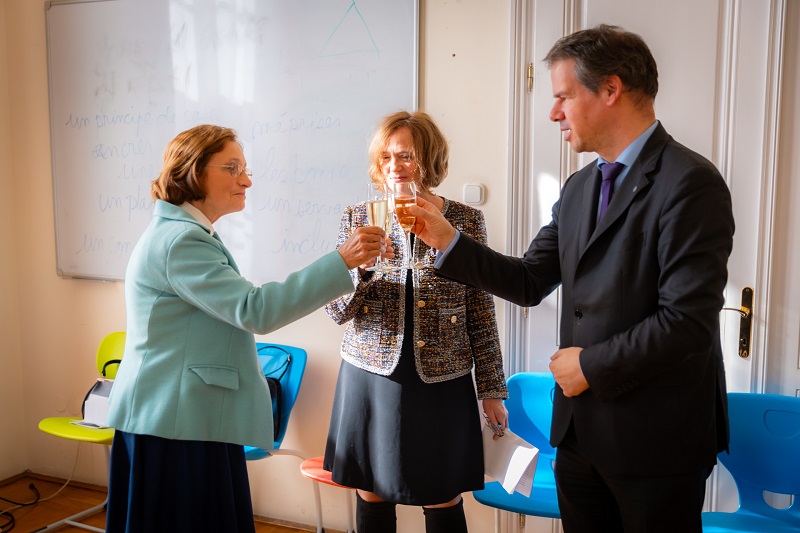
Jonathan Lacôte, Ambassador of France to Hungary, extends his greetings to Ildikó Farkas and Timea Gyimesi.
Photo: Ádám Kovács-Jerney
The Order of Academic Palms was established by Napoleon I in 1808 to recognize excellence in French higher education. Since 1955, the decoration of the order – a silver insignia symbolizing laurel branches and suspended from a deep purple ribbon – has been awarded to individuals by the French Minister of Education.
Ildikó Farkas: “The French-speaking world has opened up to us.”
In his laudation, French Ambassador Jonathan Lacôte first praised the work of Ildikó Farkas: “Her approach has profoundly influenced her students, teaching them to value precision, appreciate subtlety, and respect the complexity of language. These are the very qualities that define the distinguished French humanities tradition in Szeged – a tradition to which Ildikó Farkas has contributed so greatly,” he said in a speech delivered in both French and Hungarian. “Faithful to her discreet, refined humanist convictions, she embodies everything the Order of Academic Palms aims to honor: the transmission of knowledge, rigor, passion, and unwavering service to the French language – always without seeking the spotlight,” Jonathan Lacôte added as he described the recently retired instructor of the University of Szeged’s Faculty of Humanities and Social Sciences.
From 1983 until her retirement, Ildikó Farkas served as an instructor in the French Department of the University of Szeged. For many years, she also worked as a civil servant at the Hungarian Translation Unit of the Council of the European Union. Her areas of professional focus include EU terminology – with English and French as source languages – as well as the impact of the translation-aid software Trados on Hungarian-language EU texts. In addition to linguistic subjects, she taught French–Hungarian and Hungarian–French translation and interpreting at the university, collaborated with Szeged-based joint ventures, and also engaged in literary translation.
“What motivated me? Primarily the students. I was constantly learning from them. I often told them that, in my view, the best way to learn is by teaching. Their questions were always important. It is also striking how many more questions international students tend to ask. Unfortunately, the impact of Prussian-style traditional Hungarian education is still quite evident among Hungarian students – they just sit quietly while the professor imparts knowledge from the podium,” Ildikó Farkas explains.
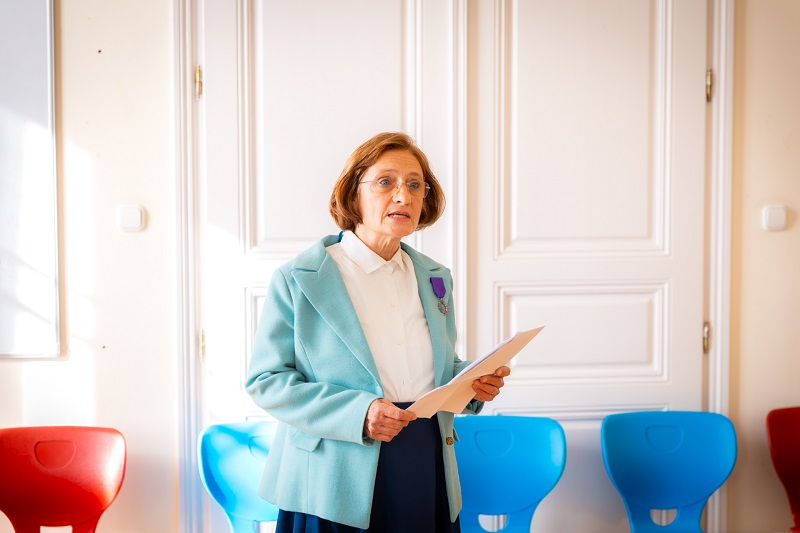
Ildikó Farkas, specialist interpreter and retired senior assistant professor of the University of Szeged’s French Department
Photo: Ádám Kovács-Jerney
As for Ildikó Farkas’s commitment to the Francophone world, in 2019 she and Zsuzsanna Gécseg jointly developed the linguistic component of the Francophonie in the Digital Age specialization at the University of Szeged’s French Department, which has remained an integral part of the curriculum ever since.
The specialization aims to explore the cultural and social heritage of European and non-European Francophone regions by examining information creatively, along with the cultural, social and economic knowledge produced in today’s media environment. The program not only strengthens students’ competence in the ‘standard’ form of French used in France but also broadens it by introducing them to the linguistic varieties spoken in Francophone regions such as Belgium, Switzerland, Canada, the French overseas departments, and Africa.
“It was quite a challenge for me to develop this curriculum, as we essentially had to build it from scratch. Of course, it was also highly stimulating from a scholarly perspective – I learned a great deal in the process. And it was definitely worth it, because I discovered that students are genuinely interested in the varieties of French spoken across today’s Francophone regions. The French-speaking world has opened up to us,” says Ildikó Farkas.
Recalling the beginnings of her own French studies, Ildikó Farkas notes:
“In the early 1960s, French language instruction was already permitted in Szeged. My parents enrolled me at the ‘Ságvári Primary School’ (now SZTE’s Báthory István High School and Primary School for Teaching Practice), where we were taught by an excellent French teacher, Gábor Nemes. When I moved on to secondary school, my teacher was Béla Kovács, who had previously been a Premonstratensian monk – a truly charismatic figure. He was very strict about ensuring that we learned everything thoroughly, and he was also an outstanding community organizer – qualities later highlighted in a documentary by Mónika Kiss-Stefán. Under Béla Kovács’s guidance, pursuing a French major became a natural path for me. By then, French culture already held a certain appeal in Szeged: many families believed it was valuable for their children to speak French.”
Timea Gyimesi: “A well-crafted sentence can open up new worlds for students.”
In his laudation at the presentation of the Order of Academic Palms, French Ambassador Jonathan Lacôte addressed Associate Professor Timea Gyimesi, Head of the French Department, with the following words:
“With this distinction, the French Republic honors more than 35 years dedicated to promoting the French language and advancing scholarly reflection on it. The award is also an expression of gratitude to a university instructor who, since 1989, has helped make the University of Szeged one of Central Europe’s leading centers for French-language studies.”
The ambassador also highlighted Timea Gyimesi’s four books, drawing particular attention to her 2023 essay collection Elmozdulások és riturnáliák a kortárs francia és magyar irodalomban (Shifts and Recurring Motifs in Contemporary French and Hungarian Literature), which he described as a patient search for resonances between the two cultures.
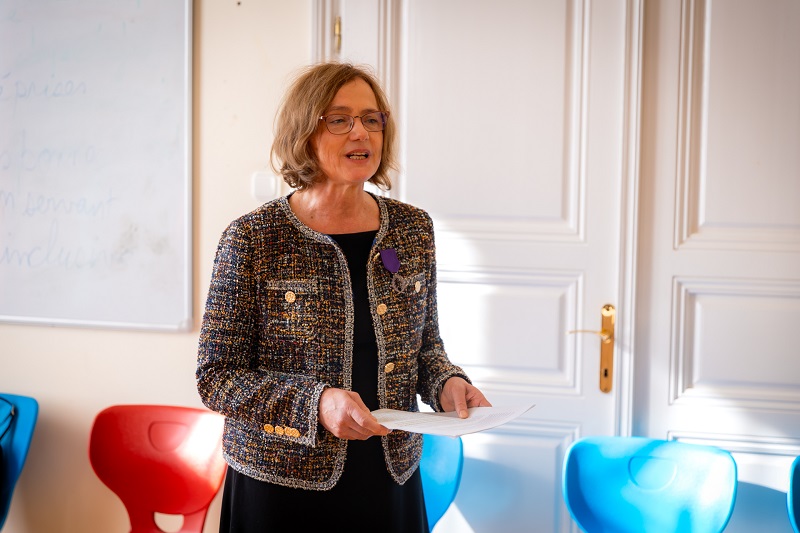
Timea Gyimesi, literary scholar, associate professor and head of the University of Szeged’s French Department
Photo: Ádám Kovács-Jerney
“Your dynamism,” the Ambassador continued, addressing Timea Gyimesi, “has significantly strengthened Hungary’s scholarly presence in the Francophone world. Since 2015, you have organized several international conferences in Szeged – on Gilles Deleuze on the themes of speed, attention, and perception; on the relationship between humans and machines; on literature as a paradigm; and, most recently, on empathy in the arts and in literature. Each of these has opened space for meaningful dialogue among researchers from France, Belgium, Germany, Spain, Canada, and Central Europe.”
“Your career reflects a profound commitment to the French language and culture, paired with a rare openness to fostering dialogue between intellectual traditions and to training young researchers who can ‘think’ in both Hungarian and French. Your work has built a lasting bridge between our countries. France is deeply grateful to you!” Jonathan Lacôte concluded.
Associate Professor Timea Gyimesi studied French language and literature, Hungarian language and literature, and comparative literary studies at the József Attila University (a legal predecessor of SZTE) between 1983 and 1989, then joined the faculty there upon completion of her studies in 1989. From 1990 to 1991, she pursued DEA master’s degree studies at the Université de Paris VII Denis Diderot, where she defended her thesis Le Principe de deux chez Michel Tournier. Between 1992 and 1995, she completed her doctoral studies at the same university under the supervision of Julia Kristeva, defending her PhD dissertation in November 1997, entitled Avatars de la lettre. Approches de l’impossible dans l’œuvre de Michel Tournier.
Timea Gyimesi also hosted the event welcoming the French writer Michel Tournier during his 1993 visit to the University of Szeged:
“It was a memorable encounter for me,” she recalls, “because – overcoming my inhibitions – I dared to ask bold, even provocative questions of the then-celebrated and widely known author in front of the audience gathered in the Auditorium Maximum, the historic main lecture hall at the Faculty of Humanities and Social Sciences. After our conversation, he acknowledged with appreciation that I knew his works better than he did himself. Anyway, the auditorium was packed. Everyone understood French… It is almost impossible to imagine that today. Unfortunately, writers visiting Budapest have long since stopped coming to Szeged for events of this kind. And although Szeged remains the center of Francophonie in Hungary, these occasions gradually became scarce after the 1990s, along with much other support.”
“French actually entered my life by accident,” Timea Gyimesi notes. “After primary school, I had planned to focus on math and English, but at the high school in Esztergom students couldn’t yet choose a specialization – they were simply assigned to a class without any entrance procedure. That’s how I ended up in the French specialization program. I was very lucky, though, because in that class the French teacher was truly remarkable – witty, cultured and charismatic, with the ability to convey that distinctive art of living that anyone who has encountered French will instantly recognize and cherish. For me, this instructor embodied everything that French still represents today: not only a language and a culture, but also elegance, wit, erudition, and linguistic mastery. Later on, I applied to study both French and Hungarian at the university in Szeged. It was there that I realized how language shapes what a person is able to express about the world. Strangely enough, French, with its Cartesian rigor and clear structure, seemed better suited to me for generating my ideas. Still, writing in French is quite challenging, as it requires thinking in French, which is, of course, dependent on one’s actual level of mastery at any given moment. Even today, my mission is to teach students who attend my classes how to think – how to ask questions and recognize that, through reading and interpretation, they can find answers to the problems they encounter in their own lives. I might even put it this way: I teach them to see. In fact, I believe teaching is one of the most important professions, because even a single well-crafted sentence has the power to open new worlds for students.”
Over the past year, Timea Gyimesi spent a month as a visiting professor at Bordeaux Montaigne University in France, where she taught courses on the geophilosophy of Gilles Deleuze and Félix Guattari in the master’s program in design. More recently, she represented the University of Szeged at a Francophone conference held in Cluj, Romania:
“Alongside my conference presentation – devoted, to everyone’s surprise, to the newly recognized Hungarian Nobel laureate in literature, László Krasznahorkai – I also presented the research projects currently underway at the French Department. The response was overwhelmingly positive. They were amazed that a small French department at a university in a non-Francophone country is so open to innovative and timely topics, and capable of showcasing such a wide spectrum of high-level scholarly work. They were also impressed by the Francophone specialization we have launched in recent years. Indeed, I can say that, together with our Hungarian and international students, we are continually striving for renewal and growth, so that – even in this demanding and ever-changing environment – we can offer our students a coherent worldview and thoughtful strategies for understanding.”
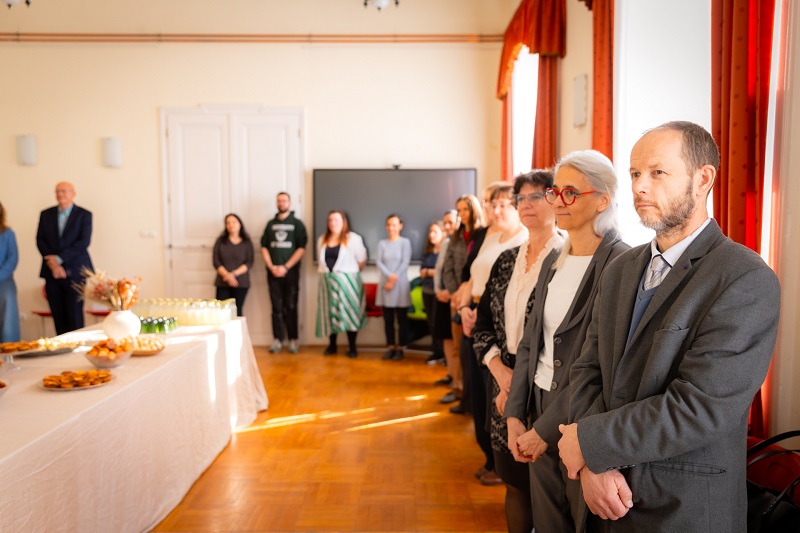
Representatives of the French Department at the Faculty of Humanities and Social Sciences of the University of Szeged and of other Francophone institutions in Szeged at the ceremony
Photo: Ádám Kovács-Jerney
The French Department at the University of Szeged’s Faculty of Humanities and Social Sciences maintains extensive international partnerships with numerous universities in France, including the University of Angers (Université d’Angers), the Catholic University of the West in Angers (Université catholique de l’Ouest), the University of Strasbourg (Université de Strasbourg), Paris 8 University (Université Paris 8), the University of Lorraine (Université de Lorraine), Bordeaux Montaigne University (Université Bordeaux Montaigne), the universities of Le Mans and Tours, and Côte d’Azur University (formerly Université Nice Sophia Antipolis). In 2020, the Department launched a dual-degree master’s program in cooperation with the University of Limoges.
Original Hungarian article by Sándor Panek
Feature photo: Recipients of the French Order of Academic Palms – Ildikó Farkas, specialist interpreter, retired senior assistant professor of the French Department at SZTE’s Faculty of Humanities and Social Sciences; and Timea Gyimesi, literary scholar, associate professor and head of department
Photo: Ádám Kovács-Jerney