The University of Szeged has inaugurated its Human Kinesiology Laboratory, where cutting-edge robotic technologies are being deployed to enhance the effectiveness of rehabilitation therapies and actively support patients throughout their recovery process.
“The equipment installed in the new laboratory delivers exceptionally precise and highly repeatable movements, enabling genuinely effective, personalized rehabilitation,” emphasized Prof. Dr. Csaba Lengyel, President of the Albert Szent-Györgyi Clinical Center at the University of Szeged, at the inauguration of the Human Kinesiology Laboratory. He pointed out that such precision is particularly critical for patients who have sustained neurological injuries resulting in impaired movement coordination. Professor Lengyel also emphasized that bringing such innovative developments into operation is always a source of pride for the Clinical Center – particularly when they go beyond routine patient care, education, and research.
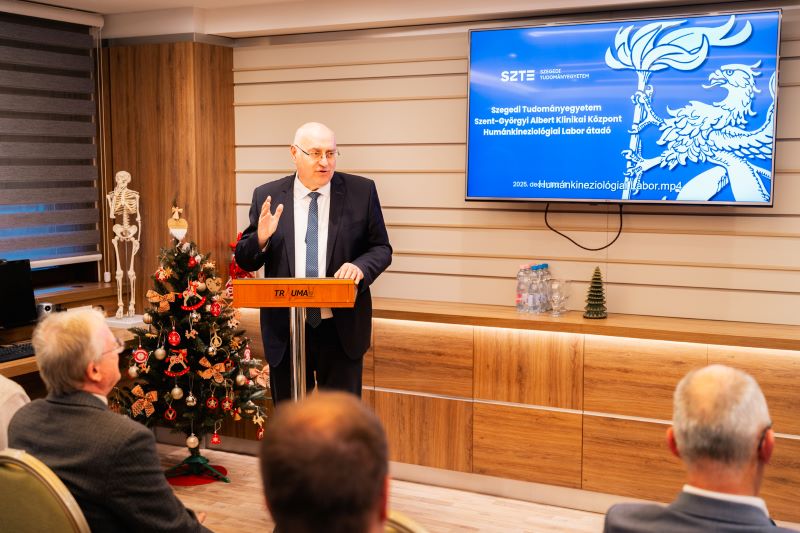
Prof. Dr. Csaba Lengyel, President of SZTE’s Albert Szent-Györgyi Clinical Center
Photo by Ádám Kovács-Jerney
Prof. Dr. Péter Klivényi, Head of the Department of Neurology at the SZTE Clinical Center, pointed out that while acute specialist care is well established in Hungary, rehabilitation services continue to receive comparatively limited attention nationwide – despite the fact that neurological conditions frequently result in long-term functional impairment. With the opening of this new facility, however, the University of Szeged has taken a significant step forward in the field of rehabilitation, strengthening its position not only within Hungary’s healthcare landscape, but also on the European stage.
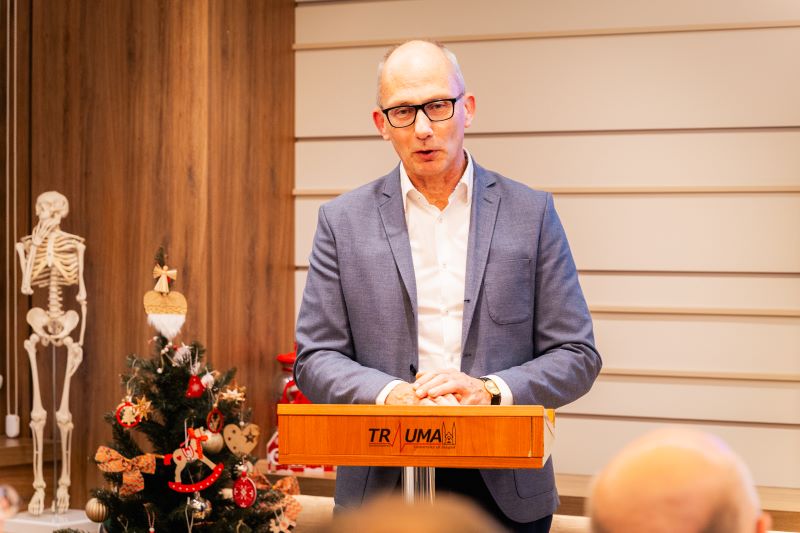
Prof. Dr. Péter Klivényi, Head of the Department of Neurology at the Albert Szent-Györgyi Clinical Center
Photo by Ádám Kovács-Jerney
At the inauguration, Dr. Péter Cserháti, President of the Hungarian Rehabilitation Society, also addressed the audience. He explained that hospital care has increasingly shifted toward short-term and emergency interventions, which makes the University of Szeged’s development far more than a self-contained institutional investment or a mere technological showcase. Rather, it represents a timely and practical response to current healthcare realities. Although the acquisition of such advanced equipment involves substantial expenditure, its application can reduce the duration of inpatient rehabilitation by as much as two months, allowing the cost of a single unit to be recovered within just two weeks. “These robots do not tire, so patients can make measurable progress day by day,” he emphasized.

Dr. Péter Cserháti, President of the Hungarian Rehabilitation Society
Photo by Ádám Kovács-Jerney
Attendees also had the opportunity to observe robot-assisted care in practice, with several of the devices demonstrated by Prof. Dr. Gábor Fazekas, neurologist, rheumatologist, and specialist in rehabilitation medicine. These demonstrations offered a clear glimpse into the laboratory’s broader capabilities: equipped with a wide range of advanced technologies, it applies innovative robotic solutions to deliver tailored rehabilitation – from gait retraining for patients with lower-limb paralysis to targeted therapy for the hands and fingers, arms, and shoulders. Beyond restoring upper and lower limb function, rehabilitation robots have also proven effective in enhancing neurocognitive abilities, an approach that may be particularly beneficial for patients recovering from stroke.
Another device demonstrated was a treadmill-based system that allows patients to practice walking with body-weight support. During the exercise, a projected route appears on a screen, guiding patients as they follow the path, lift their legs to step over virtual obstacles, and gradually refine their movements, while integrated safety systems ensure full stability throughout the session. The training can also be synchronized with music, further enhancing accessibility by enabling even patients with visual impairments to engage effectively in the therapy.

Treadmill-assisted gait training with body-weight support
Photo by Ádám Kovács-Jerney
The robotic systems used in the new laboratory deliver finely tuned therapies with exceptional precision and intensity. Using integrated sensors and advanced analytical algorithms, they allow for real-time motion analysis and objective performance assessment. As a result, both patients and clinicians receive clear, accurate feedback on progress – presented in a form that is easy for patients to understand.
Source: SZTEinfo
Photos by Ádám Kovács-Jerney