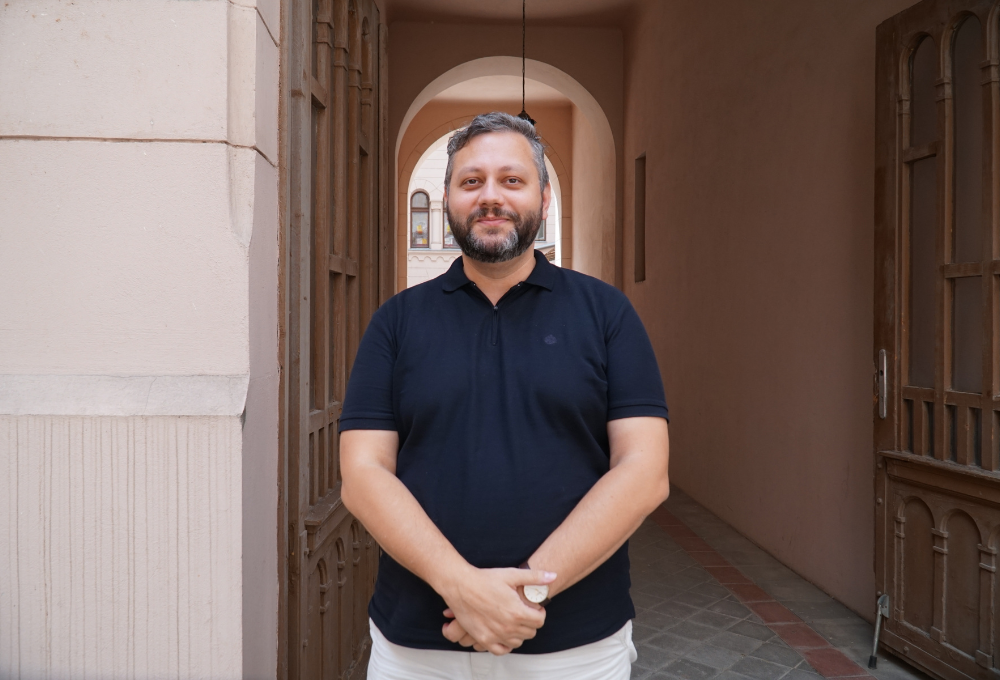
Dr. habil. Csaba Szabó, Assistant Professor at the Department of Religious Studies of the University of Szeged’s Faculty of Humanities and Social Sciences, has been awarded a Momentum (Lendület) Grant by the Hungarian Academy of Sciences (MTA) in 2025 – becoming the first scholar from the faculty to receive this prestigious recognition. The Momentum Program supports outstanding early-career scholars and accomplished researchers in launching research groups with the potential for major scientific impact. Professor Szabó’s five-year project, REMITHRA: Faces of Mithras – The Material and Cultural Legacy of an Ancient Cult in Central and Eastern Europe, will be carried out by the newly established MTA–SZTE Momentum Mithras Research Group, which is set to begin work this fall. As principal investigator, Professor Szabó spoke about the significance of the award and outlined his vision for the research ahead.
Q: What kind of selection process do applicants go through for a Momentum grant?
A: The selection process consists of three stages, and preparing a competitive proposal usually takes months of work. This was actually our third attempt, so we had already gained some experience – though I’ve heard of candidates who applied as many as six times. It’s quite rare to succeed on the first try.
In the first round, proposals are evaluated anonymously by international experts. If a project ranks among the top submissions, it advances to the second stage, where the Momentum jury – a multidisciplinary panel – conducts a professional review. Based on their ranking, the final decision is then made by the Momentum Committee, which is composed of senior members of the Hungarian Academy of Sciences.
Applicants are notified of the results two to three weeks later, followed by a detailed professional review within another three weeks. These reviews are usually seven to eight pages long and show clear evidence of expert insight – far from superficial feedback. So, even for those who are not selected, such a review serves as a valuable resource for refining and bolstering future applications.
Q: Why Mithras? What do we actually know about this ancient tradition that inspired your grant-winning proposal?
A: I’d start by noting that we don’t typically refer to it as a ‘religion’ in a modern sense, because after 395 CE, Christianity became the only officially recognized religion of the Roman Empire. In fact, this is a major topic of scholarly debate: can we even talk about ‘religion’ as we understand it today when describing those earlier periods? Ancient society was polytheistic, and what existed were cults rather than organized religions. The cult of Mithras was one of many such traditions.
It was a mystery cult centered on initiation rituals, offering its members spiritual and religious development through seven distinct stages – all within small, close-knit communities. These groups typically numbered 20 to 30 individuals. They were roughly the size of a small, modern prayer group, with members gathering in sanctuaries often converted from private homes. While most of these sites were located in urban areas, some were established in more remote locations: along roadsides, in forest clearings, or carved into rocky landscapes. What makes this particular project especially relevant is the strong regional connection: a significant number of Mithraic sites have been uncovered in the territory of the ancient Roman province of Pannonia [much of which overlaps with present-day Hungary]. As a result, Hungarian museums today hold outstanding collections of Mithras-related artifacts.
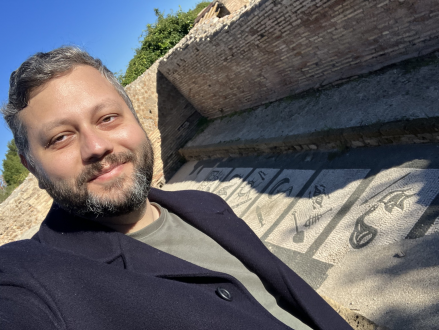
Csaba Szabó at a Mithras sanctuary
Q: What makes this ancient cult especially relevant as a subject in today’s context?
A: The project’s timeliness is underscored by the discovery of a new Mithras sanctuary in December 2023 in Aquincum, within present-day Óbuda [a historic district of Budapest], where a major real estate developer accidentally uncovered a sanctuary during construction. This is an exceptionally rare event, as such finds occur only once every 40 years or so. With approximately 150 known Mithras sanctuaries across the entire Roman Empire, the fact that six have now been found in Aquincum actually places Óbuda third on this list in Europe – just behind Rome and Ostia.
These sanctuaries, typically small and furnished with twin podiums, were exclusively attended by male initiates. This exclusivity is quite unusual, given that polytheistic religions were generally inclusive and open to anyone who wished to join. To this day, we still don’t fully understand why the cult of Mithras maintained such a strict admission policy.
Q: It seems there was a need for male-only groups even back then...
A: Indeed – the concept has several modern-day parallels, such as cigar societies or the tradition of English gentlemen’s clubs. It’s also worth noting that members of the Mithras cult typically came from the military, civil service, or merchant class – groups that were highly mobile and traveled extensively throughout the empire.
While we can’t say for certain, it’s likely that these men were seeking more than just professional or military engagement. They may have needed a space for spiritual renewal and inner reflection. As a result, each sanctuary had its own distinct internal world – a kind of small-scale society. So, for those who faced limited prospects in their personal lives or military careers, active participation in the Mithras community may have offered a meaningful form of compensation and fulfillment. This idea is further supported by the notable presence of freed slaves among the members – many of whom appear to have taken on especially engaged or prominent roles compared to those of average participants.
Q: What kind of methodology will the research group use?
A: The material evidence of the cult will be catalogued in a digital database that we are developing in collaboration with the Klebelsberg Library at the University of Szeged. This will form the foundation for a series of analyses rooted in religious studies and the sociology of religion – a methodological approach that has not yet been applied in our region. We aim to investigate questions such as: Who were the members of these communities? In which cities and settlements were their sanctuaries established? And how did the cult of Mithras relate to other religious movements within the Roman Empire?
We also plan to study the reception history of the cult. Although by the 5th century there was no longer any trace of Mithraic worship in our region, the movement was rediscovered during the Renaissance and drew increasing attention from the 18th and 19th centuries onward. By the mid-19th century, scholarly and academic interest had also begun to take shape. As part of our research, we will examine what publications have appeared on Mithras in both international and Hungarian scholarship. To do this, we’ll be collaborating with Róbert Péter’s AVOBMAT project team, which uses an AI-based data visualization program.
Naturally, the project is not designed with developers or innovators in mind – yet it could offer a valuable model for collaboration among archaeological teams, humanities researchers, and private stakeholders. While Mithras sanctuaries are rarely unearthed – perhaps once in a generation – archaeological discoveries of various kinds continue to emerge, and each presents its own challenges in terms of how these sites should be showcased, understood, and connected to the surrounding community. Public engagement, tourism potential, and sustainable use are all key considerations. Our research group will also address these questions, as public outreach and social relevance are key pillars of the project.
Q: What kind of results do you expect to achieve by the end of the fifth year?
A: We’ve committed to producing at least two monographs – one in Hungarian and one in English – because contributing to both the international and Hungarian academic discourse is essential. Alongside these, we’ll be publishing several edited volumes, scholarly studies, and a substantial number of popular science articles. A key expectation is that we also engage with wider audiences under the banner of public science and open science. To that end, we’ll be launching a website, a Facebook page, a YouTube channel, and a podcast. And of course, it’s mandatory that all major publications be open access. This kind of visibility and outreach are especially important, as one of the project’s milestones will be applying for a grant from the European Research Council (ERC) at some point during the five-year period.
The ultimate goal is to ensure the long-term operation of the research group once it is established. There are several possible paths forward: transitioning to internal funding from the university or faculty; continuing under the advanced category of the Momentum Program; or becoming self-sustaining through voluntary commitment. The most ambitious route is securing ERC funding – which would elevate the project to the level of a fully international, European research initiative. That is why we designed our Momentum proposal with that goal in mind, incorporating many of the ERC’s core criteria from the outset.
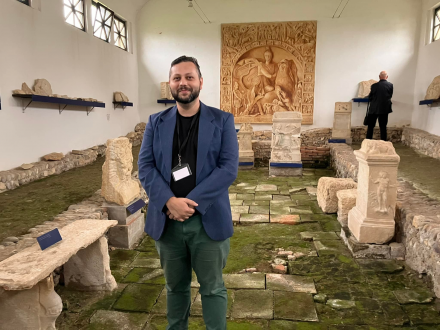
Csaba Szabó at a Mithras sanctuary
Q: What was it like to open the letter announcing the results – especially knowing that you're the first at the Faculty of Humanities and Social Sciences in Szeged to receive this grant?
A: I actually had to wait for the results quite a while. In previous years, they were usually announced around mid-June – but this year, the official notification didn’t arrive until the very end of the month. Until then, I was refreshing my inbox multiple times a day, wondering when the letter would finally come. In the end, it landed just as a Zoom call was wrapping up one afternoon. I saw the email arrive – and the wording was different from what I’d seen in the previous two years. I was overjoyed. I called everyone on the team, and we celebrated.
It really was a big moment for me. I’ve been researching this topic for 15 years – it was the subject of both my BA and MA theses – so the feeling was incredibly uplifting. At the same time, it comes with real responsibility. Although I’ve had postdoctoral grants before, I’ve never led a team. Now, I’ll be working with more than a dozen people over the next five years.
Q: And you’re the one who has to coordinate all of this.
A: That’s right. It’s a bit like managing a startup – we have people with very different temperaments and professional backgrounds: classical philologists, linguists, epigraphers, archaeologists, scholars of religion, and museum professionals. Overseeing all of that will definitely be a challenge. Fortunately, we have an excellent administrator who can help with things like budgeting – which is an entirely different world.
Another important aspect is that ours is a very small department. Unfortunately, we have very few students at the moment – so this project also brings a welcome boost of motivation to the unit. I’m hopeful it might even attract PhD students to join us.
With that in mind, my advice to colleagues and early-career researchers would be this: don’t hesitate to apply! It’s especially important for small departments to develop clear and ambitious research directions. At the same time, teaching remains a central priority – and we’re committed to bringing the results of our research into the classroom. A project like this can truly energize both the department and its students – or, to put it more playfully, give them momentum. In that sense, the choice of the name Momentum by the Hungarian Academy of Sciences is particularly apt – the program truly does provide fresh energy and direction for researchers, departments, and institutions alike.
Original Hungarian article by Nikolett Lengyel / SZTE BTK
Photos: Csaba Szabó
Feature photo: Dóra Krizsán / SZTE BTK