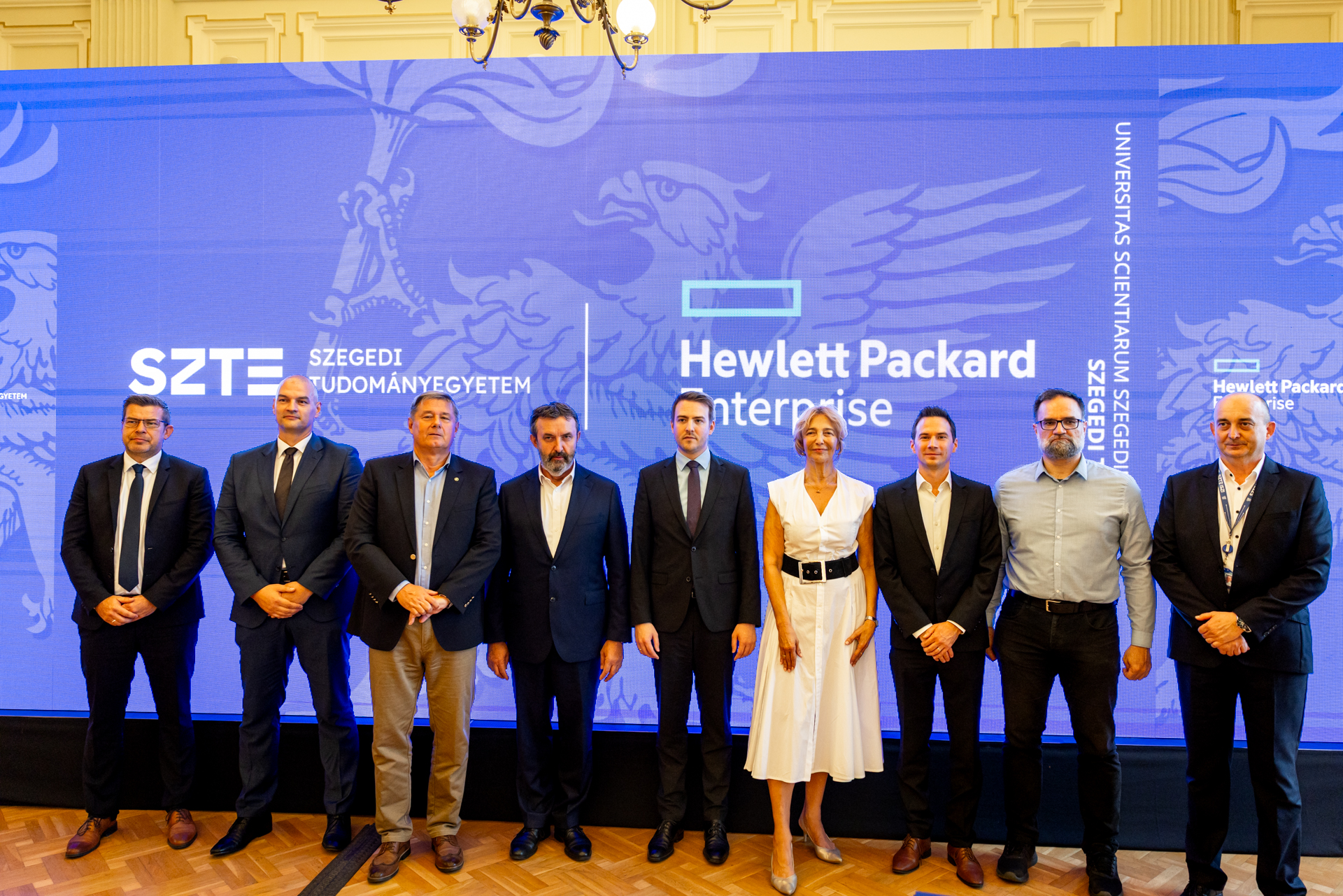
At a ceremony held on campus on July 8, 2025, the University of Szeged officially unveiled a new supercomputer with a capacity of 1.75 petaflops, which means it is capable of performing 1.75 quadrillion (1.75 × 10¹⁵) operations per second. Backed by the Artificial Intelligence Competence Center within the University of Szeged’s Center of Excellence for Interdisciplinary Research, Development and Innovation, the system will provide vital computational resources for AI-driven research at the university. This cutting-edge, European-class infrastructure is expected to drive progress not only in artificial intelligence but also across a wide range of scientific fields. During the ceremony, the University of Szeged and the Hewlett Packard Enterprise Company (HPE) signed a strategic cooperation agreement to ensure ongoing professional and technological support for the system.
The University of Szeged has commissioned a new supercomputer-based advanced infrastructure to maintain its leading role in AI research and applications in Hungary and to strengthen its position as a key player in international research. At the event, Prof. Dr. László Rovó, Rector of the University of Szeged, emphasized that AI now permeates nearly every scientific field and that high-performance supercomputers are essential for research that relies on its applications.

Professor Dr. László Rovó, Rector of the University of Szeged
Photo by István Sahin-Tóth
At the event, László Bódis, Deputy State Secretary for Innovation, praised the University of Szeged’s growing innovation ecosystem, which has now been further strengthened by the addition of Hewlett Packard Enterprise’s supercomputer. He noted that two programs are in place to support innovative technology companies: the ‘Fast Track’ program for the physical sciences and engineering, and the ‘Life Sciences Catalyst’ program, which will provide support in the life sciences.
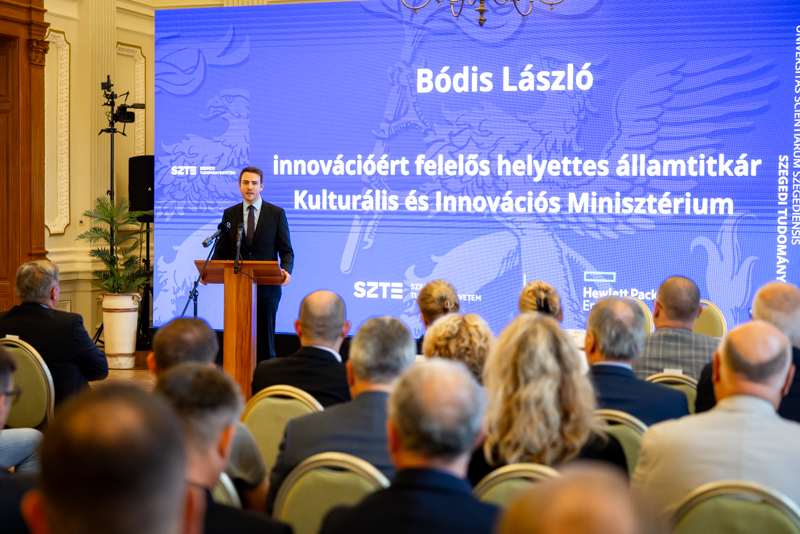
László Bódis, Deputy State Secretary for Innovation
Photo by István Sahin-Tóth
At the ceremony, Prof. Dr. László Palkovics, Government Commissioner for Artificial Intelligence, shared two recent milestones in expanding Hungary’s supercomputing capacity. Specifically, on the day of the event, it was announced that Germany’s ParTec AG will invest €3 billion in Hungary to build a supercomputing data center with a capacity of 1,600 petaflops. In addition, a recent agreement ensures that, through the HUN-REN SZTAKI consortium, Hungarian researchers will gain access to JUPITER – the world’s fourth-largest supercomputer, located in Jülich, Germany. This system has a capacity of 800 petaflops, of which 10 petaflops will be dedicated to Hungary. Dr. Palkovics emphasized that Hungary aims to achieve 40 petaflops of domestic capacity by 2030, noting that the University of Szeged’s 1.75-petaflop investment is part of this broader strategy.
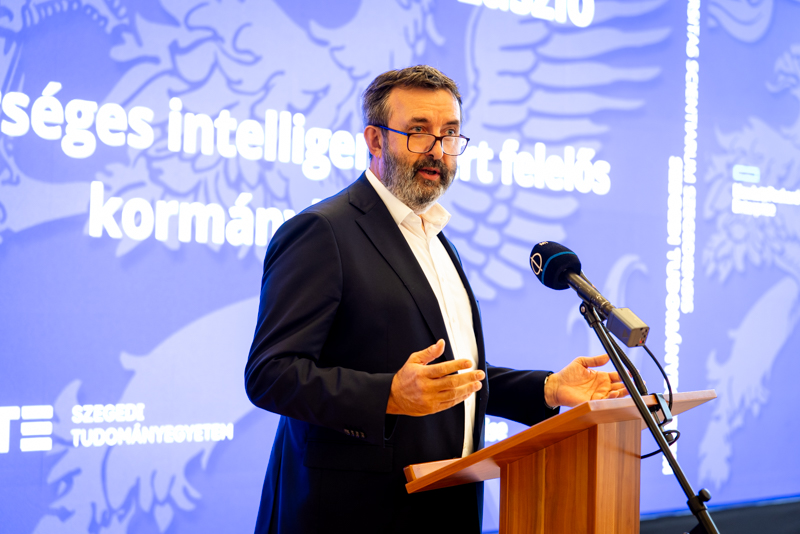
Dr. László Palkovics, Government Commissioner for Artificial Intelligence
Photo by István Sahin-Tóth
At the University of Szeged, the need for dedicated AI computing capacity has emerged in response to the growing volume of data used in AI-driven research in recent years. The new infrastructure will support a range of projects, including Prof. Dr. Antal Berényi’s neurocybernetics research, the development of cochlear implants led by Prof. Dr. László Rovó, Dr. Gergely Röst’s mathematical modeling of epidemic dynamics, and Prof. Dr. Márk Jelasity’s AI research, which explores the vulnerabilities and internal knowledge representations of large language models.
Additionally, the new supercomputer – optimized for AI – will be valuable for genomics research, enabling the analysis of an entire human genome in hours instead of days. It will also support drug development, where simulating molecular behavior can help accelerate the design of targeted therapies. Moreover, the system is expected to play a significant role in physics and materials science, too – for example, by efficiently running simulations of new material structures.
At the event, Dr. Judit Fendler, Chancellor of the University of Szeged, highlighted the key resources of the University’s Center of Excellence for Interdisciplinary Research, Development and Innovation (IKIKK). These resources support the institution’s educational, research, clinical, and market-oriented goals. The Center’s life sciences cluster includes major facilities such as the SZTE Biobank and the Central Sequencing Laboratory, while the Science and Mathematics Cluster features the MOL Advanced Core Facility for Separation Techniques and the Competence Center for Materials Science.
To strengthen AI support for these projects, the University of Szeged’s Center of Excellence established the Artificial Intelligence Competence Center. This dedicated unit, led by Prof. Dr. Márk Jelasity, will assist research efforts with advanced data processing and modeling.
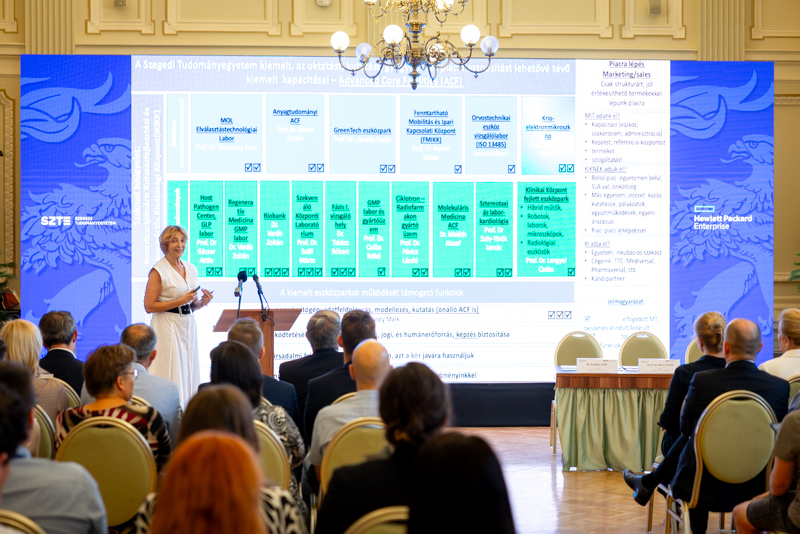
Dr. Judit Fendler, Chancellor of the University of Szeged
Photo by István Sahin-Tóth
The Artificial Intelligence Competence Center at the University of Szeged is now inviting university research groups to submit requests for AI-related support and computing time for their projects. Prof. Dr. Márk Jelasity, head of the Competence Center, explained that their goal is to provide expert guidance for AI ideas and projects developed at the University. “This might be as simple as recommending methodologies for researchers to use with their data, or it could involve taking on specific tasks and actively participating in project implementation,” he said. “Anything in between is possible, and we already have experience handling a wide variety of requests.”
According to Prof. Dr. Zoltán Kónya, Vice-Rector Scientific Affairs and Innovation at the University of Szeged and head of IKIKK, the new supercomputer will also be used to enhance the university’s administrative processes through artificial intelligence. For example, an AI assistant could handle 90-95 percent of student inquiries and similarly streamline basic clinical patient management workflows. Prof. Dr. Kónya noted that all university projects can be reviewed to identify ways AI might improve their efficiency. “Artificial intelligence will typically take over time-consuming and repetitive tasks, allowing the university to boost both its research and operational efficiency,” he explained.

Tibor Szpisják, Managing Director, Hewlett Packard Enterprise
Photo by István Sahin-Tóth
The operation and integration of the HPE supercomputer into the university’s IT infrastructure are overseen by the University of Szeged’s Directorate for IT and Services, led by Director Csaba Fekete, who played a key role in both preparing and implementing the investment. In addition to highlighting that the project was implemented in a way that ensures flexibility for future capacity expansion, which is a strategic advantage for the university, the Director emphasized:
“We have deployed cutting-edge technology with performance that positions us at the forefront of global academic research and AI innovation. However, operating the supercomputer entails several new technical challenges. One of the most significant ones is managing energy consumption and efficiency, as the system itself requires 26 kWh of electricity to run, plus an additional 14 kWh for cooling. From a sustainability perspective, it is critical that the system delivers exceptional performance with relatively low energy use thanks to its advanced, next-generation technologies. [In addition,] it is a strategic advantage for the university to have implemented the project in a way that ensures flexibility for future capacity expansion. ”
Speaking at the event, Gábor Tóth, Managing Director of PC Trade Systems Kft., the local supplier involved in delivering the system, stated:
“In the supercomputer market, the Cray system developed by Hewlett Packard Enterprise powers three of the world’s fastest supercomputers, the fastest in Europe, and now one here in Szeged as well. One of the key features of the system delivered here is that its capacity can be scaled according to actual usage. This reflects the University of Szeged’s commitment to responsible financial management, ensuring that costs always align precisely with actual system usage. This is the HPE GreenLake model, which also enables the University of Szeged to operate as a service provider and meet the needs of the region,” he emphasized. “It is a great honor for us to be part of this unique project, both as a supplier and as a future support partner. We are proud that our alma mater has benefited from such a forward-looking initiative,” he added.
The new system at the University of Szeged comprises six HPE nodes – high-performance standalone computing units – equipped with NVIDIA H100 and H100 SXM+ graphics processors. Data management is handled by an HPE Cray storage system based on the LUSTRE file system, while ultra-fast interconnects between machines are provided by NVIDIA InfiniBand technology. Together, the servers offer a combined total of 416 cores and deliver an overall performance of 1.75 petaflops, meaning they can execute 1.75 quadrillion floating-point operations per second. This makes the system tens of thousands of times more powerful than a typical computer, enabling tasks that would take days or weeks on conventional systems to be completed in just minutes.
Original Hungarian article by Sándor Panek
Feature photo (left to right): András Újhegyi, CEO of SZTE TTC Zrt.; Gábor Tóth, Managing Director of PC Trade Systems; Professor Dr. László Rovó, Rector of the University of Szeged; Professor Dr. László Palkovics, Government Commissioner for Artificial Intelligence; László Bódis, Deputy State Secretary for Innovation; Dr. Judit Fendler, Chancellor of the University of Szeged; Tibor Szpisják, Managing Director, Hewlett Packard Enterprise; Professor Dr. Márk Jelasity, Head of the Artificial Intelligence Competence Center at SZTE IKIKK; Csaba Fekete, Director of IT Services at the University of Szeged
Photo by István Sahin-Tóth