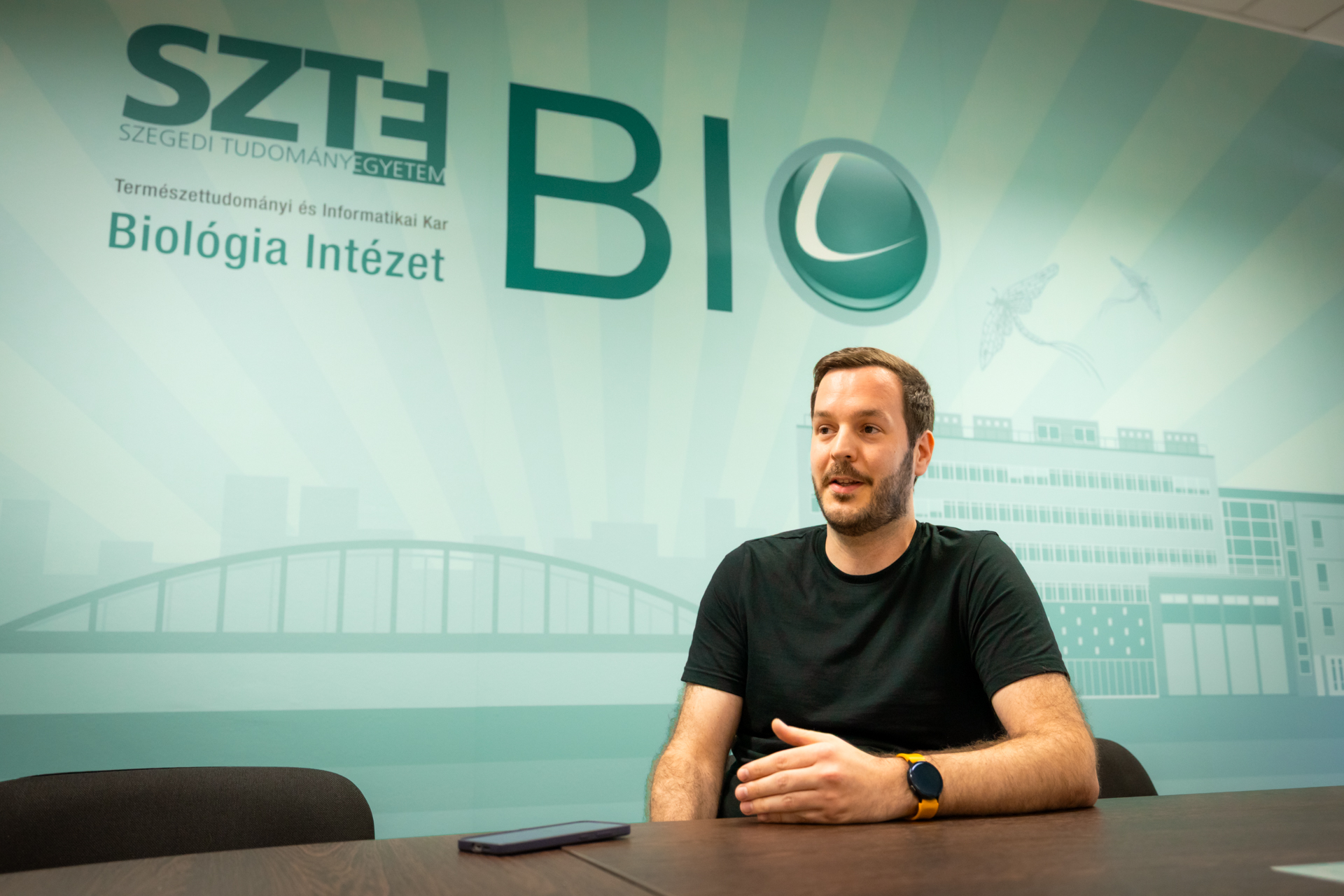
Dr. Gábor Feigl, habilitated senior assistant professor at the University of Szeged’s Department of Plant Biology, has been awarded a prestigious research grant through the Hungarian Academy of Sciences’ Momentum (Lendület) Program. His project will explore how plants respond to the combined stress of anthropogenic pollutants – human-induced contaminants such as microplastics, heavy metals, and pharmaceutical residues. By uncovering how these stressors interact to impact plant life, the research aims to support the future of sustainable crop production in an increasingly polluted environment.
What happens to agricultural crops when newly emerging human-made pollutants – including heavy metals, microplastics, nanoparticles, and antibiotic residues – are simultaneously present in the soil? And what innovative solutions might help plants withstand this combined stress?
These are the key questions driving the work of the Anthropogenic Stress and Plant Resilience Research Group, recently established under the leadership of Dr. Gábor Feigl as part of the Hungarian Academy of Sciences’ Momentum (Lendület) Program at the University of Szeged.
“While the effects of individual stress factors are relatively well understood, the combined impact on plant growth and health remains largely unclear,” Dr. Feigl says.
"One of the most rapidly expanding fields in plant biology is the study of how human-induced stressors affect plant systems," notes the plant biologist. "It is now widely recognized in basic research that, under real-life agricultural conditions, plants are simultaneously exposed to multiple environmental pollutants that cause stress. These combined stress factors can interact in complex ways. That’s why it’s essential to study not only the individual effects of these stressors but their combined impact as well. The main reason for this is that when a plant is exposed to any kind of stress, it becomes less resilient to other stressors, which can ultimately lead to lower crop yields."
Dr. Gábor Feigl’s research group is launching a five-year program that will begin by mapping the effects of various potential stress-inducing substances.
“We already have preliminary data on how certain individual stressors affect plants, and now we’re moving on to test their combinations,” explains Dr. Feigl. “Whenever a plant is exposed to stress, a specific signal transduction response is triggered in the background. In this phase of the project, our goal is to gain a clearer understanding of these processes unfolding within plant tissues and cells.”
The second phase of the project will focus on exploring innovative pre-treatment strategies to boost plant resilience against multiple stress factors. As part of this effort, Dr. Gábor Feigl’s lab will test two types of seed priming: one using nano-sized silicon dioxide, and the other involving bio-priming – a method in which beneficial microorganisms are applied to seeds during the early stages of germination.
“When we apply treatment to seeds during the pre-germination phase, it triggers a biological response that the plant can later ‘remember,’” explains Dr. Feigl. “We initiate germination just enough to activate this response, then halt the process – before full germination occurs – and dry the seeds back down.” This priming technique is expected to enhance the plant’s internal stress-response mechanisms. The silicon-based treatment, for instance, may improve the plant’s ability to tolerate future environmental stress. In parallel, the team is also exploring a biological approach known as bio-priming, in which beneficial soil microorganisms are applied to the seeds during early development. “These naturally occurring microbes are not pathogenic and won’t cause infection – though, of course, dosage is critical,” he emphasizes.

Dr. Gábor Feigl's research team conducts Petri dish experiments during the initial phase of the study.
Photo by Ádám Kovács-Jerney
In the third phase of the project, Dr. Gábor Feigl’s research group aims to bridge the gap between fundamental research and real-world application. This objective aligns closely with one of the core missions of the Momentum initiative: to ensure that scientific insights translate into practical contributions – supporting more sustainable agricultural practices and strengthening plant resilience in increasingly polluted environments.
According to Dr. Gábor Feigl, this phase involves gradually transferring results from controlled laboratory experiments to real agricultural conditions. It is a particularly delicate stage of the research, as outcomes observed in Petri dish experiments can often change once soil – with its complex and variable properties – is introduced into the system.
“Ideally, biological processes should behave similarly across different systems – but in reality, that’s often not the case,” explains Dr. Gábor Feigl. “For example, we have in vitro results showing how plastics affect plants in Petri dishes. But when we repeat the same experiment using even a simple potting soil system, everything can change. The plant’s response shifts, the plastic interacts differently, and root growth may follow an entirely new pattern – because in a more complex medium, many additional factors come into play and influence the outcome.”
This complexity highlights one of the core challenges of the project’s third phase: translating laboratory findings into real-world agricultural contexts. In controlled in vitro systems, the interaction is limited to the stressor and the germinating plant. However, once soil is introduced, its diverse physical and chemical properties can significantly influence how the stressor behaves – and, in turn, how the plant responds.
“Factors such as soil pH, the presence of native bacteria and fungi, other potential pollutants, or available nutrients can all influence the outcome,” notes Dr. Feigl. “That’s why we also study how the soil environment might amplify or mitigate the effects of various stressors.”
To better track these changes, the research team is working to identify molecular markers that respond consistently to specific stressors under in vitro conditions. These same markers will later be examined in plants grown in soil, allowing the team to monitor how plant responses shift as the experimental environment becomes increasingly complex.
According to Dr. Feigl, an additional potential benefit of the research is the identification of plant species – or specific plant processes – that could be harnessed for phytoremediation in response to anthropogenic stressors. At the University of Szeged’s Institute of Biology, scientists have long been investigating how pollutant-tolerant plants might be used to help clean up contaminated soil and water.
Some plant species naturally thrive in environments with high concentrations of heavy metals. For example, Alyssum lesbiacum, native to the Greek island of Lesbos, exhibits remarkable tolerance to nickel contamination – an adaptation to the region’s naturally nickel-rich soils. In fact, heavy metal resilience is relatively common among plants. Certain willow species, for instance, not only tolerate toxic metals but also produce large amounts of harvestable biomass in a short period, making them especially promising candidates for phytoremediation efforts.
However, when it comes to newer and less studied environmental stressors – the primary focus of the Momentum project – our understanding remains limited. In this context, identifying tolerant plant species or enhancing the adaptability of existing agricultural crops could represent a major outcome of the research, with potential long-term benefits for both agriculture and environmental remediation.
One such emerging stressor is antibiotic contamination, which, according to Dr. Feigl, presents complex and often unpredictable challenges. “We’ve conducted experiments where the same plant species responded positively to one antibiotic but negatively to another,” he explains. “What we do know is that a significant proportion of antibiotics used in livestock farming and human medicine are excreted unmetabolized, entering wastewater systems – and eventually making their way into the soil.”
Once in the soil, antibiotics can exert direct effects on plants or, more subtly, alter the composition of the soil microbiome. “These microbial shifts can disrupt the natural balance of the system, potentially allowing harmful microbes to gain a foothold,” Dr. Feigl explains. “Such changes can trigger cascading effects – influencing not only microbial communities, but also the health and development of the plants themselves.”
Dr. Gábor Feigl offers the following assessment of the impact of microplastics:
“Our research in recent years shows that plastics can significantly influence the early development of plants. They have the potential to affect germination, alter root growth, and trigger signal transduction processes that may have long-term consequences for plant health. In addition, some studies suggest that microplastics can act as vectors – meaning they can facilitate the spread of other pollutants. Because these materials are not entirely inert, they can bind to contaminants and later release them, potentially over considerable distances. Our core hypothesis is that plastics interact in some way with other anthropogenic stressors. What we don’t yet know is whether those interactions are beneficial or harmful. It’s possible that plastics could bind to pollutants like heavy metals and limit their bioavailability, thereby reducing their impact. But it’s also possible that they could bind to substances such as antibiotics or nanomaterials and later release them unpredictably – causing secondary pollution that may lead to additional negative effects.”

Dr. Gábor Feigl, habilitated senior assistant professor at the Department of Plant Biology of the University of Szeged
Photo by Ádám Kovács-Jerney
The research project will also include a range of advanced “omics” analyses – large-scale molecular studies that examine entire sets of genes, metabolites, or microbial communities – across different experimental systems.
“As part of the project, we’ll be conducting cutting-edge, 21st-century molecular investigations,” explains Dr. Gábor Feigl. “Specifically, we plan to carry out metabolomic analyses on plant samples and metagenomic analyses on soil samples, both of which will be evaluated using bioinformatics tools to help us interpret large datasets.” In the metabolomic studies, the team will examine how combinations of human-derived stressors influence the balance of metabolic products in plants. The metagenomic analyses, by contrast, will focus on the structure of microbial communities in the soil. “Our colleagues will extract all the DNA present in the soil samples and, using bioinformatics, identify the microbial species living there. Shifts in microbial composition are important indicators – if the profile changes, it likely reflects a disruption in soil health, which can directly affect the plants growing in that environment.”
Original Hungarian article by Sándor Panek
Feature photo: Dr. Gábor Feigl, habilitated senior assistant professor, Department of Plant Biology, University of Szeged
Photo by Ádám Kovács-Jerney