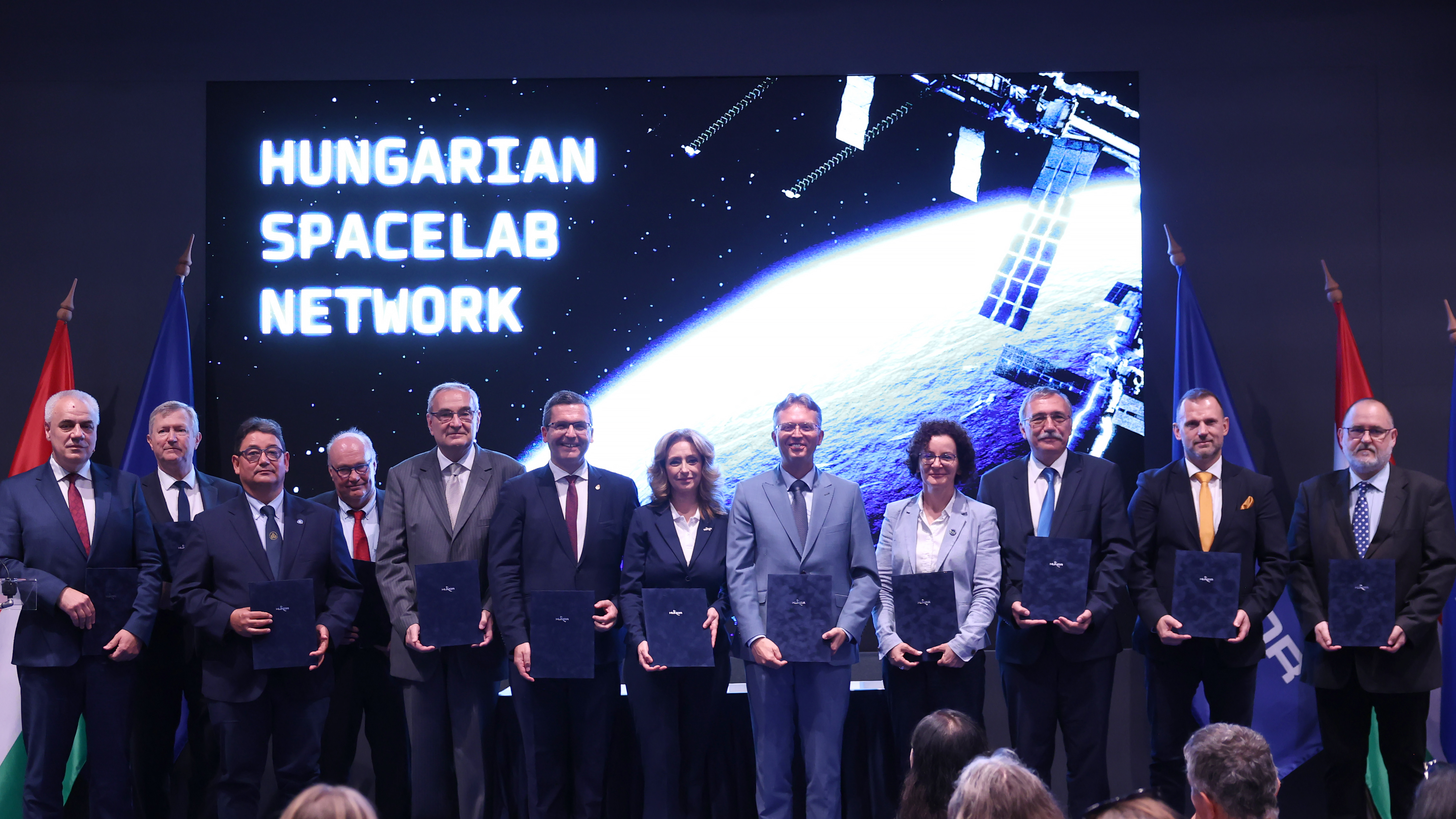
A giant leap was made toward strengthening Hungary’s space sector with the signing of an agreement to establish the Hungarian Spacelab Network. The new collaborative platform brings together nine universities, the Ministry of Foreign Affairs and Trade, the Ministry of Culture and Innovation, and the HUN-REN Institute for Computer Science and Control. The signing ceremony was held in Budapest on July 14, 2025.
On July 14, 2025, a cooperation agreement was signed to establish the Hungarian Spacelab Network. The goal of the initiative is to strengthen Hungary’s role in international space research, develop the required infrastructure, and create a bridge between science, industry, and the public sector.
Prof. Dr. Zoltán Kónya, Vice-Rector for Science and Innovation at the University of Szeged, stated that the Hungarian Spacelab Network brings together universities involved in the HUNOR Hungarian Astronaut Program – institutions that have already demonstrated their research potential on the international stage.
Just recently, three research projects from the University of Szeged’s Center of Excellence for Interdisciplinary Research, Development, and Innovation were included in the HUNOR Program’s experimental portfolio and carried out aboard the International Space Station by Hungary’s astronaut during the nation’s first ISS mission.
Led by Dr. Attila Gácser, researchers from the Department of Biochemistry and Molecular Biology at the Faculty of Science and Informatics (TTIK) are investigating whether the DNA-damaging effects of cosmic radiation can be mitigated or prevented. Their experiments – conducted on fruit flies that were sent to and returned from the ISS – address a fundamental challenge of long-duration spaceflight, particularly in preparation for future missions to Mars
In a parallel study, Dr. Dóra Tombácz and her team at the Department of Medical Biology are examining the human microbiome – the complex community of bacteria, viruses, and fungi that inhabit the body. Their research explores how spaceflight-induced stressors affect microbial composition and dynamics, with important implications for astronaut health during extended space missions.
Meanwhile, at the Department of Physiology within the Albert Szent-Györgyi Medical School (SZAOK), Dr. Attila Nagy and his team are analyzing data supplied by the Hungarian astronaut. Their work supports ongoing research into how microgravity and other space-related factors impact learning.
The Hungarian Spacelab Network builds on the research outcomes of the astronaut’s experiments conducted aboard the International Space Station, advancing this work in collaboration with leading universities across the country. In addition to the University of Szeged, member institutions include the University of Miskolc, Eötvös Loránd University, the University of Pécs, Óbuda University, Széchenyi István University, Semmelweis University, the Budapest University of Technology and Economics, and the University of Debrecen.
For more on related research initiatives at the University of Szeged within the HUNOR program, see the article”Advancing Science in Space: University of Szeged's Projects Set for Next ISS Mission.”
Source: IKIKK-infó – Anna Bobkó
Photo by MTI (Hungarian News Agency)