ELI ALPS now boasts a new solar power park, incorporating multiple engineered units that maximize renewable electricity production. The largest unit of the solar power park, generating 4.07 megavolt-amperes (MVA AC), has been installed on the undeveloped land adjacent to the institute. Another distinctive element of the facility is a specially designed 0.6 MVA AC unit mounted on a solar structure above the institute’s parking lot, allowing it to function simultaneously as a covered carport. In addition, a 0.19 MVA AC floating unit operates on the reservoir in front of ELI ALPS, and a 0.04 MVA AC dual-axis solar tracker system adds yet another unique feature to the park.
The newly inaugurated solar power facility marks a key milestone in a major energy project with a total value of HUF 5 billion, supported by the Hungarian Ministry of Energy. Of this amount, HUF 2 billion was allocated specifically for the construction of the facility. Led by the Foundation for the University of Szeged, the consortium seeks to advance sustainability through the installation of photovoltaic systems and the development of geothermal energy solutions. As part of upcoming subprojects, additional renewable energy systems will be commissioned at SZTE, further strengthening the university’s long-term commitment to sustainable energy use.
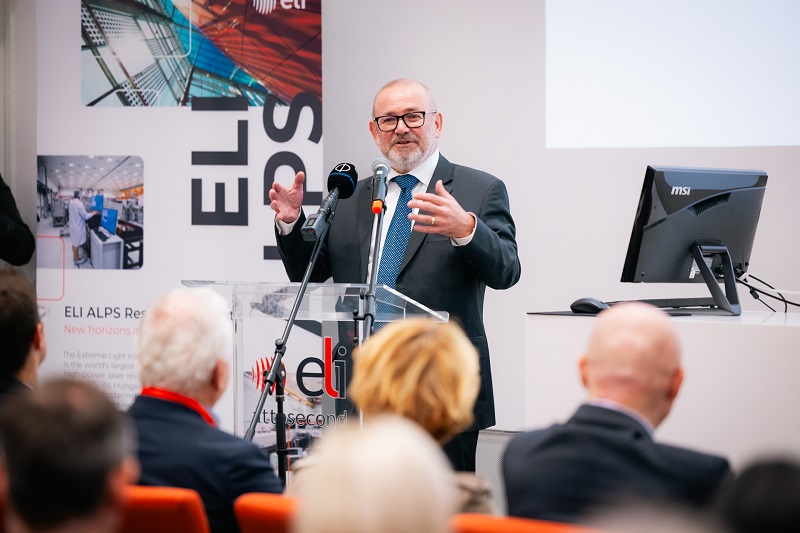
Csaba Lantos, Minister of Energy
Photo by Ádám Kovács-Jerney
At the inauguration ceremony, Csaba Lantos, Minister of Energy, emphasized that the solar power park is one of the ministry’s flagship projects, reflecting the core priorities of Hungary’s current energy policy – the simultaneous development of nuclear and renewable energy production. He noted that the University of Szeged and ELI host the laser-based transmutation project, which, in its future application phase, could offer a solution for managing spent nuclear fuel. At the same time, the newly installed solar facility will allow ELI ALPS to meet a substantial share of its energy demand from renewable sources.
The Minister also announced that Hungary has purchased a new technology from the United States to help address the challenge of storing spent nuclear fuel. He highlighted another emerging priority in Hungarian energy policy – the planned deployment of small modular nuclear reactors (SMRs). He added that these reactors could potentially be installed alongside industrial facilities in the future.
Regarding renewable energy, Csaba Lantos noted that, alongside Hungary’s existing 8,200 MW of solar power capacity, wind-turbine-generated energy will also become part of the national energy portfolio. He identified geothermal and biomass-based energy as additional alternative sources. The Minister emphasized that energy storage will be a central focus of future development efforts, as it will allow surplus electricity generated on sunny days to be used at later times.
At the inauguration, Prof. Dr. László Rovó, Rector of the University of Szeged, noted that renewable energy currently accounts for 10 percent of the university’s total consumption, with 4 percent provided by solar power. He added that, as part of its large-scale project, SZTE is launching new solar and geothermal developments that will further increase the share of sustainable energy sources in the university’s operations.
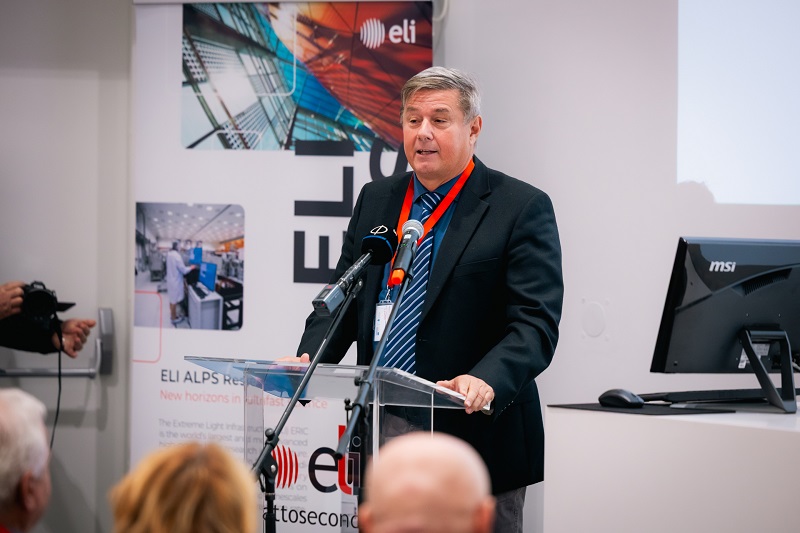
Prof. Dr. László Rovó, Rector of the University of Szeged
Photo by Ádám Kovács-Jerney
The University of Szeged’s progress in sustainable energy use is also reflected in its position in the international GreenMetric University Ranking, where it currently stands at an impressive 75th place worldwide and is regarded as one of the greenest universities in Hungary. The institution’s social engagement and commitment to sustainability were further underscored in the summer of 2024, when it received the QS “Commitment to Sustainability” International Award.
At the event, László Makai, Board Member of Energosun Investment Zrt., the company responsible for constructing the solar power park, explained that new technologies were tested both in solar energy generation and in the design of the supporting structures. These innovations include a solar tracking system that continuously reorients the panels for optimal solar input, a support-frame installation built above a parking area, and a floating solar unit placed on a reservoir – the first system of its kind in Hungary.
Prof. Dr. Gábor Szabó, Managing Director of ELI ALPS, described the laser pulses produced at the research institute as “the most sustainable photons in the world.” He noted that ELI ALPS was designed from the outset with sustainable energy solutions in mind – for example, its buildings are equipped with both solar panels and solar collectors. The waste heat generated by the cooling system, which is essential for the stable operation of the lasers, as well as by other equipment, has long been recovered and reused. At the same time, careful attention had to be paid to ensuring that sustainability measures did not interfere with the lasers’ optimal performance. Even slight fluctuations in humidity or temperature within the laboratories can shift the laser spectrum. As Prof. Dr. Szabó remarked with humor, “We have the most expensive thermometers at ELI,” since the 20-million-euro laser systems immediately signal any irregularity.
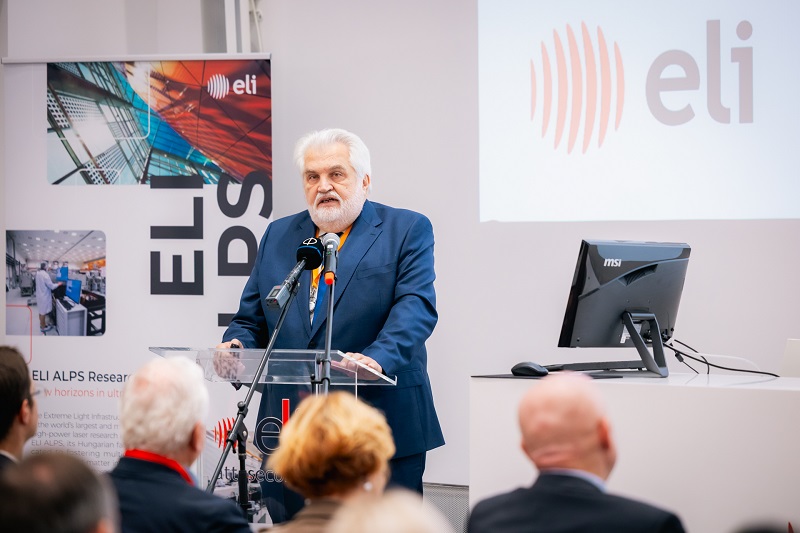
Prof. Dr. Gábor Szabó, Managing Director of ELI ALPS, and Chair of the Board of Trustees of the Foundation for the University of Szeged
Photo by Ádám Kovács-Jerney
Prof. Dr. Gábor Szabó explained that the newly established solar power plants now enable the research institute to cover 30–35 percent of its electricity demand from renewable sources. Even this one-third share already places ELI ALPS among the most sustainable large-scale scientific infrastructures in the world. The proportion of renewables is expected to rise to 50 percent once a future project provides the necessary solar energy storage capacity. He added that ELI ALPS will not simply utilize the solar power park but will also launch experimental projects to achieve multiple benefits from the new developments. For example, in collaboration with the county anglers’ association, fish have been introduced into the reservoir located in front of the ELI facility, and the institute is regularly monitoring whether the floating solar units contribute to improving the wellbeing of aquatic life. The team hypothesizes that the large surface coverage provided by the panels offers shelter from summer UV radiation, thus creating a more favorable environment for the ecosystem.
The reservoir’s water supply is replenished daily with approximately 60 cubic meters of water, pumped from a deep cellar beneath ELI ALPS’s central laboratory block. The water is naturally very clean, and before it is released into the reservoir, it passes through a gravel bed for additional purification.
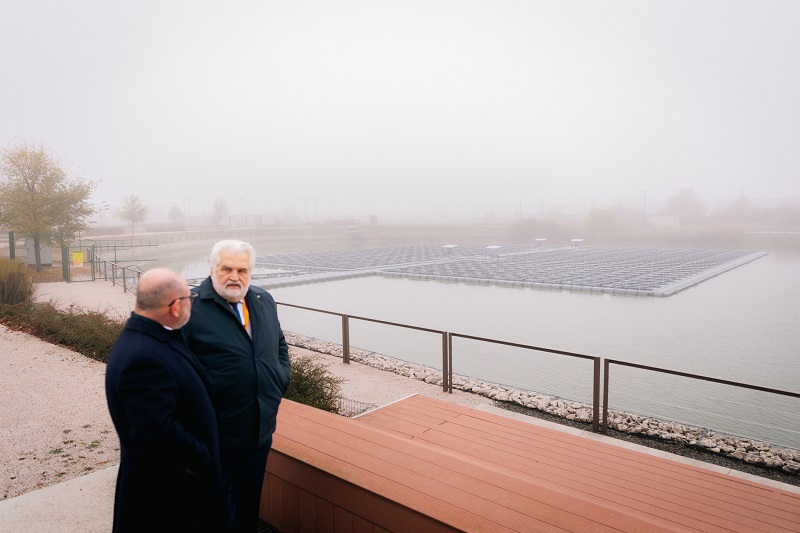
Csaba Lantos and Prof. Dr. Gábor Szabó at the floating solar power module installed on the reservoir in front of the ELI ALPS facility
Photo by Ádám Kovács-Jerney
Another innovative experimental method is also being tested at ELI ALPS to help balance solar energy overproduction. During the day, excess electricity is used to produce slush ice, and the stored cooling capacity is then utilized at night to cool the laboratories.
Prof. Dr. Gábor Szabó noted that the construction of the solar power park did require the removal of a few trees. However, drawing on the expertise of the Municipality of Szeged, a Miyawaki forest – a dense, diverse, and fast-growing mini-forest – will soon be planted on site to replace the felled trees.
Original Hungarian text by Sándor Panek
Feature photo: Prof. Dr. László Rovó, Rector of the University of Szeged; Prof. Dr. Gábor Szabó, Managing Director of the ELI ALPS Research Institute and Chair of the Board of Trustees of the Foundation for the University of Szeged; Csaba Lantos, Minister of Energy; and László Makai, Board Member of Energosun Investment Zrt. – at the inauguration of the ELI ALPS solar park.
Photo by Ádám Kovács-Jerney