Hungary’s National Academy of Scientist Education held its 25th Meeting of Nobel Laureates and Talented Students in Szeged, marking a milestone year for the long-standing initiative. The event has expanded to such an extent that it has outgrown the University of Szeged’s József Attila Study and Information Center and was relocated to the Pick Arena, where nearly 4,000 students and teachers gathered for this year’s program. After the opening remarks, the audience heard a lecture by Sir Peter Ratcliffe, the British cell biologist awarded the 2019 Nobel Prize in Physiology or Medicine – a recognition he shared with two fellow researchers – for uncovering how cells sense oxygen levels and adapt to changing oxygen availability.
In his lecture, Sir Peter Ratcliffe outlined the research journey behind the discovery of cellular oxygen sensing to illustrate how scientific breakthroughs build on earlier findings. Before delving into the topic itself, he reflected on the broader role of science. He remarked, for example, that he agrees with those who argue that what we typically teach as ‘history’ is largely the history of human violence – even though the history of science is far more consequential than the history of military conquest. For young people interested in discovery-driven science, he emphasized, reading the history of science is essential for understanding how earlier scientists arrived at their breakthroughs. “And then they can see just how chaotic, random, and full of lucky turns the process of discovery really is,” Professor Ratcliffe added. He also noted that more than 90 percent of all scientists who have ever lived are alive today. He went on to explain that since the Enlightenment, knowledge has expanded in entirely unpredictable ways – leaving us with an extraordinary depth of scientific understanding, remarkable technological capabilities, and countless opportunities for new discoveries.
Professor Ratcliffe told the audience that he regards teachers as the most important – yet far from adequately compensated – members of society. He encouraged students to pay close attention to their teachers, reminding them that “what you put into your mind determines your future.”
The first major heuristic insight from Sir Peter Ratcliffe’s research came when he and his colleagues identified the oxygen-sensitive regulatory element within the gene responsible for producing erythropoietin (EPO), the hormone that plays a key role in red blood cell formation. Their breakthrough realization was that this mechanism operates not only in the kidney’s EPO-producing cells but in every cell, in essentially the same way. Professor Ratcliffe recalled that he had hoped to submit their manuscript in person at the London editorial office of Nature, but when he arrived at half past ten, the receptionist informed him that “everyone is at lunch.” The paper was ultimately rejected by mail. “The group of experts working in this area was very small, and fortunately for me, there were few competitors – which is why we eventually managed to publish the work anyway,” the professor added.

Sir Peter Ratcliffe, Nobel Prize-winning British cell biologist
Photo courtesy of the National Academy of Scientist Education
In the next stage of the research, William Kaelin – who later shared the Nobel Prize with Peter Ratcliffe – and other scientists discovered that when the VHL tumor suppressor gene is defective, cells behave as if they are in a constant state of oxygen deprivation. This finding revealed that VHL plays a key role in regulating the HIF protein. As Professor Ratcliffe explained, HIF functions like a switch: when oxygen is scarce, it activates the appropriate genes, and when oxygen is abundant, it turns them off. He also pointed out that the key insight was recognizing that HIF can be broken down only in the presence of oxygen. In other words, a cell can literally ’measure’ oxygen levels because oxygen is required for the degradation process itself.
“This is an exceptionally elegant biochemical solution. The degradation of the protein – and the very ‘switch’ that triggers that degradation – is itself oxygen-dependent. So when oxygen levels are low, degradation slows, HIF accumulates, and the entire hypoxic response program switches on,” the researcher explained.
The next challenge was to understand which oxygen-dependent step determines whether HIF is degraded. In other words: how does a cell actually sense oxygen?
Then came biophysicist Patrick Maxwell and chemist Christopher Schofield, who demonstrated that a specific site on the HIF protein undergoes hydroxylation – a chemical modification that occurs only if oxygen is actually present in the cell. Once hydroxylated, HIF is recognized by VHL, which triggers its degradation. Without oxygen, hydroxylation does not occur, and HIF remains active. “It is rare to find a mechanism in biology that is both so simple and so beautifully elegant,” Professor Ratcliffe said of the Nobel Prize-winning discovery.
The HIF protein regulates hundreds of genes: it stimulates red blood cell production, promotes the growth of new blood vessels, shapes metabolic processes, and helps cells adjust to oxygen deficiency. The medical significance of this discovery lies in the fact that the oxygen-sensing system is involved in numerous diseases – including certain cancers, where tumors try to adapt to low-oxygen conditions.
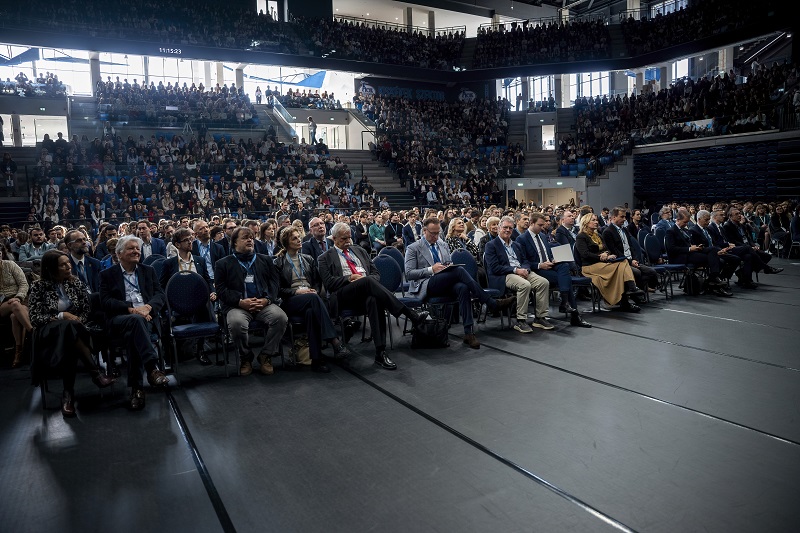
The 25th Meeting of Nobel Laureates and Talented Students at the Pick Arena in Szeged Photo courtesy of the National Academy of Scientist Education
The event was opened with greetings from key supporters of the National Academy of Scientist Education program: Dr. László Botka, Mayor of Szeged, speaking on behalf of the City of Szeged, and László Bódis, Deputy State Secretary for Innovation, representing the Ministry of Culture and Innovation. Mayor Botka highlighted that research and knowledge lie at the heart of the city’s development, while the state secretary emphasized that Hungary’s competitiveness depends on the innovative potential of its young people. He also noted that, under the National Research Excellence Program, a dedicated subprogram has been launched to support early-career researchers.
At the Meeting of Nobel Laureates and Talented Students, Prof. Dr. Márta Széll, Vice-Rector for Strategic Planning at the University of Szeged, also addressed the audience on behalf of the four other Hungarian universities participating in the program. She highlighted that the goals set by Albert Szent-Györgyi in 1940, during his rectorship, remain just as relevant today. She added that when Kuno Klebelsberg invited Szent-Györgyi back to Hungary, the future Nobel Prize-winning biochemist established a prominent research school – one that produced exceptional scientists such as Ilona Banga and Brunó F. Straub, both of whom might well have been worthy of a Nobel Prize. The legacy of that school, she noted, ultimately contributed to Katalin Karikó’s Nobel Prize-winning achievements.
Prof. Dr. Széll warmly encouraged the high school students attending the event to consider pursuing their studies at the University of Szeged.

Prof. Dr. Márta Széll, Vice-Rector for Strategic Planning at the University of Szeged
Photo courtesy of the National Academy of Scientist Education
“I wish for you to be inspired by the Nobel laureates and to take part in this event with genuine openness and enthusiasm – and to carry this same spirit forward into your future profession! If you do, recognition will surely follow. It may not come in the form of a Nobel Prize; it might be the grateful smile of a patient whose life is made easier because of your work. Believe me, it will be worth it,” concluded Prof. Dr. Márta Széll.
In his lecture, Prof. Dr. Péter Hegyi, Program Director of the National Academy of Scientist Education, expressed concern that global trends show a declining interest in science among young people.
“We need to demonstrate the power, the benefits, and the true value of science. That is one of the reasons we founded the Academy – to help reverse this trend; because our future depends on how many young people choose a path in science!” said the director of the Centre for Translational Medicine at Semmelweis University, whose own scientific journey also began in Szeged.
“Across the European Union, each year, 1.7 million people die under the age of 75. If we simply applied the knowledge we already possess, 1.2 million of those lives could be saved. In other words, two-thirds of deaths in Europe occur because scientific findings are not incorporated into prevention, treatment, and follow-up care. This is why we need science-oriented physicians,” emphasized Péter Hegyi, whose key scientific contributions include establishing the professional follow-up program for Hungarian patients treated for pancreatitis.

Prof. Dr. Péter Hegyi, physician–scientist and Program Director of the National Academy of Scientist Education
Photo courtesy of the National Academy of Scientist Education
The head of the National Academy of Scientist Education highlighted that out of Hungary’s 650 secondary schools, 400 have already joined the program, with students working under the guidance of 32 biology teachers across 27 regional education centers. He also announced that this year the Academy has expanded its activities to include chemistry by involving 24 chemistry teachers at 24 regional centers. In addition, in the coming years, the Academy plans to launch a new talent development program built around mathematics and computer science.
The Academy’s high-school initiatives are open to a selected group of secondary school students – the Szent-Györgyi Students – who have already achieved outstanding results in national or international competitions in biology or chemistry and who demonstrate a strong commitment to pursuing research careers.
The University Training program of the National Academy of Scientist Education admits both university and doctoral students – referred to as Szent-Györgyi University Students – whose training currently takes place in four Hungarian cities: Szeged, Budapest, Debrecen, and Pécs. Beginning in 2025, the program will be organized in eight research workshops instead of the previous six, providing even more young scientists with the opportunity to grow, collaborate, and contribute to the discoveries of the future.
Original Hungarian article by Sándor Panek
Feature photo: The 25th Meeting of Nobel Laureates and Talented Students at the Pick Arena in Szeged
Photo courtesy of the National Academy of Scientist Education