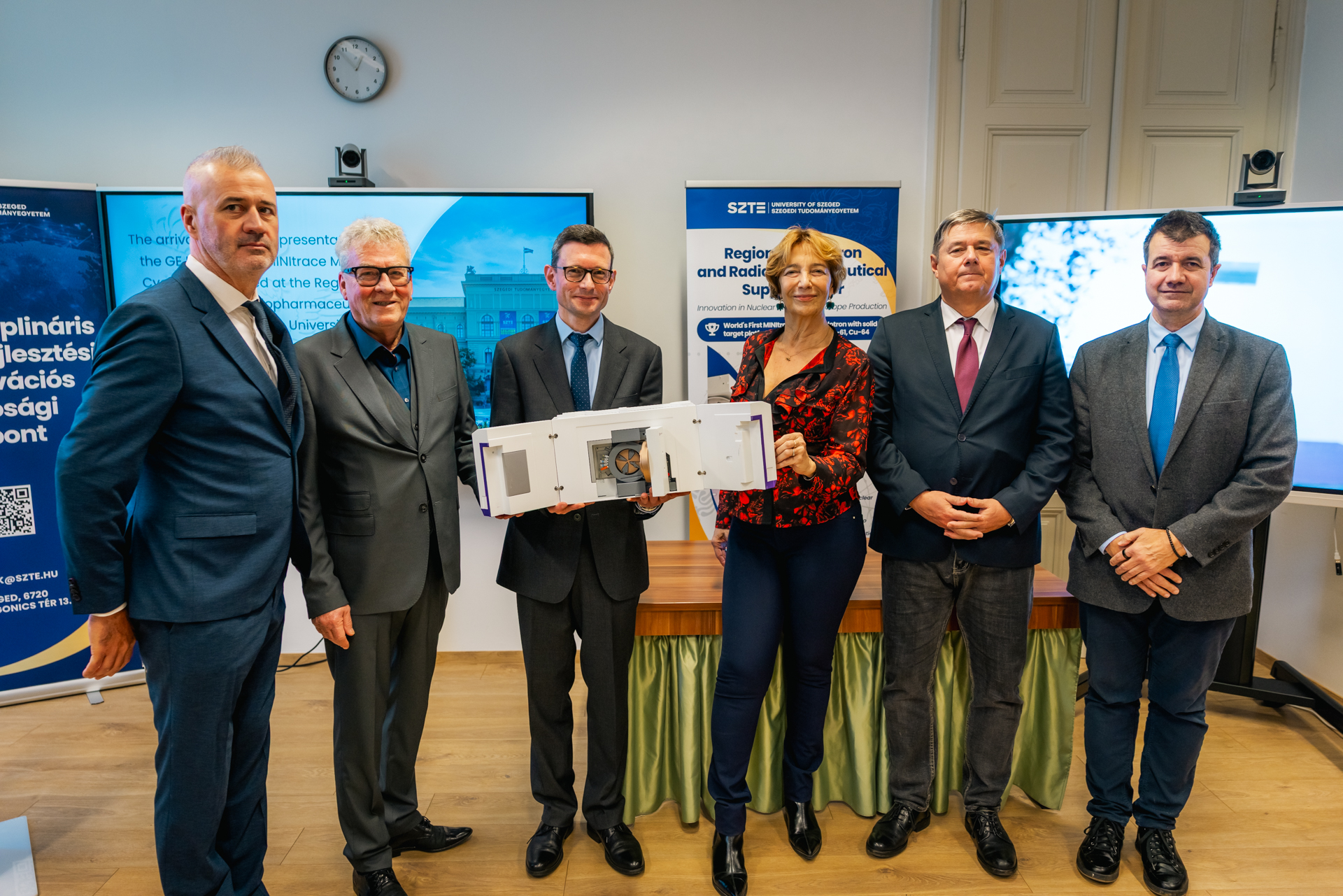
Following a cornerstone-laying ceremony for SZTE’S Regional Cyclotron and Radiopharmaceutical Supply Center in April, another major milestone has been reached in one of the University of Szeged’s flagship strategic investments. On December 9, GE HealthCare announced that – for the first time worldwide – the MINItrace Magni cyclotron will be installed at the University of Szeged, marking a major advance for nuclear medicine and theranostic treatment in Hungary. At a special event held at the University’s main building, the significance and future impact of the pioneering device were outlined by Prof. Dr. László Rovó, Rector of the University of Szeged; Dr. Judit Fendler, Chancellor; Prof. Dr. László Pávics, Professor at the Institute of Nuclear Medicine and project leader; Dr. György Erőss, Regional Customer Relations Manager for Central and Eastern Europe at GE HealthCare Hungary Kft.; and Jan Wolber, Global Product Leader for GE HealthCare Digital.
Elevating regional healthcare to international standards
For decades, the University of Szeged has been at the forefront of nuclear medicine research and diagnostics. The SZTE Regional Cyclotron and Radiopharmaceutical Supply Center, currently under construction, is a unique facility that will enable the production of radioisotopes using cyclotron technology, followed by the on-site manufacture of radiopharmaceuticals for medical imaging. Through this investment, the University of Szeged is elevating regional healthcare to international standards. Upon completion, the facility will support diagnostic, research, and educational activities in parallel, strengthening both clinical capacity and academic excellence.
“Approximately twenty years ago, the first commercially available radioisotope production system designed for use in urban hospitals was installed in Hungary – the first of its kind in the region,” recalled Dr. György Erőss, Regional Customer Relations Manager for Central and Eastern Europe at GE HealthCare Hungary Kft. “Just a few days ago, our newest-generation cyclotron left our factory, and today we have reached another milestone. Once again, we are here, as the device manufactured for the University of Szeged – the MINItrace Magni cyclotron – has arrived at the new Regional Cyclotron and Radiopharmaceutical Supply Center.”
   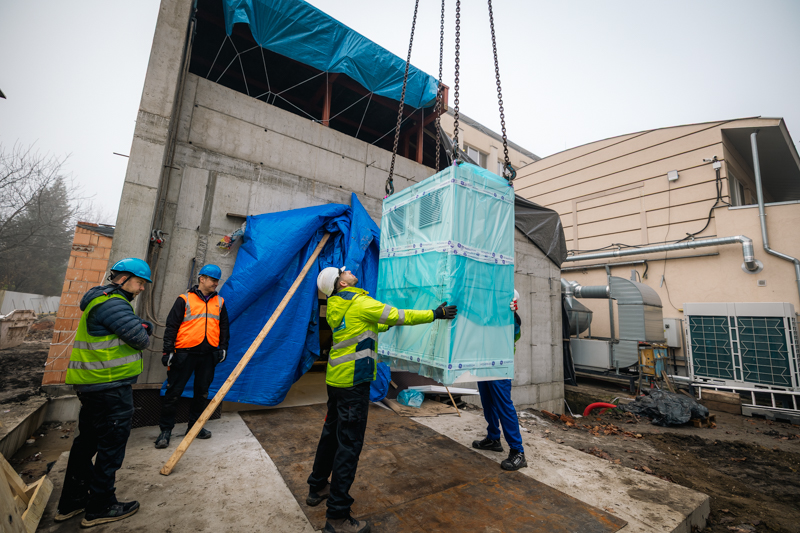          |
| MINItrace Magni cyclotron arrives at SZTE. Photo Gallery by István Sahin-Tóth |
Driving the future of theranostics at SZTE
With the installation of the MINItrace Magni cyclotron, the commissioning of a key component of the cyclotron facility is now underway. Despite its compact design – with a footprint of just 7.2 m², roughly the size of a commercial refrigerator – the system produces radioactive isotopes reliably and cost-effectively.
This development significantly expands the possibilities of medical imaging while improving patient access to advanced diagnostic procedures. By enabling hospitals to produce isotopes locally for molecular imaging, the MINItrace Magni helps meet the growing global demand for personalized healthcare.
“We are immensely proud that the University of Szeged is taking a strategic role in the development of theranostics – a rapidly emerging field that brings diagnostics and therapy together,” said Dr. György Erőss. “As a partner, we are pleased to contribute to this work and to continue our collaboration side by side, assuming a leading role not only regionally but also at the national level. While today marks an important milestone, I believe we are, in fact, standing at the very beginning of a long journey – one we will pursue together in the service of precision medicine and the future of healthcare.”
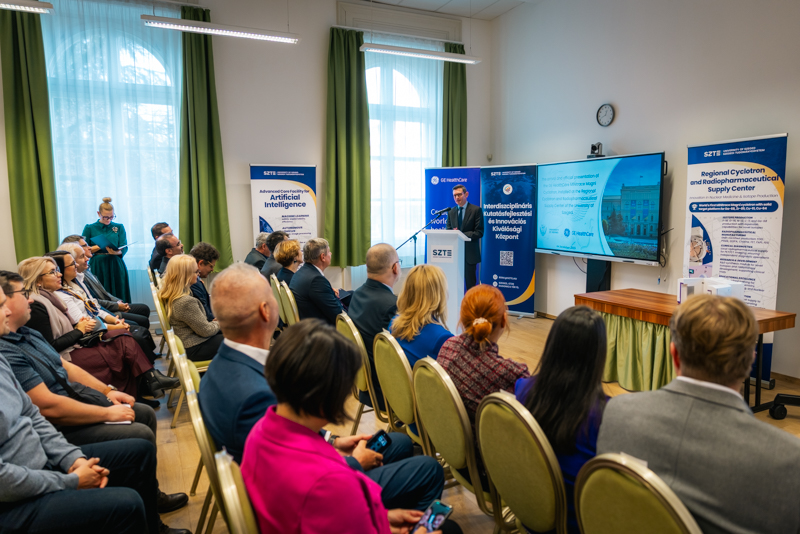
Press conference following the installation of the cyclotron
Photo by István Sahin-Tóth
A new level of molecular imaging
As noted by Jan Wolber, Global Product Leader for GE HealthCare Digital, the cyclotron provides a powerful new platform for the large-scale production of radiopharmaceuticals. Beyond its production capacity, the MINItrace Magni enables the next generation of research and development, supporting the creation of new radiopharmaceuticals not only for diagnostic use but also for theranostic applications, where diagnostics and therapy are closely integrated.
“Theranostics is currently gaining strong momentum across the molecular imaging field, and we are very much looking forward to the results the Szeged facility will deliver in this area. More than twenty years have passed since the first cyclotron was commissioned in Hungary – now is the time to take imaging to the next level,” said Jan Wolber.

Jan Wolber, Global Product Leader for GE HealthCare Digital
Photo by István Sahin-Tóth
SZTE at the heart of innovation
In his welcoming remarks at the press conference, Rector Prof. Dr. László Rovó emphasized that the new facility opens up wide-ranging opportunities across multiple scientific disciplines. Its breadth of potential applications is already evident, and, over the long term, the investment is expected to deliver benefits that extend well beyond what can be fully anticipated today.
The Rector also recalled that although the underlying principle of the cyclotron was first developed in 1929 by Hungarian physicist Sándor Gaál, it was never published due to an unfortunate chain of events and therefore failed to gain international recognition. While the first patent related to the technology was later filed by Leó Szilárd, it was Ernest Lawrence who ultimately became internationally recognized as the inventor of the cyclotron, having been the first to successfully construct the device and subsequently receiving the Nobel Prize for his work.
Professor Rovó emphasized that the new cyclotron system will fill a critical gap in Hungary’s healthcare and research infrastructure. He also highlighted the University of Szeged’s decades-long tradition in nuclear medicine research and diagnostics, noting that the new technology builds directly on this established foundation.
The Rector also noted the pivotal role of Prof. Dr. László Pávics in advancing prostate cancer treatment – an area in which the new equipment is expected to unlock significant additional potential. A recent milestone in this work is the launch of a treatment at the University of Szeged’s Institute of Nuclear Medicine that is currently unique in Hungary. This targeted radioisotope therapy improves survival outcomes for patients with advanced prostate cancer. The innovative approach is closely linked to Professor Pávics’s work, which also enabled the first prostate-specific radiopharmaceutical treatment in Hungary to be carried out at the University of Szeged.
“Developments like this lay the foundations for ensuring that the University of Szeged remains a stronghold of innovation in the years ahead. This investment will serve education, research, and patient care alike, while also strengthening our connections with industry partners. The new Center carries the potential for discoveries that can benefit all of humanity – discoveries that may even lead to future Nobel Prizes for Hungary and for the University of Szeged,” concluded Prof. Dr. László Rovó.

Dr. Judit Fendler, Chancellor of the University of Szeged; János Hermann, Managing Director of AC Komfort Kft.; and Prof. Dr. László Rovó, Rector
Photo by István Sahin-Tóth
A dream coming true
As Prof. Dr. László Pávics, Professor at the Institute of Nuclear Medicine and project leader, recalled, several decades ago he and his colleagues articulated a shared vision: to elevate nuclear medicine in Szeged to a level of excellence recognized across Europe.
“Over the years, numerous concepts were developed to support modernization, including the renewal of our equipment portfolio and the introduction of new diagnostic methods into patient care. Ultimately, with the support of European Union funding, we were able to establish a new six-bed inpatient unit, an outpatient care unit, and all the necessary radiation-protection infrastructure,” Dr. Pávics noted.
The Professor went on to explain that, alongside standard nuclear medicine equipment, the institute has also introduced state-of-the-art hybrid imaging technologies. He emphasized the role of a new generation of residents who are open to innovation and eager to embrace emerging methods. Supported by dedicated physicians and highly skilled technologists, their work is further reinforced by an interdisciplinary team of radiopharmacologists, physicists, and engineers – together ensuring that all professional, technical, and regulatory requirements are met to operate a center of excellence in nuclear medicine and theranostics.
“The culmination of this long development process is the establishment of the SZTE Regional Cyclotron and Radiopharmaceutical Supply Center, where today we are celebrating the world’s first installation of the MINItrace Magni system. I would like to thank everyone who contributed to turning this long-held vision into reality,” said Prof. Dr. László Pávics.
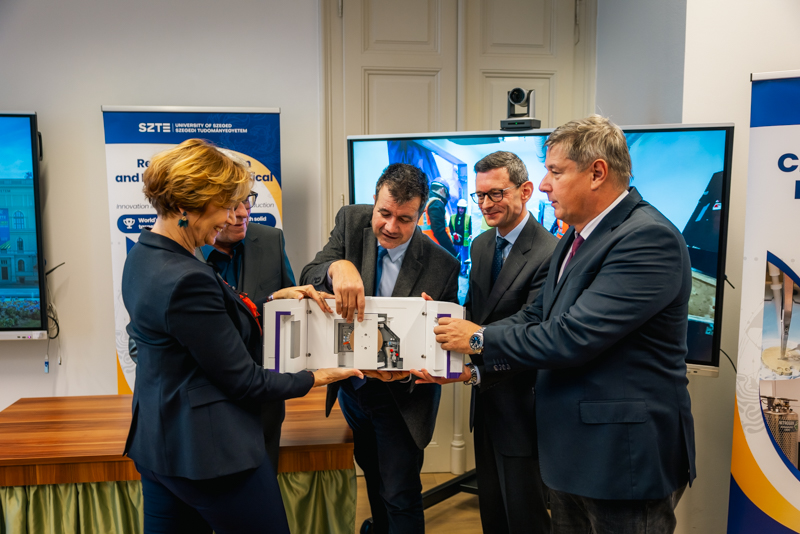
Presenting a cyclotron model: Dr. Judit Fendler, Prof. Dr. László Pávics, Dr. György Erőss, Jan Wolber, and Prof. Dr. László Rovó
Photo by István Sahin-Tóth
A market with significant growth potential
Dr. Judit Fendler, Chancellor of the University of Szeged, highlighted that the University’s healthcare development initiatives have gained unprecedented momentum in recent years. The SZTE Regional Cyclotron and Radiopharmaceutical Supply Center represents another major technological leap – not only for the University, but also at the national level. She added that SZTE’s strategic vision is to develop infrastructure that supports its areas of excellence, providing world-class technology on which students, instructors, and the country’s leading researchers can all rely.
“Our institution has a tradition spanning several decades in research and diagnostic activities related to nuclear medicine. At the same time, the discipline continues to evolve, and beyond diagnostics it is playing an increasingly important role in therapeutic procedures as well. As a regional service center, we perform more than 3,000 PET/CT examinations each year. Until now, we have had to obtain the radiopharmaceutical preparations needed for such examinations from external sources, which has meant a significant additional cost. There are radiopharmaceuticals for research and therapeutic purposes that, due to transport distances, are currently either not available at all or only at very high cost. This is precisely the gap our new center will address. In the region, including nearby cross-border areas, there is no similar production capacity, even though future demand for any available capacity is expected to be high,” the Chancellor explained.
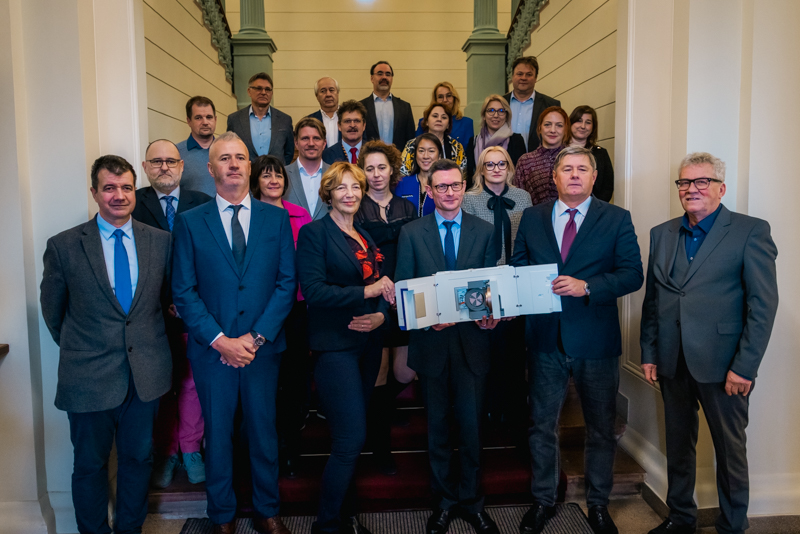
Photo by István Sahin-Tóth
Bringing SZTE one step closer to the science of the future
At the press conference held to mark SZTE’s most recent milestone, Chancellor Judit Fendler noted that the new facility builds on the University of Szeged’s long-standing academic traditions while opening new pathways in education, research, and professional training for future generations:
“Our former Nobel Prize-winning Rector, Albert Szent-Györgyi, viewed the training of future researchers as one of the core responsibilities of universities. In the field of education, this facility will provide outstanding practical support for pharmacy training, for postgraduate and specialist pharmacy programs, and for the training of radiochemists, physicists, engineers, as well as professionals in nuclear medicine and technology. This unique instrumentation will make it possible to establish new graduate and postgraduate training tracks, as well as specialized further-training courses, expanded modules, and professional development programs. In addition, our partners will also benefit from this development. Thanks to our research and development synthesis module, we will be able to produce isotopes that have become more prominent in recent years and will play an important role in the development of the rapidly expanding field of radioisotope-based therapies. At the University of Szeged, we are building the science of the future. Today, with another major step forward, we have moved closer to seeing our own cyclotron begin operation next year.”
Original Hungarian text by Tímea Fülöp
Feature photo: János Hermann, Managing Director of AC Komfort Kft., Prof. Dr. László Pávics, Jan Wolber, Dr. Judit Fendler, Prof. Dr. László Rovó, and Dr. György Erőss
Photo and video by István Sahin-Tóth