Once our school is authorised, we are planning to offer the following subjects to our students:
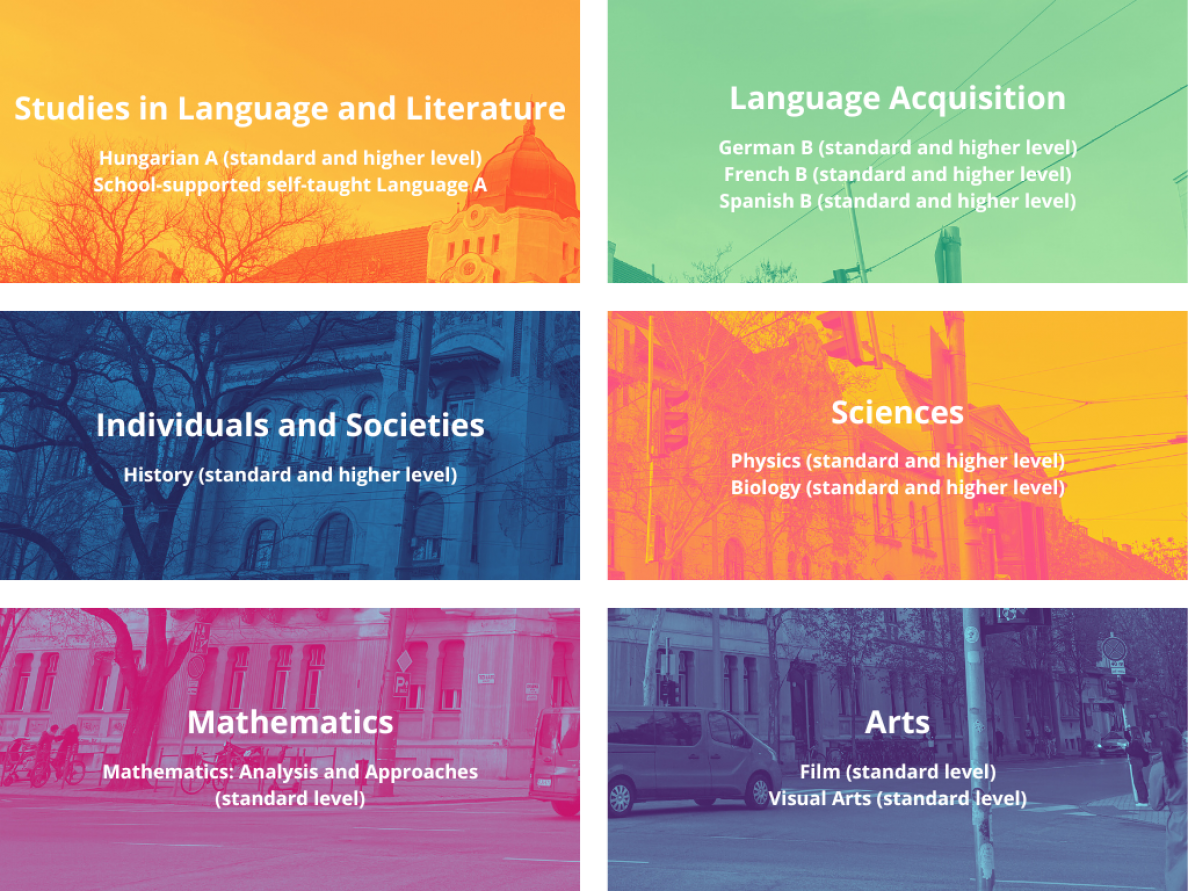

Hungarian A: Literature
The course offers an introduction to a comprehensive, diverse and flexible analysis of world literature. The course revolves around three areas of exploration and seven central concepts, allowing students to appreciate and consider the selected texts from fresh perspectives. Class work features individual research, reflection and analysis of the texts, discussions, debates, groupwork, projects, presentations, drama exercises, critical and creative writing. The aim of this course is not only to grant students a comprehensive and in-depth understanding of literature, but to foster an active relationship with the reading materials.
German, Spanish, and French B
Our language acquisition courses focus on introducing our students both to the target language and its associated cultures. While we do study the language, its vocabulary and grammar, there is a highlighted focus on communication skills (reading, writing, speaking, and listening). These courses also integrate global issues and cultural perspectives to encourage students’ critical thinking and the development of students’ intercultural skills. We use a myriad of authentic texts to study the topics in a cultural context.
History
The History course in an IB programme emphasizes historical thinking skills, such as analysis, evaluation, and argumentation. We study history using a global approach: instead of studying a single country’s history, multiple international and intercultural examples are analysed by students. Students are also expected to evaluate how history is written, and how historians’ records are shaped by bias and cultural context.
Physics
The IB program provides an excellent opportunity for students to gain a deeper understanding of physics while developing their analytical and research skills. It focuses not only on acquiring facts but also on understanding and solving problems. Students are encouraged to think independently, ask questions, and connect the knowledge they acquire across different subjects. This approach helps them not only recognize scientific relationships but also enhance their critical thinking skills.
Biology
The Biology course offers students a chance to study the subject in a conceptual way. Students see the subject as a collection of inter-connected topics, and as an ever-evolving branch of natural sciences. Practical work is important, since students participate in experiments and research. We also analyse real-world questions in connection to biology, like climate change, public health, and ethical considerations related to biology.
Mathematics: Analysis and Approaches
The course is designed for students who wish to delve deeper into theoretical concepts, abstraction, and rigorous analytical thinking, making it particularly suitable for those planning to pursue careers in science, engineering, or mathematics-related fields. Our teaching methods are more interactive and student-centered: instead of traditional lecturing, greater emphasis is placed on inquiry-based learning, problem-solving, and independent research. Students are encouraged not only to reproduce learned material but also to recognize deeper connections and apply their knowledge creatively to solve real-world problems.
Film
The course is an exciting journey into the art and craft of filmmaking, offering students a deep understanding of cinematic storytelling, film theory and production techniques. Through analysis, creative projects and hands-on experience, students explore a wide range of films, develop their critical thinking skills, and gain practical knowledge in screenwriting, directing, cinematography, and editing. The course encourages both individual expression and collaborative work, preparing students to appreciate film as an art form and a powerful means of communication.
Visual Arts
The course encourages students to develop their own artistic voice through an inquiry-based approach. Instead of focusing on technical skills, art history, and national artistic heritage, students are encouraged to explore different mediums, techniques, and cultural influences. As part of the course, students create a portfolio that reflects personal exploration and critical thinking. Assessment includes a comparative study, process portfolio, and exhibition, emphasizing global perspectives and conceptual depth.
SZTE Báthory István Gyakorló Gimnázium is a Candidate School* for the Diploma Programme. This school is pursuing authorization as an IB World School. These are schools that share a common philosophy—a commitment to high quality, challenging, international education that SZTE Báthory István Gyakorló Gimnázium believes is important for our students.
*Only schools authorized by the IB Organization can offer any of its four academic programmes: the Primary Years Programme (PYP), the Middle Years Programme (MYP), the Diploma Programme, or the Career-related Programme (CP). Candidate status gives no guarantee that authorization will be granted. For further information about the IB and its programmes, visit http://www.ibo.org