


At the University of Szeged, students can navigate every stage of the innovation process – a message highlighted at SZTE’s 13th Innovation Day, where Katalin Karikó addressed a large audience and reflected on the innovation pathway that ultimately led to her groundbreaking discovery. Held in the Ceremonial Hall of the University’s Main Building, the event also honored this year’s recipients of the SZTE Innovation Award.
In line with its established tradition, this year the University of Szeged presented its Innovation Awards before an audience that filled the Ceremonial Hall of SZTE’s Main Building. At this grand celebration of innovation, welcome addresses were delivered by Prof. Dr. László Rovó, Rector of the University, and Veronika Varga-Bajusz, State Secretary for Higher Education. Their remarks were followed by an address from Prof. Dr. Gábor Szabó, Chairman of the Board of Trustees of the Foundation for the University of Szeged, who highlighted the robustness of the university’s innovation ecosystem. The program concluded with a keynote speech by Prof. Dr. Katalin Karikó, Nobel laureate and research professor at the University of Szeged, who shared innovation-related insights accumulated through her own research experience.
Prof. Dr. László Rovó: Klebelsberg and Szent-Györgyi showed the way
In his welcome address, Prof. Dr. László Rovó described innovation as a process in which researchers use the tools of science to develop meaningful answers to the problems they seek to solve. He emphasized that innovation is far more complex than merely generating a research idea. As an example, he pointed to Kuno Klebelsberg, who not only founded the University of Szeged but also created the institutional infrastructure and attracted prominent scientists to join its ranks. Among them was Albert Szent-Györgyi, who received the Nobel Prize just seven years after arriving in Szeged and went on to establish a research school that ultimately helped pave the way for Katalin Karikó’s Nobel-winning achievements.
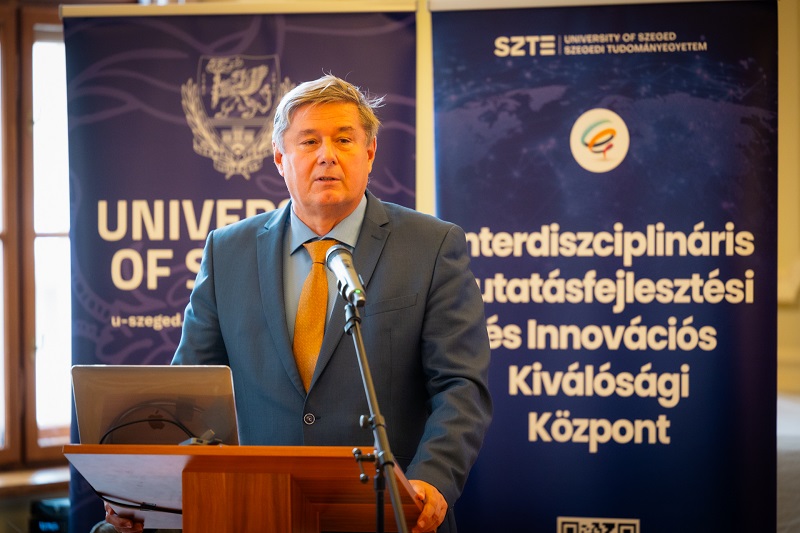
Prof. Dr. László Rovó, Rector of the University of Szeged
Photo by Ádám Kovács-Jerney
According to Prof. Dr. László Rovó, the leadership of the University of Szeged is committed to building a cutting-edge scientific infrastructure that supports its young researchers. This ecosystem includes the university’s state-of-the-art Advanced Core Facilities, such as the Central Sequencing Laboratory, or the country’s most powerful supercomputer dedicated to artificial intelligence. The Rector also noted that the establishment of the Center of Excellence for Interdisciplinary Research, Development, and Innovation represents another major step forward. He added that progress at SZTE is a continuous, long-term undertaking – noting that, in February 2026, one of the world’s most advanced cryo-electron microscopy centers will begin operation at the University.
Veronika Varga-Bajusz: SZTE’s receipt of the 2025 Innovative University of the Year Award is no accident
Veronika Varga-Bajusz, State Secretary for Higher Education, Vocational and Adult Education, and Youth at the Hungarian Ministry of Culture and Innovation, also addressed the audience at SZTE’s Innovation Day. She emphasized that the University of Szeged has long been associated with exceptional scientific achievement – a legacy built by figures such as Nobel Prize-winning biochemist Albert Szent-Györgyi, physicist Zoltán Bay, and mathematicians Alfréd Haar and Frigyes Riesz. “It is important to highlight the internationally recognized work carried out by the University of Szeged in the field of innovation. It is therefore no surprise that the university secures prominent places in international rankings and was recognized this year with the 2025 Innovative University of the Year Award at the gala hosted by the Ministry of Culture and Innovation,” she noted. The State Secretary added that SZTE’s success in this area is further demonstrated by the fact that in 2024 the University’s revenues from corporate research and development approached HUF 2 billion, and the institution has built a broad industry network that now includes more than 200 partners.
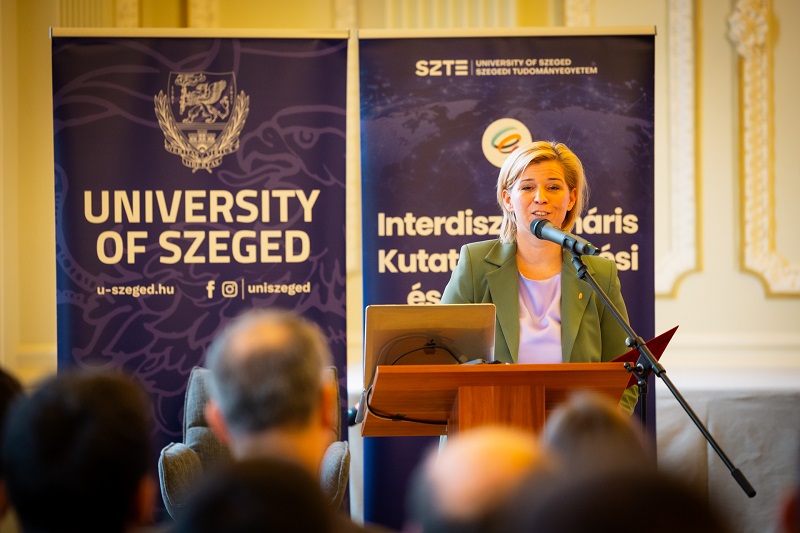
Veronika Varga-Bajusz, State Secretary for Higher Education, Vocational and Adult Education, and Youth at the Ministry of Culture and Innovation
Photo by Ádám Kovács-Jerney
Prof. Dr. Gábor Szabó: The entire innovation process can be mastered at the University of Szeged
Prof. Dr. Gábor Szabó, Chairman of the Board of Trustees of the Foundation for the University of Szeged and President of the Hungarian Association for Innovation, illustrated the often vague and open-ended nature of public discussions about innovation by observing that the term innovation is slowly turning into an empty buzzword. According to the professor of physics, innovation is fundamentally different from the routine act of creating something new. In this regard, the Association maintains that innovation must meet two essential criteria: it must incorporate an element of novelty, and it must generate economic value that is realized on the market.
Prof. Dr. Gábor Szabó considers it a significant achievement that the whole innovation process can be carried out within the University of Szeged. The technology transfer company is fully operational; initial steps can be launched at the Center of Excellence for Interdisciplinary Research, Development, and Innovation; proof-of-concept funding opportunities are available; and all other components required to complete the process are in place.
“The strength of the University of Szeged’s innovation support system lies precisely in the fact that students here can become familiar with the entire pathway from research results to practical applications. This knowledge is essential, because there are countless ways an invention can fail and only a few ways it can succeed. Those who are not persistent, or who cannot restart after early setbacks, will never reach the end of the process. That is why, as guidance for young innovators, I would emphasize that the most important human quality for successful innovation is resilience in the face of failure,” Prof. Dr. Gábor Szabó noted.
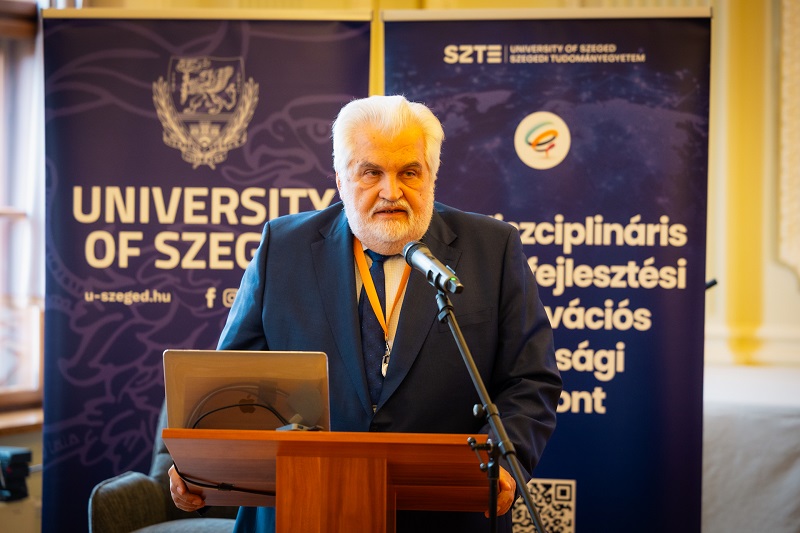
Prof. Dr. Gábor Szabó, Chairman of the Board of Trustees of the Foundation for the University of Szeged
Photo by Ádám Kovács-Jerney
Prof. Dr. Katalin Karikó: "Less Complaining, More Doing”
In her keynote lecture, Katalin Karikó shared her reflections on the practical realities of innovation. She noted that after formulating an idea and generating scientific results, the next essential step is to establish a company to further develop the patent. In the case of medical treatments, clinical trials must then determine whether the given therapy truly works. According to the Nobel laureate, a further critical stage is ensuring that society ultimately accepts the product.
“A vaccine only protects once it is in someone’s arm,” the scientist remarked, before referencing the Dunning–Kruger effect – the observation that the less someone knows, the more certain they tend to be about the validity of their own views. In response to this challenge, Karikó stressed that everyone has a responsibility to take action.
The SZTE professor also illustrated the development of CRISPR–Cas9 and mRNA therapies through examples from her own career. She emphasized that bringing ideas to life requires not only establishing a company but also building a research team whose trusted, mutually respectful members learn from one another. As an example, she mentioned János Ludwig, the organic chemist with whom she began her research as a PhD student at the Szeged Biological Research Center, as well as her mentee, Norbert Pardi, who has since become a leading international expert on the lipid nanoparticles essential for mRNA delivery.
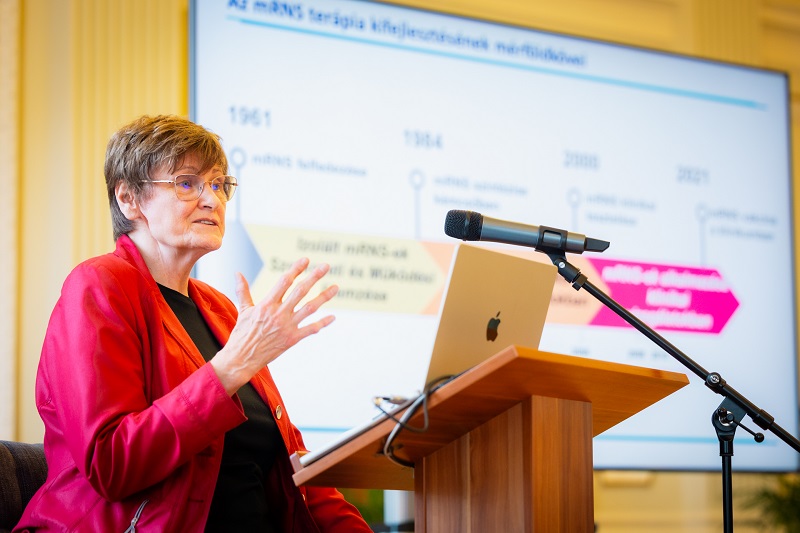
Prof. Dr. Katalin Karikó, Nobel laureate scientist and professor at the University of Szeged
Photo by Ádám Kovács-Jerney
“When you can’t obtain funding for your innovation, make sure to convince at least one fellow researcher whose support will keep you going,” she said, referring to neurosurgeon David Langer and immunologist Drew Weissman, who supported her work. Karikó also recalled an example that illustrates the challenges of the innovation environment: the patent she filed jointly with Drew Weissman was sold by the University of Pennsylvania for only USD 300,000 to a buyer who later earned USD 150 million from a sublicence.
Katalin Karikó also reflected on her personal motivations, explaining that helping even a single person makes her efforts worthwhile. It was in keeping with this mindset that she remained at Germany’s BioNTech longer than originally planned, so she could witness at least one patient benefit from the team’s research.
“I was actually less successful in academia than in industry,” Professor Karikó noted, “because doing lab work with your own hands means you publish less.” She added that she had learned a great deal not only from her fellow researchers but also from Hans Selye, whose well-known book on stress helped her develop effective strategies for managing pressure. “Less complaining, more doing,” she emphasized, underscoring the importance of staying motivated even after setbacks.
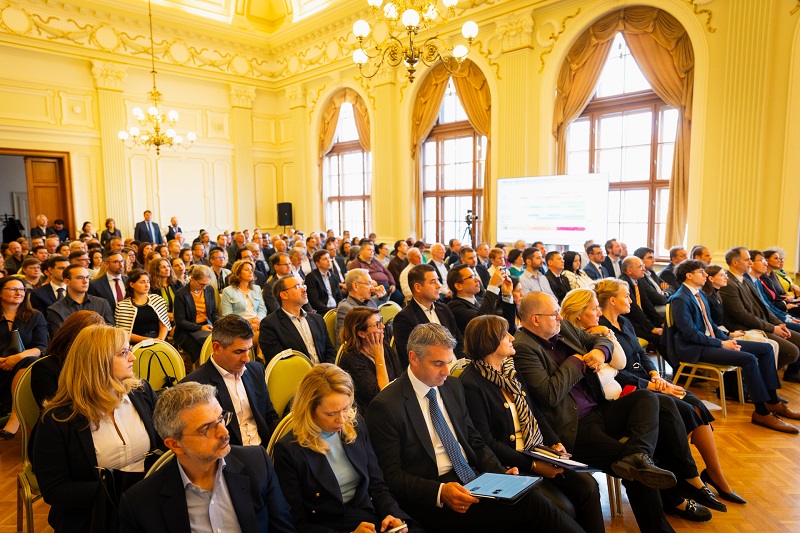
Audience at the 13th SZTE Innovation Day
Photo by Ádám Kovács-Jerney
Recipients of the SZTE Innovation Award:
Mihály Kiss – Most Innovative Student Project
Cintia Hajdu – Most Innovative PhD Project
Supervisors: Dr. Csaba Janáky, Dr. Gergely Ferenc Samu
Zsolt Datki – Most Innovative Research in the Life Sciences
Collaborators:
Dr. Vilmos Bilicki
Dr. Zoltán Richárd Jánki
Attila Kormányos – Most Innovative Research in Physical Sciences
Collaborators:
Dr. Balázs Endrődi
Dr. Csaba Janáky
Dr. Serhiy Cherevko
Tatiana Priamushko
Krisztina Karsai – Most Innovative Research in the Humanities or Social Sciences
Collaborators:
Dr. habil. Péter Kovács
Prof. Dr. Zsanett Fantoly
Dr. Andor Gál
Dr. Bálint Csaba Kelemen
Pál Pásztor – Most Innovative Work in the Field of Healthcare Development
Collaborators:
Dr. Tímea Rácz
Dr. Mátyás Bukva
Recipients Recognized for Implemented Projects:
Prof. Dr. Zoltán Bozóki – Recognized for the intellectual property ”Measuring Device for Photoacoustic Measurement in a Flowing Medium”
Dr. László Janovák – Recognized for the utilization of the intellectual property “Composition and Method for Creating Bifunctional Thin Films with Superhydrophobic and Photocatalytic Properties”
Prof. Dr. Tamás Martinek – Recognized for the utilization of the intellectual property
“Delivery of Therapeutic Macromolecules into Human Cells via the Caveolar Pathway Using a High-Affinity, GM1 Ganglioside Receptor-Specific Oligopeptide Tagging Sequence”
Prof. Dr. Mihály Racsmány – Recognized for the implemented project “Translational Pedagogy Software”
Dr. András Sápi – Recognized for the implemented project “Catalytic Brick”
Proof of Concept Letters of Appointment Awarded:
Dr. Tamás Marik received Proof of Concept funding for his proposal titled “Development of a Prototype of a Water-Soluble Plant Conditioner and Yield-Enhancing Product for Use in Seed Treatment.”
Co-researchers: Prof. Dr. Csaba Vágvölgyi, Dr. László Kredics, Dr. Chetna Tyagi, Gergő Terna, Fanni Kovács
Dr. Pál Pásztor received Proof of Concept funding for his proposal titled “DoseLearn – Clinical Protocol and ML-Based Predictive Model for the Personalized and Objective Planning of Long-Term Sedation–Analgesia and Weaning.”
Co-researchers: Dr. Mátyás Bukva, Dr. Tímea Rácz
Dr. Zsolt László Datki received Proof of Concept funding for his proposal titled “Development of a Micro-In Vivo–Based, AI-Driven Ultrasensitive Toxicological Testing System.”
Co-researchers: Dr. Vilmos Bilicki, Dr. Zoltán Richárd Jánki
Dr. Gábor Katona received Proof of Concept funding for his proposal titled “Development of an Innovative Nasal Medical Device.”
Co-researchers: Prof. Dr. Ildikó Csóka, Dr. Bence Sipos
Dr. Anita Kovács received Proof of Concept funding for her proposal titled “Formulation of the SMART Moisturizing Shower Gel, and Investigation of Its Dermatological Effects and Stability.”
Co-researchers: Dr. Szilvia Berkó, Dr. Mária Budai-Szűcs
Dr. Roland Nagy received Proof of Concept funding for his proposal titled “Objective Hearing Assessment Stimulated by a Bone-Conduction Hearing Aid Device.”
Co-researcher: Prof. Dr. László Rovó
Prof. Dr. Attila Hunyadi received Proof of Concept funding for his proposal ”Chemical Characterization and Preliminary Veterinary Evaluation of a Next-Generation Black Soldier Fly Larva-Based Feed Supplement Prototype.”
Co-researchers: Dr. Noémi Crul-Tóth, Dr. Róbert Berkecz, Dr. Máté Vass, Asafotei Oaklekie Enéh, Dr. Eszter Ducza, Dr. Ákos Benk
Dr. Csaba Bereczki received Proof of Concept funding for the proposal titled ”Precisely to the Norm – A Program for the Proper Blood Pressure Assessment of Hungarian Children and Adolescents.”
Co-researchers: Dr. Erzsébet Valéria Hídvégi, Dr. Andrea Emese Jakab
Dr. Tibor Pankotai received Proof of Concept funding for the proposal titled ”Development of a Prototype to Identify the Mitochondrial Dysfunction Underlying Post-COVID Syndrome.”
Co-researchers: Dr. Barbara Nikolett Borsos, Dr. Zoltán Gábor Páhi
Dr. György Orsy received Proof of Concept funding for the proposal titled ”Sustainable Production of Indole Derivatives Using Continuous-Flow Green Chemistry Technology.”
Co-researchers: Associate Professor Dr. György Szőllősi, Lili Kóczán, László Pusztai
Dr. Melinda Tar received Proof of Concept funding for the proposal titled ”Integrated Application of Camera-Based Phenotyping and Machine Learning for Assessing Plant Resilience.”
Co-researchers: Dr. Vilmos Bilicki, Dr. Edit Mikó, Dr. Péter Jakab, Ingrid Melinda Gyalai, Flórián Kovács
The university as a creator of social value
At SZTE’s Innovation Day, Dr. Lina Landinez, CEO of the Accreditation Council for Entrepreneurial and Engaged Universities (ACEEU), delivered a lecture highlighting the University of Szeged’s leading international position in entrepreneurship. She pointed to SZTE’s recent milestone achievement – becoming the first university in Hungary to earn dual ACEEU accreditation as both an entrepreneurial and an engaged university – as a clear reflection of the broader transformation underway in higher education worldwide.
In her presentation, Dr. Landinez emphasized that universities must evolve from traditional knowledge producers into institutions that generate tangible social value. “Today, universities must create value for society and have a far greater impact socially, culturally, and economically,” she stated. “Those that make this mission a priority will be among the elite in the future.”
Unitree G1 and the future
Before the start of the Innovation Day program, a Unitree G1 humanoid robot greeted the audience. “In my world, data is the fuel – in your world, it is curiosity that sets everything in motion. The future will likely be mine, but innovation belongs to you – to this university, which turns new ideas into reality every day,” it announced. The robot then added: “Let’s launch the future together – the future we are building jointly today.”
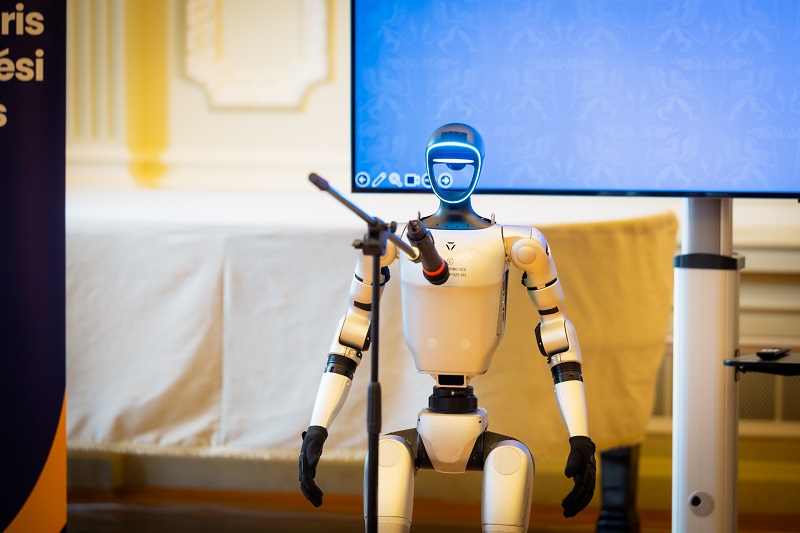
A Unitree G1 humanoid robot greeted the audience at Innovation Day.
Photo by Ádám Kovács-Jerney
The Unitree G1’s clattering walk may not have been flawless just yet, as Rector Prof. Dr. László Rovó opened his remarks by saying: “We have just seen a small piece of the future. And as perhaps a somewhat larger piece of the present and the past, I’d like to think that my own walk was still a bit smoother than that of our esteemed future.”
Further program highlights
During Innovation Day, key experiences and achievements related to the SZTE Virtus Researcher Career Program, along with an overview of the Virtus Student Program, were also presented by Prof. Dr. Zoltán Kónya, Vice-Rector for Scientific Affairs and Innovation and Professional Director of the Center of Excellence for Interdisciplinary Research, Development and Innovation (IKIKK), and by Prof. Dr. Ildikó Csóka, Deputy Chancellor, Director-General for Strategy and Development, and Operational Director of IKIKK.
As part of the day’s program, the University of Szeged and Roche Hungary signed a strategic Memorandum of Understanding, while in the afternoon a roundtable discussion and an InnoPitch session titled “From Idea to Market Application – Opportunities, Pitfalls, and Best Practices Along the Research Innovation Path” gave university researchers the opportunity to present their ideas to potential investors. Running in parallel, a Supercomputer and AI Showcase highlighted the University of Szeged’s latest digital developments through presentations by Csaba Fekete, Director at SZTE’s Directorate for IT and Services, and Prof. Dr. Márk Jelasity, Head of the Department of Computer Algorithms and Artificial Intelligence.
A detailed report on the afternoon programs will be published soon.
Original Hungarian article by Sándor Panek and Helga Balog
Feature photo: The Innovative University of the Year 2025 Award is raised high by Prof. Dr. Katalin Karikó and Prof. Dr. László Rovó – joined by Veronika Varga-Bajusz, Secretary of State for Higher Education, representing the ministry that conferred the award.
Photos by Ádám Kovács-Jerney